The State Securities Commission (SSC) recently announced the revocation of Bibica Joint Stock Company's (BBC) public company status. This decision stems from Bibica's shareholder structure, which no longer complies with public company requirements.
According to the Securities Law, a public company must have at least 10% of its voting shares held by a minimum of 100 investors who are not major shareholders. However, Bibica's shareholder structure is highly concentrated, with PAN Group currently holding 98.3% of the capital.
Bibica originated as a candy workshop of the Bien Hoa Sugar factory, established in the 1990s. Its initial products included candies and biscuits, later expanding to include cookies, malt, mooncakes, and sponge cakes. Well-known brands under Bibica include Hura, Goody, Gooka, Quasure Light, Sumika, Migita, Zoo, and Cheery. The company currently boasts over 100,000 sales points across Vietnam and also exports its products to Japan, South Korea, and the US.
The company was privatized in 1999 and listed on the HoSE in late 2001 under the ticker BBC. It was one of the first food and beverage stocks to be traded on the exchange.
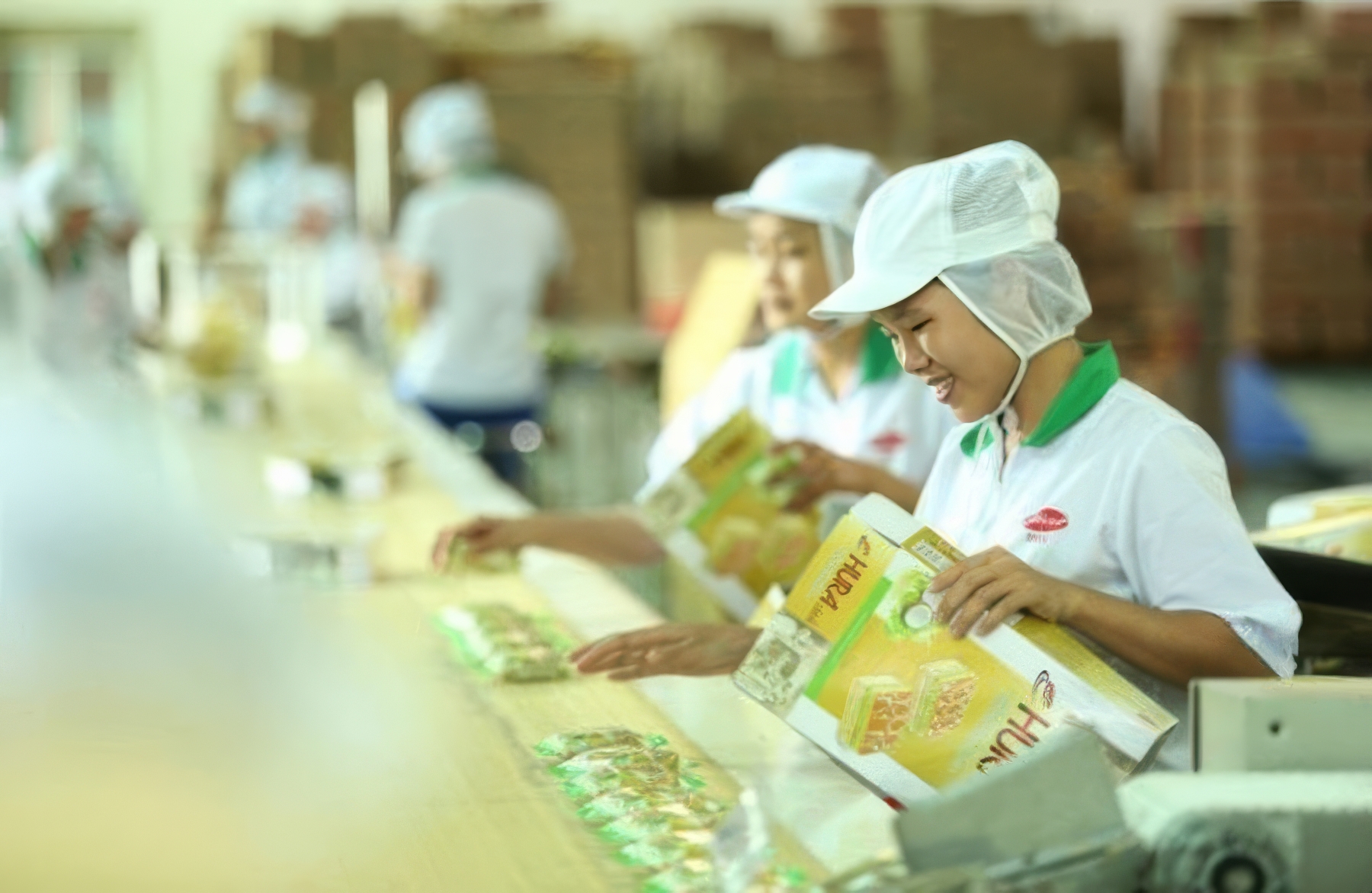 |
Workers at a Bibica factory. Photo: BBC |
Over the past 26 years since going public, Bibica reported a loss only once, in 2002. Even in the late 1990s, the company achieved revenues exceeding 100 billion dong, though profits remained modest.
Since 2013, Bibica's revenue has consistently surpassed one trillion dong, with profits in the tens of billions. Its peak profit occurred in 2022, during the height of social distancing measures, with nearly 193 billion dong in after-tax profit. Between 2016 and 2024, the company's gross profit margin hovered around 30%. Despite this, both revenue and profit growth trends remained stagnant for many consecutive years.
In the first 9 months of this year, BBC's revenue reached nearly 1.127 trillion dong, an increase of approximately 2.5% compared to the same period last year. Due to cost reductions, after-tax profit rose by over 18% to nearly 71 billion dong.
By the end of September, Bibica's total assets amounted to nearly 2.2 trillion dong. Of this, cash and cash equivalents, along with short-term financial investments (primarily bank deposits), accounted for nearly 693 billion dong, representing almost 32% of total assets. Thanks to its strong financial health, the company has consistently paid cash dividends. However, the payout ratio has not been exceptionally high, with a peak recorded at 36%, equivalent to 3,600 dong per share.
Bibica attracted foreign capital early on. In 2007, Lotte Group (South Korea) began investing in BBC, gradually increasing its ownership to over 44% and becoming the largest shareholder. However, subsequent actions by the South Korean investor, notably the desire to rename the company to Lotte-Bibica, raised concerns about a potential takeover and the erasure of a Vietnamese brand. To prevent this, a group of domestic shareholders partnered with SSI to form a counterweight.
The battle for control of Bibica began in mid-2012 as the two groups raced to increase their stakes. This competition led to continuous disputes between the South Korean investor and the Vietnamese enterprise for several years. By 2015, PAN Group replaced the SSI group as the second-largest shareholder, holding 42.3%. The balance of power remained deadlocked, as the ownership percentages of the two groups differed by only 0.3%, making a consensus virtually impossible.
After a prolonged struggle, Lotte divested its entire stake of over 44% in late 2020. Since then, PAN Group has progressively increased its ownership to the current 98.3%.
Recently, PAN also announced plans to transfer its entire stake in Bibica to Sari Murni Abadi (SMA), an Indonesian consumer goods conglomerate that owns the Momogi snack brand. This transaction will enable SMA to expand its product portfolio and international market presence, leveraging Bibica's three factories in Dong Nai, Tay Ninh, and Hanoi, which boast a production capacity of over 20,000 tons of confectionery annually.
On the stock market, BBC closed on 8/12 at 76,100 dong per share. The current market price is 42% higher than at the beginning of the year. Due to the highly concentrated shareholder structure, the stock's liquidity is very low, with an average trading volume of just over 1,000 shares per session over the past year.
Tat Dat