The findings were revealed in the survey report "Workforce Readiness Level of Vietnamese Businesses 2026," recently released by human resources solutions provider Talentnet Academy. The survey was conducted among 161 businesses across 17 sectors, ranging from finance, technology, and manufacturing to real estate and agriculture.
According to Nguyen Minh Tam, Director of Talentnet Academy, businesses operating in Vietnam (including domestic and multinational enterprises) have moved beyond merely recognizing AI's importance and are entering an adaptation phase. AI is becoming a direct factor influencing work methods and operations, compelling businesses to redefine necessary competencies.
31% of surveyed businesses reported AI as a strategic priority, alongside revenue growth, market diversification, and optimizing operational efficiency. However, a significant gap exists between this declaration and the actual application of the technology. Only 3% (five businesses) assessed themselves as ready to master AI technology in the future. The remaining businesses indicated their AI adoption is fragmented or still in the initial familiarization and gradual development stages.
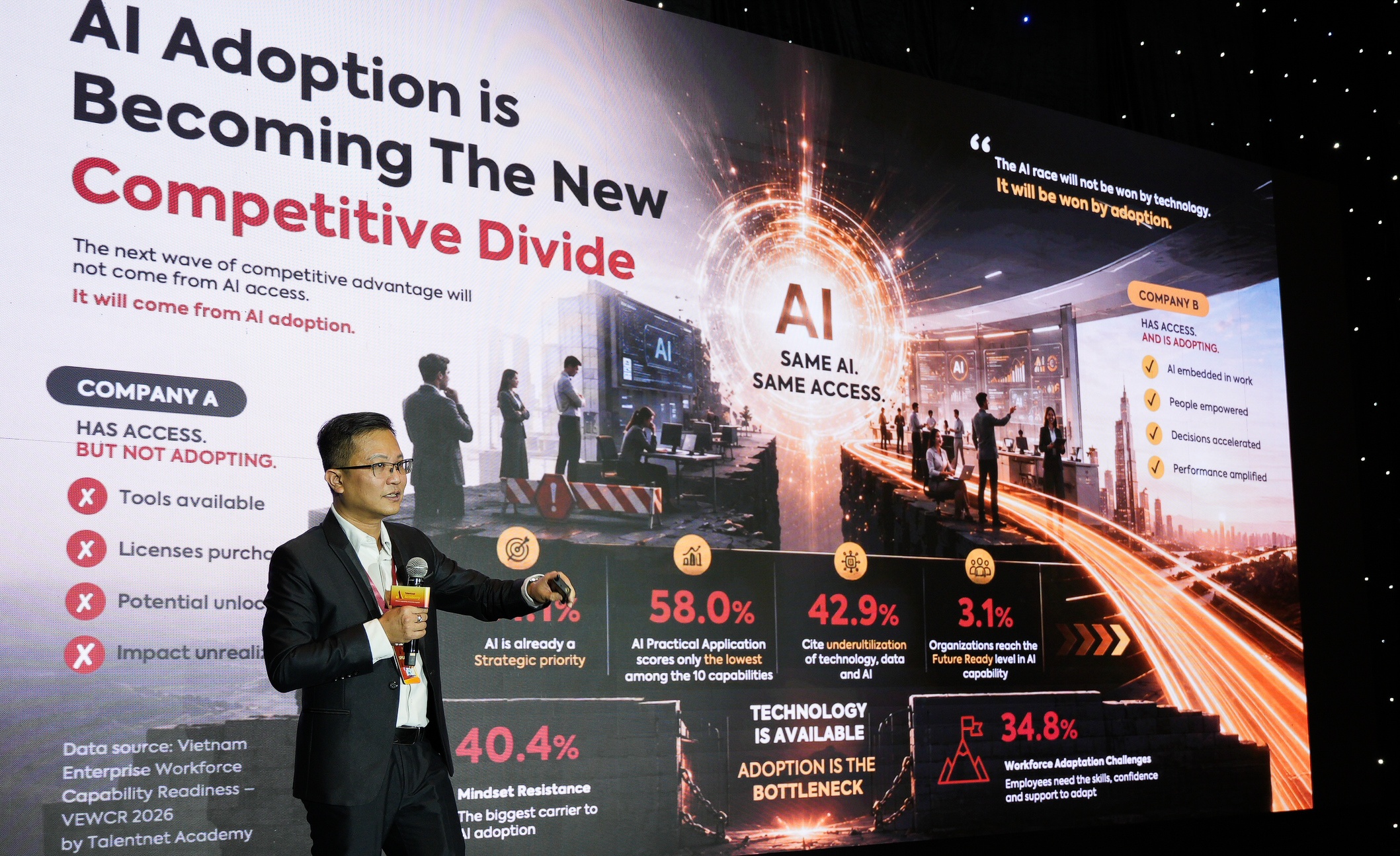 |
Nguyen Minh Tam, Director of Talentnet Academy, presented the survey results on the afternoon of 8/6. Photo: Talentnet |
Nguyen Minh Tam, Director of Talentnet Academy, presented the survey results on the afternoon of 8/6. Photo: Talentnet
According to Darren Cheng, Growth Director at the professional social network LinkedIn, the rate of AI adoption among Vietnamese businesses is increasing, but most applications are limited to basic tasks such as drafting emails, correcting spelling, outlining ideas, and compiling meeting documents.
To move beyond this threshold, Cheng suggested businesses adopt a multi-dimensional approach to AI. In terms of breadth, AI should extend beyond IT or human resources departments to encompass every role within an organization. Regarding depth, each position requires different levels of AI skills, tailored to specific job functions. For example, instead of writing programming code themselves, employees can now use Agentic AI to perform tasks, focusing instead on critical thinking and in-depth data analysis.
"Businesses cannot train once and then stop; they need to build long-term talent roadmaps and recruit the right people from the outset, because AI is not a fleeting trend but a new state of the labor market", recommended the LinkedIn expert.
Echoing this view, Nguyen Minh Tam stated that in the current landscape, businesses gain an advantage over competitors not merely by knowing a lot about AI, but by applying this technology extensively and deeply to optimize operational efficiency. Businesses are not short on ambition, but they struggle because their existing capabilities have not kept pace with the speed and demands of expansion.
Tam assessed middle management as the group facing the most pressure in AI adoption within businesses. This segment serves as the link between strategy and daily operations, yet they must adapt to entirely new job requirements: instead of merely monitoring key performance indicators, they need to become team coaches and manage AI tasks.
According to LinkedIn statistics, the number of AI-related job postings in Vietnam has increased by 60% since late last year, placing it among the highest in the region. However, the talent acquisition rate in this field remains below 3%.
A positive sign is that Vietnamese workers are proactively adapting to the increasing demand for AI application skills from businesses. LinkedIn data shows 84% of workers believe AI will positively impact their careers, leading them to independently update their knowledge in this field.
Phuong Dong