The head of government shared this assessment at the "CEO 500 - Tea Connect" dialogue program on 25/11, part of the Autumn Economic Forum 2025.
Prime Minister Pham Minh Chinh identified five key conditions essential for Ho Chi Minh City's successful transformation into an internationally competitive megacity. These include capital, infrastructure, institutions, human resources, and smart governance. He emphasized the necessity for the city to develop an international financial center, projected to be operational from 2026. Furthermore, HCMC requires robust infrastructure, including digital infrastructure, coupled with transparent and competitive institutions to attract investors.
"Beyond internal strengths, Ho Chi Minh City requires cooperation from the international community, guided by the principle of 'harmonious benefits, shared risks'," the prime minister stated, urging investors to continue collaborating with the city.
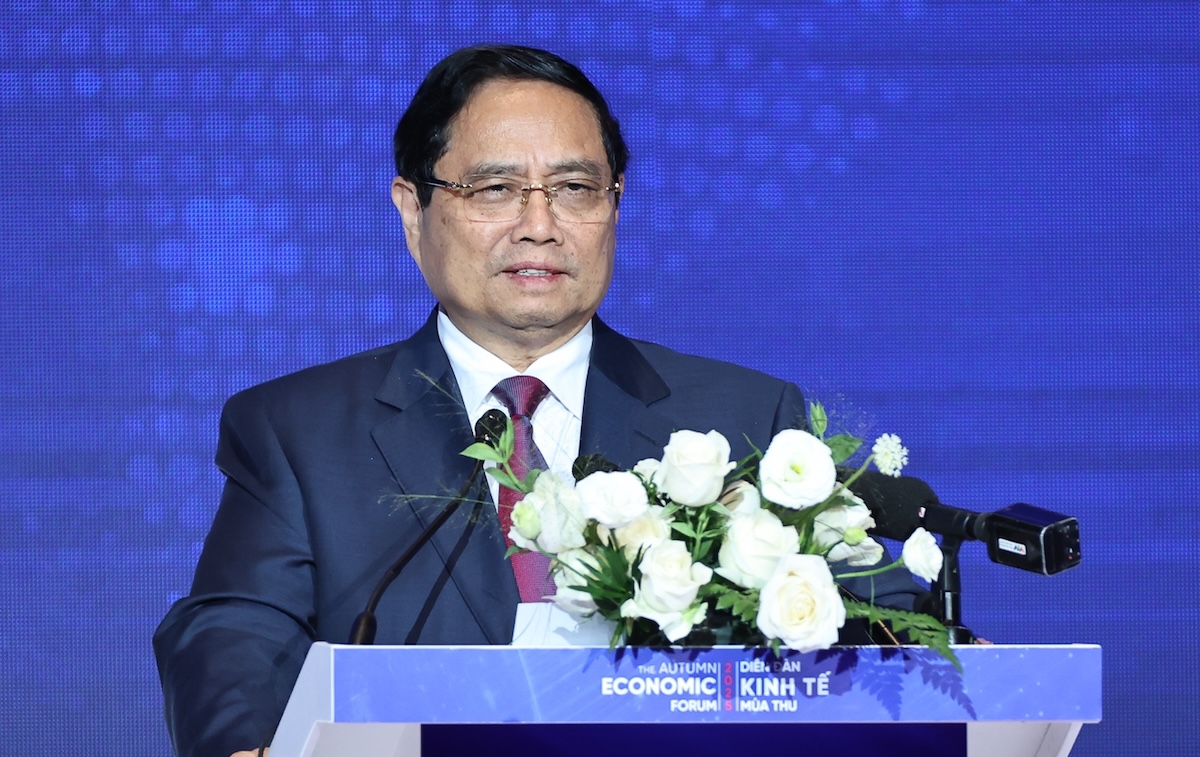 |
Prime Minister Pham Minh Chinh speaking at "CEO 500 - Tea Connect" on the afternoon of 25/11. Photo: VGP |
Prime Minister Pham Minh Chinh speaking at "CEO 500 - Tea Connect" on the afternoon of 25/11. Photo: VGP
Following its recent merger, Ho Chi Minh City now boasts a population exceeding 14 million, contributing nearly 25% to the national economy, positioning it as a significant regional player. Compared to major regional cities like Seoul, Shanghai, Singapore, and Bangkok, post-merger HCMC has the largest area and its population is second only to Shanghai. City Party Secretary Tran Luu Quang detailed the local strategy to develop a megacity based on a "three regions – one special zone – three corridors – five pillars" model. These five pillars are: high-tech industry and innovation; logistics integrated with seaports, aviation, and free trade zones; an international financial center; tourism and cultural industries; and education, healthcare, science and technology.
During the CEO 500 dialogue, numerous corporations and organizations voiced strong interest in enhancing collaboration with Ho Chi Minh City. Jesse Choi, ASEAN Regional Director for Sunwah, highlighted the city's potential as a regional innovation hub, with plans to establish international high-tech vocational training centers, construct energy-efficient hyperscale data centers, and launch shared electric two-wheeler parking. Pham Thai Lai, CEO of Siemens ASEAN and Vietnam, saw opportunities for partnership in leveraging high technology for digital transformation and sustainable development. Siemens intends to assist the city in cultivating high-quality human resources by transferring knowledge and improving digital and green technology capabilities. Hiro Miura, Country Director for Nokia in Vietnam, sought collaboration on developing secure, high-performance digital infrastructure and deploying artificial intelligence (AI) applications for real-time decision-making, including traffic coordination. Qualcomm also proposed contributing new technologies to support generative AI.
Domestically, Vu Anh Tu, Chief Technology Officer of FPT, proposed positioning Ho Chi Minh City as an AI export hub and establishing robust connectivity and cybersecurity infrastructure for its international financial center. In response to these proposals, Nguyen Van Duoc, Chairman of the Ho Chi Minh City People's Committee, affirmed the city's commitment to developing an international financial center, accelerating administrative reforms, and streamlining unnecessary procedures. He stated, "Ho Chi Minh City identifies science and technology as the driving force to achieve double-digit growth targets."
Prime Minister Pham Minh Chinh expressed confidence that, given the new context, Ho Chi Minh City will innovate and evolve into a megacity capable of competing with other major global cities. "Ho Chi Minh City is making dedicated efforts, and I am certain it will succeed," he remarked.
Vien Thong