After a nearly 50-point decline in the week's first session, many securities companies projected the stock market would extend its downward momentum to 1,750 points. However, the market's actual performance defied these expectations, as capital flowed into fundamentally strong stock groups.
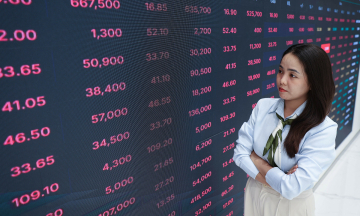
The VN-Index traded in positive territory for most of today. The index briefly reclaimed the 1,800-point mark before fluctuating around its reference level, with a range of approximately 10 points. The index for the Ho Chi Minh City Stock Exchange (HoSE) closed at 1,793 points, up nearly 3 points from its reference. Notably, the large-cap VN30 index climbed 15 points.
On the Ho Chi Minh City Stock Exchange, nearly 170 codes advanced, significantly outnumbering decliners. The large-cap basket showed even greater divergence, with 22 codes closing above their reference prices, three times the number of those that fell.
Following a strong correction, the banking sector resumed its role as a market leader. All constituent banking stocks saw gains, with ACB notably rising 5%. Mid- and large-cap banking stocks, including STB, OCB, MSB, and TPB, each increased by more than 1%.
The steel sector mirrored this positive trend, with all its stocks improving from yesterday. HPG, for instance, rose 1% to 23,500 VND, contributing positively to the overall index.
Conversely, stocks associated with Vingroup Group acted as a drag on the VN-Index's recovery. VIC, VHM, and VRE experienced losses of 0.5-1.7%, causing the overall index to fall by nearly 4 points.
The oil and gas sector also faced considerable selling pressure. PLX dropped nearly 3%, while GAS adjusted by approximately 2%; both were among the stocks with the most negative impact on market sentiment.
Despite the index's recovery, "bottom-fishing" capital inflows were not clearly evident. Today, nearly 530 million shares were successfully matched, totaling 13,700 billion VND, a decrease of about 5,000 billion VND compared to the week's first session. ACB stood out as the market's sole stock to trade nearly 1,300 billion VND, exceeding the combined value of the next two largest trades, STB and SHB.
Foreign investors significantly increased their net selling, amounting to nearly 900 billion VND. According to analysts at SSI Securities Company, the primary factors driving this prolonged capital outflow by foreign investors include concerns about domestic interest rate volatility, sustained high US government bond yields, and a global trend of capital reallocation towards markets with distinct advantages in artificial intelligence (AI) and semiconductor sectors.
Even with the index's recovery, most securities companies advised investors to reduce their stock exposure. Investors were cautioned against making new purchases until a clear bottoming signal emerges.
Phuong Dong