As of 11/2025, over 12,000 robots named Hyodol have been deployed to elderly individuals living alone across South Korea. Most of these devices are distributed through government welfare programs. Around 1,000 units are privately purchased by families, with the latest model costing 1,3 million won (879 USD).
The emergence of Hyodol became urgent, as a 6/2025 report by the Korean Medical Association highlighted an alarming reality: approximately 10 elderly people in the country commit suicide daily. While Japan and Hong Kong also face similar situations, South Korea remains among the OECD bloc's highest suicide rates.
Professor Othelia E. Lee of the University of North Carolina, United States, an expert researching social isolation, stated that South Korea is confronting a real crisis. With over 10 million people aged 65 and above, accounting for one-fifth of the population, the rapid aging rate has prevented the government from establishing adequate social welfare systems. Lee explained that traditional family structures are disintegrating, and the number of multi-generational households is sharply declining, resulting in one in every three elderly individuals living alone. Loneliness, financial pressure, and the feeling of being a burden have pushed many into depression.
Hyodol does not have the cold appearance of a machine. Instead, it embodies the look of a 7-year-old child with big eyes and a bright smile. Some versions wear pink dresses with braided hair, while others sport blue shirts with bow ties. Hidden beneath its soft fabric and metal casing is an advanced artificial intelligence (AI) system. This system acts as a virtual grandchild, tasked with addressing the crisis of a "super-aged society."
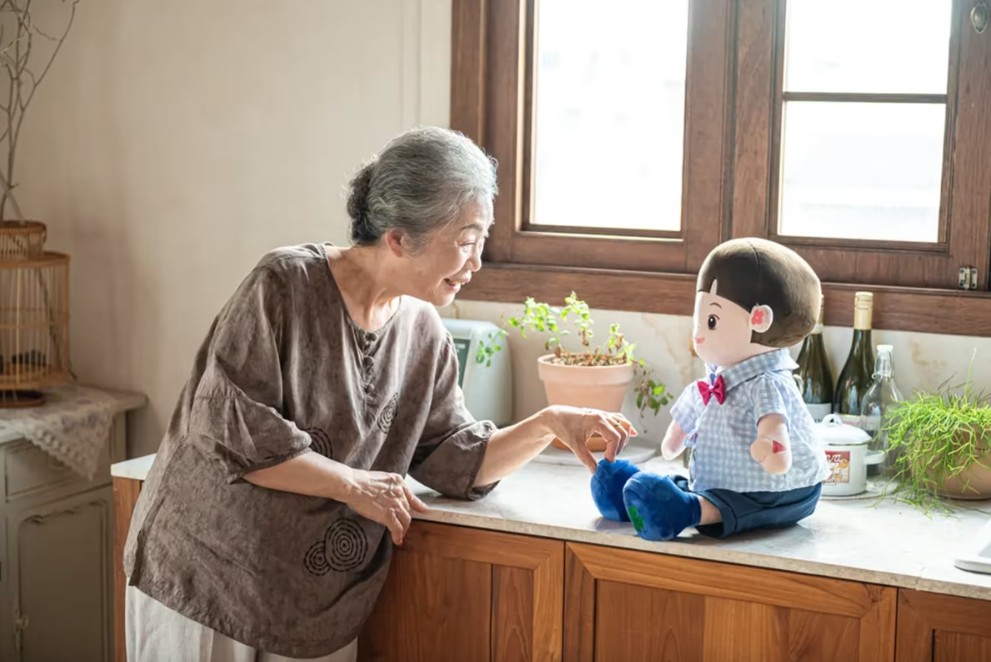 |
An elderly woman converses with an AI doll. Photo: Hyodol
In the face of a shortage of social care personnel, technology companies like Hyodol have filled this gap. The robots operate based on a web monitoring platform and a mobile application, allowing relatives or social workers to remotely monitor the daily routines and eating habits of seniors. The device serves two roles: medical support, including medication reminders and emergency alerts, and emotional comfort.
Jihee Kim, CEO of Hyodol, stated that the robot's soft, huggable design and childlike appearance help it gain users' trust. The robots can sing, guide exercises, and respond to gentle touches or hand-holding. However, its core value lies in its ability to communicate affectionately. The greeting, "Grandpa/Grandma, I've been waiting for you all day," when an owner returns home, becomes invaluable emotional medicine.
The effectiveness of this solution is demonstrated by real-world cases. A social worker recorded a case where an elderly woman with severe depression, who had previously contemplated suicide, rediscovered joy in life thanks to Hyodol's companionship. Professor Lee's 2024 study also indicated that many seniors treat the robots like their own grandchildren, giving them affectionate names, buying them clothes, and tucking them into bed. This bond significantly improves mental health and slows cognitive decline, allowing users to live at home longer instead of entering nursing homes.
However, reliance on robots also raises ethical debates, particularly the risk of 'infantilizing' the elderly. Experts worry that allowing a doll to monitor every action could diminish the self-esteem and autonomy of older adults. Jihee Kim admitted that Hyodol is not for everyone. Elderly individuals who are still mentally sharp and healthy often find the device noisy and bothersome. Consequently, the average age of current users is 82.
Internationally, the elderly care robot market is booming, forecast to reach 7,7 billion USD by 2030. Unlike South Korea's 'humanization' approach, Japan has found success with the PARO seal robot, which focuses on non-verbal touch therapy. Regardless of the approach, AI is steadily asserting its indispensable role in the future landscape of global healthcare.
Binh Minh (According to CNN)