On 14/11, a representative from Can Tho Central General Hospital announced that a patient admitted after a traffic accident was in critical condition, suffering from respiratory failure and multiple injuries. After eight days of intensive care, the patient reached the lowest level of consciousness (Glasgow 3 points), with no hope of recovery. His family made the compassionate decision to donate his tissues and organs.
Following the family's decision, Can Tho Hospital promptly activated its professional council to assess the patient's brain-dead status. Resuscitation efforts were immediately initiated to maintain the organs in optimal condition. Experts from Cho Ray Hospital, Military Central Hospital 108, National Children's Hospital, and the National Organ Transplant Coordination Center collaborated to consult, identify suitable recipients, and develop the safest plan for organ retrieval, transport, and transplantation.
At noon on 13/11, over 40 medical personnel from the aforementioned hospitals coordinated the organ retrieval surgery. The patient's liver was carefully divided into two parts: the larger portion, along with the heart, was transported to Military Central Hospital 108 for two adult recipients. The smaller portion of the liver was sent to the National Children's Hospital (both located in Hanoi) for a pediatric patient. Meanwhile, his two kidneys were transplanted into two patients with end-stage chronic kidney failure at Can Tho Central General Hospital. The corneas were also retrieved and sent to Cho Ray Hospital (TP HCM) and are currently awaiting transplantation.
According to a representative from Can Tho Central General Hospital, all five organ recipients are currently showing positive health progress following their respective transplant surgeries.
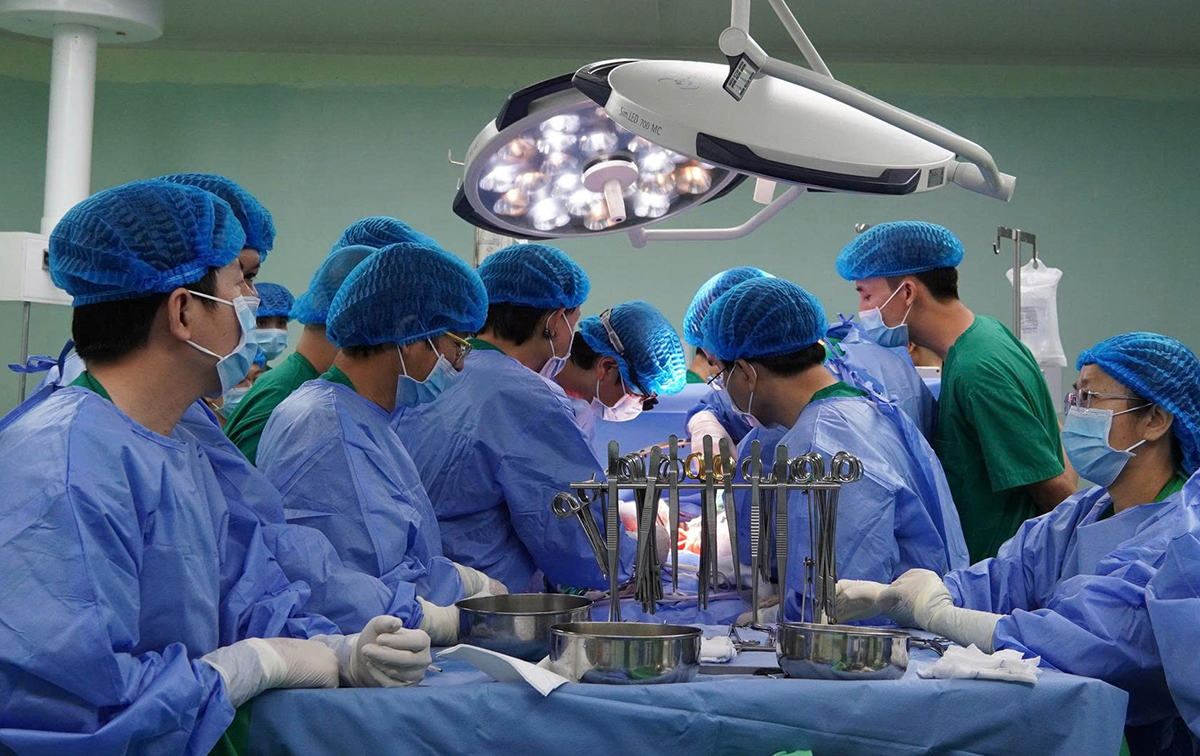 |
Doctors and nurses performing surgery to retrieve donated organs from a brain-dead patient, on 13/11. *Photo: Thanh Phong*
Doctor Pham Thanh Phong, Deputy Professional Director of Can Tho Central General Hospital, expressed profound gratitude to the donor's family for their selfless act. He emphasized the significant impact of this donation on the region's medical capabilities.
"This organ donation and transplant case marks a significant milestone and a remarkable professional advancement for the hospital and the Mekong Delta healthcare sector in organ transplantation", Doctor Phong stated. He added that it also serves as an important foundation for the hospital to pursue other organ transplant techniques, such as liver and heart transplants, in the near future.
Organ transplantation stands as one of humanity's most important medical achievements since the 20th century, often being the only life-saving measure for patients in end-stage disease. Over the past 30 years, Vietnam has performed nearly 10,000 organ transplants, primarily kidney, liver, and heart procedures. Vietnamese doctors have mastered organ transplant techniques, capable of transplanting six types of organs and performing simultaneous heart-lung, heart-liver, and liver-kidney transplants. Despite these advancements, the number of organs available from brain-dead donors remains low, while the waiting list for patients needing transplants is extensive.
By An Binh