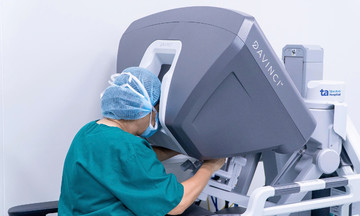
Trang, 45, recently underwent successful robotic surgery at Tam Anh General Hospital, TP HCM, to address severe endometriosis. For nearly two years, she experienced prolonged menstruation due to a uterine endometriosis tumor, leading to severe anemia, fatigue, and dizziness. Her condition was so critical that she required three blood transfusions over two summer months.
Upon examination, ultrasound results revealed Trang’s uterus was enlarged to the size of a 10-12 week pregnancy, firm, and extensively adhered to the left abdominal wall. Her right ovary also contained a cyst larger than 5 cm. Doctor Nguyen Thi Yen Thu, from the Obstetrics and Gynecology Center, explained that the significant adhesions made conventional laparoscopic surgery challenging to visualize, raising the risk of damage to surrounding structures.
To mitigate these risks, doctors opted for the da Vinci Xi robot to perform a hysterectomy and right adnexectomy. Doctor Nguyen Ba My Nhi, Director of the Obstetrics and Gynecology Center, skillfully operated the robot’s four arms from the control console. This allowed for precise dissection of the adhesive tissue and preservation of surrounding structures before the uterus was removed along with the right ovary and its cyst. The robotic system provided continuous, tremor-free movements, reducing potential harm to adjacent organs.
The surgery lasted approximately two hours, with a minimal blood loss of 30 ml and no complications. Trang recovered quickly, able to sit up and walk gently just six hours post-operation. On the third day, she was discharged in stable condition, with small incisions measuring about 0,8-1 cm.
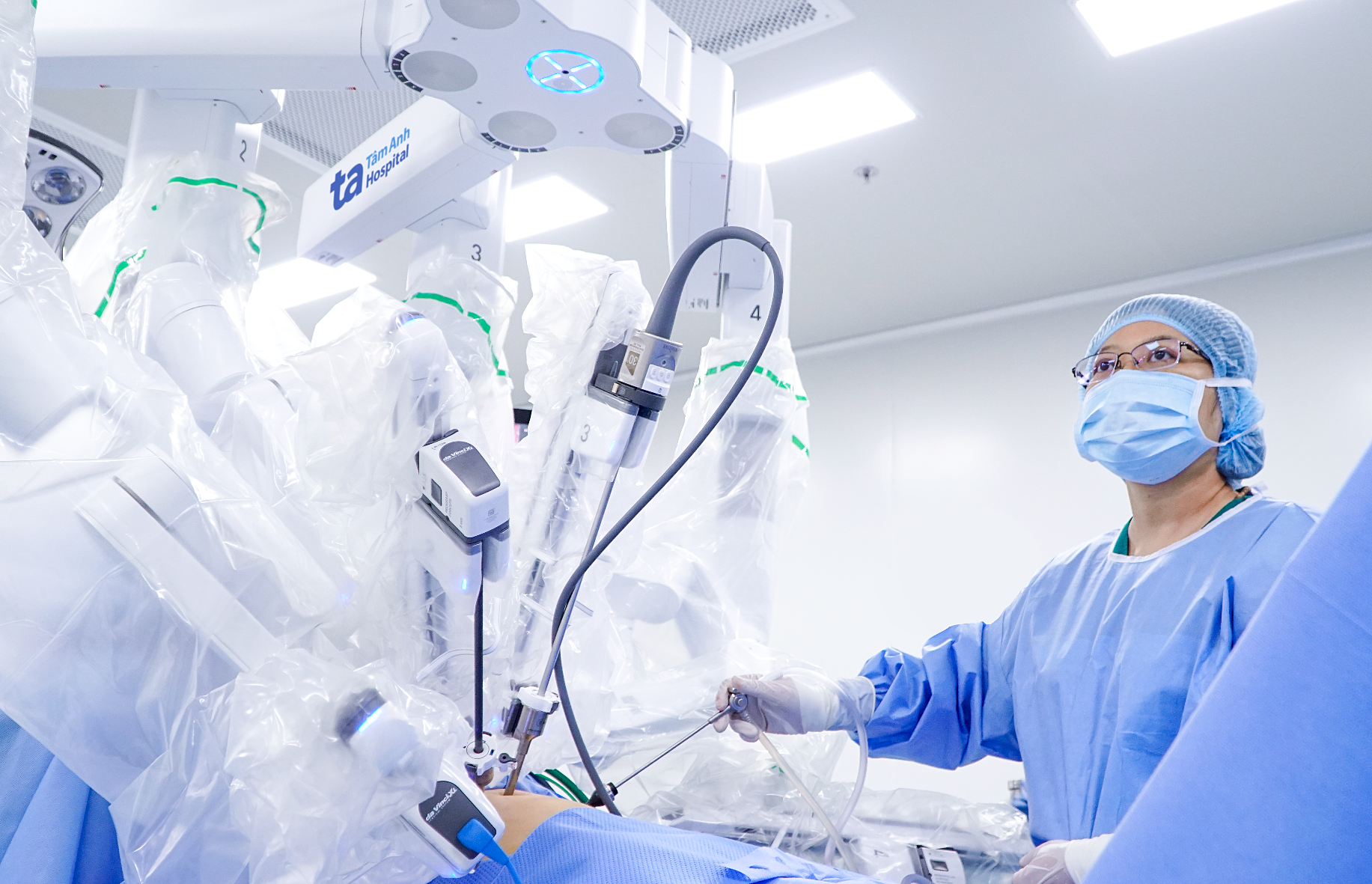 |
Doctor Yen Thu participated in the robotic surgery team performing a hysterectomy and right adnexectomy for Trang. *Photo: Trung Vu*
Doctor Yen Thu highlighted the advantages of robotic surgery compared to traditional methods. Previously, severe endometriosis cases with extensive adhesions often could not be managed by laparoscopic surgery, or failed procedures necessitated conversion to open surgery. These open procedures typically resulted in a long 12 cm incision, with a higher risk of bleeding and complications for patients.
Since the FDA approved the application of robotics in gynecological treatment in 2005, the rate of robotic surgeries has rapidly increased. This method offers a magnified 3D display, which significantly assists doctors in managing complex adhesions, inflamed tissue, and large fibroids. Patients benefit from faster recovery and shorter hospital stays. However, in Vietnam, robotic treatment for gynecological conditions is not yet widely adopted and is not covered by health insurance.
Tue Diem
*Patient's name has been changed
| From 24/11 to 30/11, Tam Anh General Hospital System is hosting a consultation week titled "120 types of cancer and complex disease surgeries with the leading modern Da Vinci Xi robot in Southeast Asia" on VnExpress. Doctors from the Obstetrics and Gynecology Center, Urology - Nephrology - Andrology Center, Endoscopy and Gastrointestinal Endoscopic Surgery Center, Thoracic - Vascular Surgery, Oncology, and Radiation Therapy will directly advise patients. Readers can submit questions here. |