In 9/2020, a video of young Gabriel crying next to an empty ice chest in Mossoro, Rio Grande do Norte state, went viral on Brazilian social media.
Moments earlier, following a report from a resident, the Guardianship Council and local police arrived. They confiscated Gabriel's tables, chairs, and lemonade stand, citing "preventing illegal child labor."
"I am not ashamed of selling things; I would only be ashamed if I stole. I work to help my mother and my siblings", the boy stated.
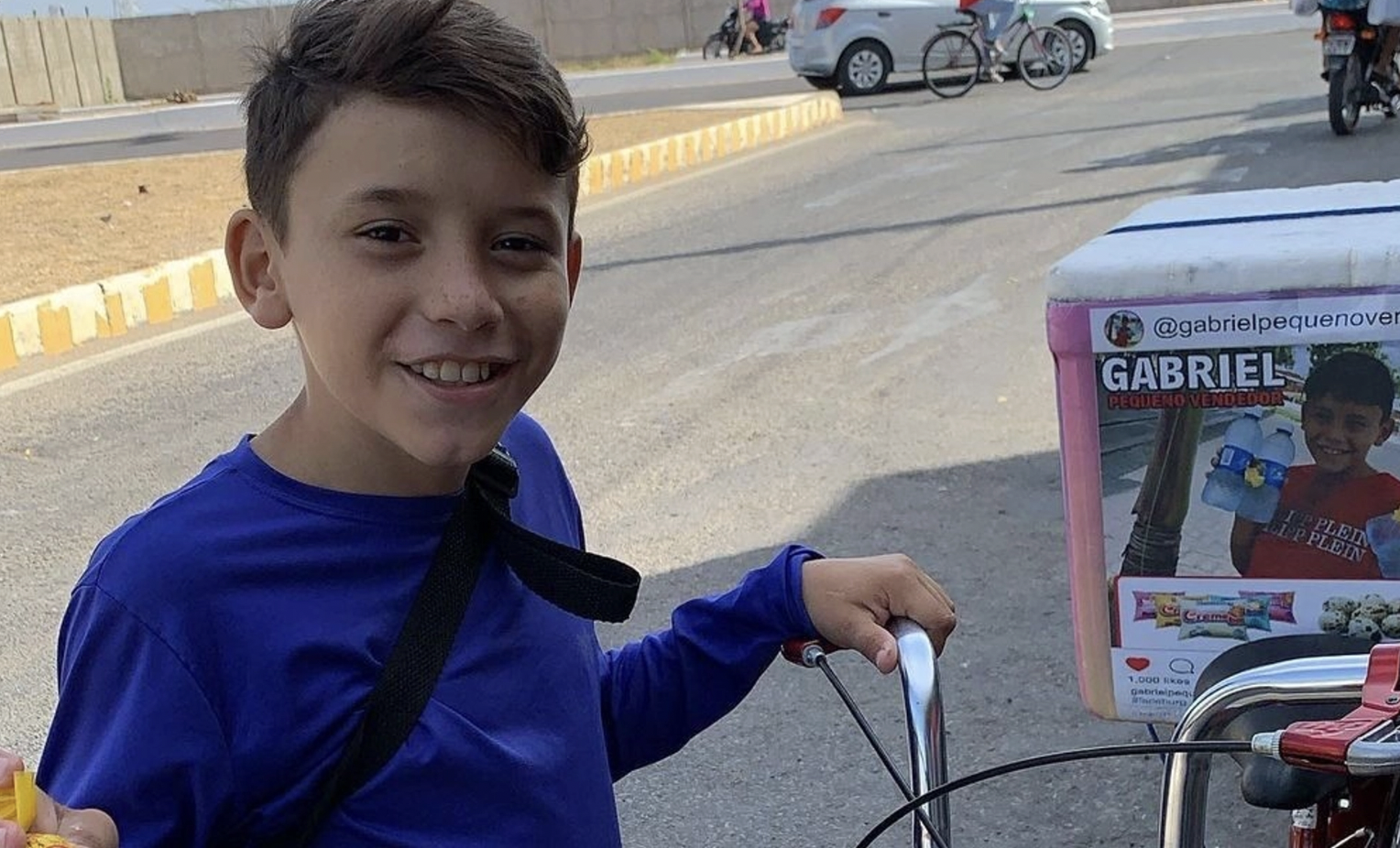 |
Gabriel selling goods in Mossoro, Rio Grande do Norte state, Brazil, in 2020. *Photo: Yourtango*. |
Gabriel's story and plight resonated with millions. An online fundraising campaign was immediately launched. The initial goal was 13,500 USD, but the amount quickly surpassed 16,000 USD, thanks to the online community's support.
Before this turning point, Gabriel lived with his mother and three younger brothers in a cramped room at his grandmother's house in the Bairro slum. His family was among the poorest in the area. Gabriel's mother, Maria das Gracas, could not work, as she provided 24/7 care for her severely disabled step-sibling.
Concerned for his mother and siblings, who often lacked milk and medicine, Gabriel decided to skip afternoon school to sell lemonade and bottled water. In the 40 degrees Celsius heat, he earned about 4-8 USD daily.
His work was not easy. Neighborhood children often pelted him with bottle caps and mocked him as "the beggar selling water." Despite this, Gabriel persisted with his dream of buying a house, so his mother and siblings would not have to live as dependents.
The community's donations turned that dream into an early reality. In 12/2020, Gabriel used most of the funds to purchase a small but sturdy house, situated away from their former slum. The home features two bedrooms, a kitchen, and a small yard, providing sufficient space for his mother to care for his brother.
"Now I can attend school with peace of mind, knowing my mother and siblings are safe from rain and wind", Gabriel shared upon receiving the house keys.
With the remaining funds, the family invested in a licensed beverage stand. Gabriel no longer needed to street vend; he now assists his mother in managing the stand on weekends. He also allocated a portion of the money to purchase a wheelchair, an oxygen monitor for his brother, and cover tuition at a better school.
Currently, Gabriel continues his studies and is known as a "little hero" by the local community. A local volunteer group provides monthly food assistance for his family. Gabriel's story exemplifies how community kindness can transform a person's fate.
According to the Brazilian Institute of Geography and Statistics (IBGE), 16.4 million people, or 8.1% of the country's population, currently live in slums under impoverished conditions. Thus, Gabriel's experience is not an isolated tragedy; it mirrors the severe housing challenges impacting millions of Brazilian families.
*By Ngoc Ngan (Based on The Guardian, Yourtango)*