An's coffee cart is set up in front of a bank on Nguyen Ai Quoc street. From 6h, customers, mostly students and office workers, start arriving. For nearly two hours, the 25-year-old continuously prepares drinks, glancing at her watch. At precisely 7:45h, An packs up, stores her equipment, and drives to work, clocking in on time.
"This lifestyle instills discipline in me," she says.
A pharmacy graduate, An currently works as purchasing staff for a company managing a chain of clinics in Ba Ria - Vung Tau and Dong Nai. Outside of office hours, from Monday to Saturday, she transforms into a sidewalk coffee shop owner.
 |
Vu An's coffee cart on Nguyen Ai Quoc street, Bien Hoa City, Dong Nai, 11/2025. Photo: Provided by character |
An's decision to start her business came late last year when she felt stagnant, often woke up late, and her income was insufficient to cover master's tuition fees. She chose the takeaway coffee cart model due to its low capital and low risk. In 11/2024, she began pushing her cart to the sidewalk, selling coffee for 15,000 to 42,000 dong per cup, only for two hours each morning.
In the initial days, An felt overwhelmed by the complete change to her biological rhythm. She had to sleep early and wake up at dawn to prepare her stand, selling while also creating promotional content for social media.
"Every morning minute is maximized," An shares. Her hard work is rewarded with an income of 4-5 million dong per month, helping her achieve financial independence and no longer needing to request tuition fee extensions.
Vu An exemplifies the "morning sidewalk, midday office" trend booming among young people. According to Anphabe's report on Gen Z labor trends, over 60% of young Vietnamese are seeking or engaging in side hustles to improve their finances.
Explaining this trend, Dr. Ngo Minh Hai, Vice Principal of the University of Economics – Finance Ho Chi Minh City, states that the main reasons stem from financial pressure and the growing culture of flexible earning among young people. A survey of 65,000 workers last year revealed that 74% found their main income was insufficient to live on. Morning sales have become a flexible and practical source of income.
Another factor is the early entrepreneurial spirit. Young people utilize their free time to test small business models, hone operational skills, and observe market demand, thereby expanding economic opportunities beyond their main jobs.
The choice of side hustles is also a strategic psychological decision. Office workers often avoid side jobs similar to their main profession, opting instead for manual labor to reduce pressure. Daily office work demands continuous thought and information processing, while activities like making coffee or arranging goods create a change of environment, allowing physical activity and mental stress relief.
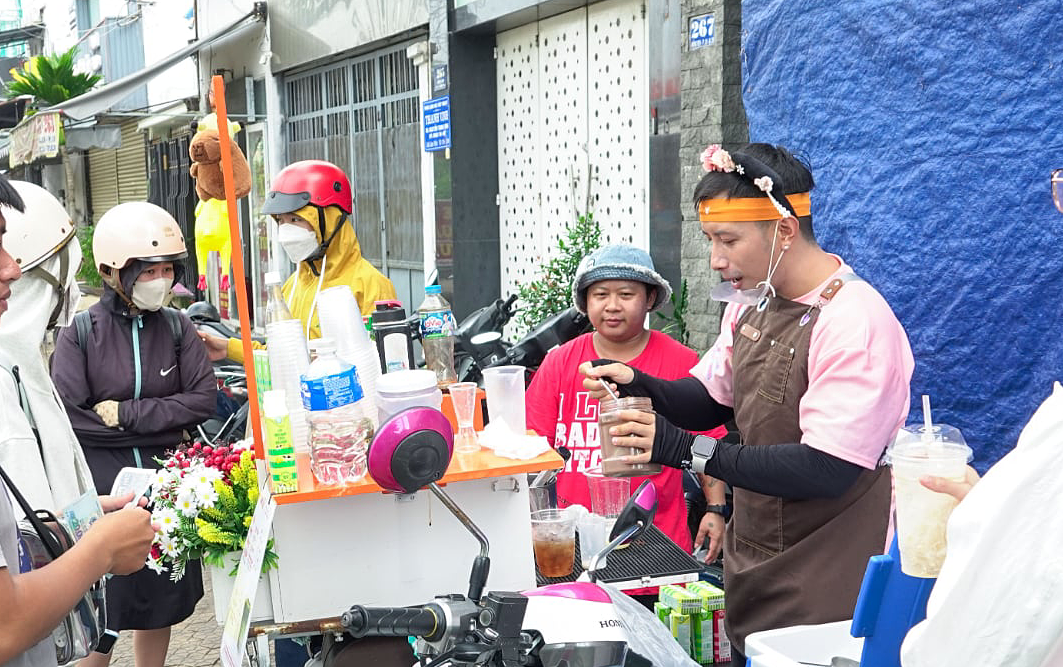 |
A coffee cart model on Dong Den street, Tan Binh ward, Ho Chi Minh City, 11/2025. Photo: Provided by character |
Dr. Hai notes that working "two shifts" brings both opportunities and pressures. This activity improves income, helping them cope with high living costs and increasing financial autonomy. The major drawbacks are health and time. Waking up early for business then working full-time leads to chronic sleep deprivation and exhaustion, impacting main job performance and reducing time for rest, study, and personal development.
"Without balance, financial benefits can come with health risks and impact long-term careers," the expert comments.
Ha Huynh, 27 years old, from Vinh Long, understands this lesson well. He is an auto service advisor and has maintained a coffee stand at Hoa Phu industrial park for three years.
"Some days, after selling, I arrive at the company at 7:30h completely exhausted," Huynh recounts. His morning sales shift only lasts about one hour, but it takes an entire evening to prepare fresh items like salted cream, arrange ingredients, and tools so that at 6h the next morning, he just needs to push the cart to the selling point.
When customers are almost gone, he rushes to work physically drained, but still has to focus on office tasks. After half a year, with his father helping clear the stand, the burden was alleviated.
To maintain sustainability, Dr. Hai advises young people to clearly define work hours and ensure 6-7 hours of sleep daily. Once they have capital and experience, they should aim to hire staff or automate processes to transform side jobs into income-generating assets rather than continuously selling their labor.
"Doing extra work is not just about earning money, but about learning to work smart and maintaining a balance between income and health," he says.
Ngoc Ngan