"I know a goshiwon is less comfortable than a studio apartment, but I cannot bear the burden of daily rising rent", said the Seoul office worker.
For Kim, returning to the cramped boarding house with shared bathrooms is her only option right now.
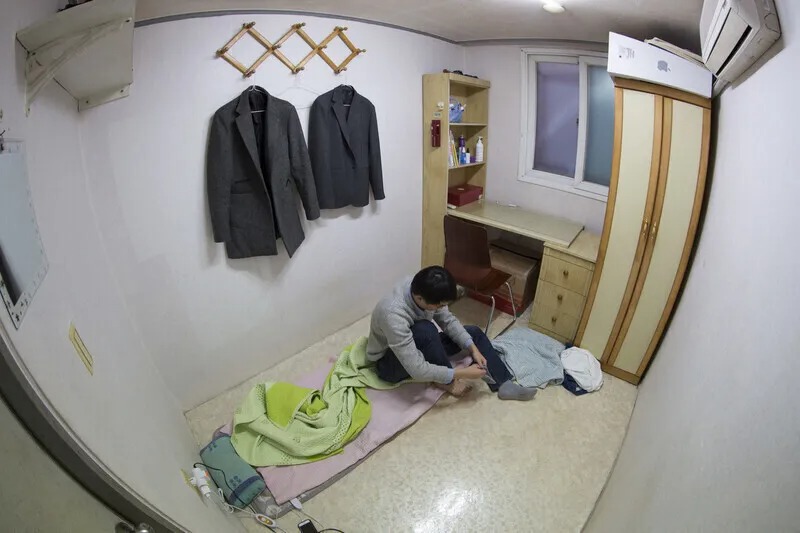 |
A goshiwon room in South Korea. Photo: Korea Times |
A goshiwon room in South Korea. Photo: Korea Times
Data from the South Korean Ministry of Land, Infrastructure and Transport shows that in 2024, the percentage of young households (aged 19-34) living in "non-residential" facilities increased to 5,3%.
"Non-residential" refers to places not designed for long-term residency, such as goshiwon, agricultural greenhouses, shacks, or containers. The percentage of young people forced into these cramped living conditions is currently twice the national average of 2,2%. The 5,3% figure also marks a return to the 2017 peak, erasing all efforts to improve housing during the 2018-2021 period.
Kang Mi-na, an expert at the Korea Human Settlements Institute (KRIHS), notes this trend is directly proportional to the influx of young people into the capital region. Despite the high costs, nearly 54% of the nation's young population remains concentrated in Seoul, Incheon, and Gyeonggi, seeking opportunities.
However, Seoul's housing market is unprecedentedly harsh. Jeonse (a lump-sum deposit rental system) prices increased for 40 consecutive weeks, leading to scarce supply. Forced to switch to monthly rent, young Seoul residents bear an average cost of 896.000 won (approximately 15,5 million dong) per month, accounting for one-fourth of their income.
The door to homeownership is also virtually closed. Seoul's Price-to-Income Ratio (PIR) has reached 13,9 years. Theoretically, a resident must save 100% of their salary for nearly 14 years to afford a home in the capital, which is twice the national average.
As a result, the homeownership rate for those in their 30s in Seoul has fallen to 25,8%, the lowest level in recorded history.
These "homes not meant for living" have become the mandatory refuge for a generation caught between urban dreams and financial realities.
Nhat Minh (According to Koreatimes/Koreaherald)