Speaking at a seminar on 9/12 titled "Hanoi's hourly gasoline vehicle ban: infrastructure and livelihood considerations", Dao Viet Long, Deputy Director of the Department of Construction, stated that the transition from gasoline motorbikes to electric vehicles affects millions of residents. Consequently, Hanoi is committed to comprehensive preparation, encompassing the legal framework, support mechanisms, infrastructure, and traffic management.
According to the Department of Construction, establishing a low-emission zone addresses two major urban challenges: persistent traffic congestion and air pollution. These issues directly hinder the capital's quality of life and socio-economic progress. Therefore, City People's Council Resolution 57/2025 on low-emission zones mandates synchronous, phased implementation.
The city is drafting a policy to support the transition to clean energy vehicles. Under the proposal, residents could receive 20% of an electric motorbike's value, up to 5 million VND. Poor households may receive up to 100% support, capped at 20 million VND, while near-poor households could get 80%, up to 15 million VND. Additionally, the city offers 30% interest support for installment vehicle purchases over 12 months and 50% support for registration fees, with poor and near-poor households receiving 100% coverage.
Hanoi also plans preferential parking fees for green vehicles and offers free use of roads and sidewalks for up to 5 years to businesses operating public electric bicycles and motorbikes. Concurrently, the city is expanding its free public transport policy to include students and industrial park workers.
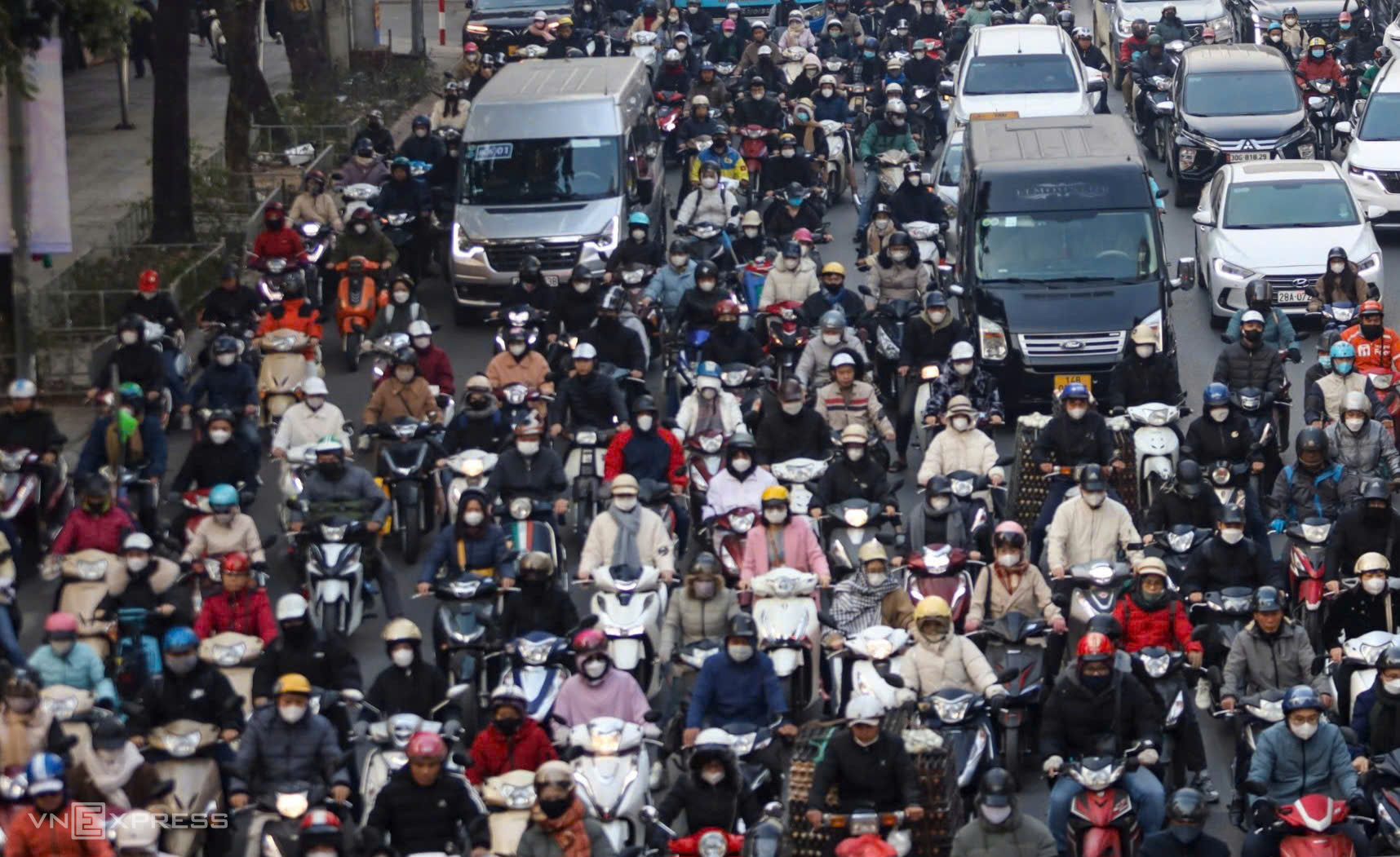 |
Vehicles on Nguyen Trai Street, Thanh Xuan Ward. Photo: Ngoc Thanh
Regarding infrastructure, the city is exploring investment support for public clean energy charging stations. This includes 30% loan interest support, 50% of land clearance costs, and a 5-year land rent exemption. Hanoi plans that at least 15% of parking spaces in Ring Road 3 areas will feature charging stations by 1/1/2030. New construction projects are expected to allocate at least 30% of parking spots for public charging stations, which will be shared infrastructure, not brand-exclusive.
Hanoi has surveyed 110 potential locations for centralized charging stations within Ring Road 3 for initial pilot implementation. The city is also researching a battery swapping system for two-wheeled electric vehicles.
In parallel, the Department of Construction is developing a mini electric bus system for the Old Quarter and historic areas, alongside promoting shared mobility. By early 12/2025, the city integrated an additional 500 electric bicycles into its public bicycle system, with plans to expand to 5,000 bicycles by 7/2026.
For high-rise apartment buildings, the Department of Construction noted that challenges regarding charging station installation fall under the jurisdiction of commune and ward People's Committees. Currently, local authorities are collaborating with apartment management boards to review and designate separate electric vehicle parking areas, ensuring charging pillars comply with fire safety regulations.
Statistics show Hanoi currently has over 8 million vehicles, including approximately 6,9 million motorbikes, plus over 1,2 million vehicles from other localities in constant circulation. The city identifies road transport emissions as contributing 58% to 74% of total air pollution. The low-emission zone resolution is slated to become effective from 7/2026.
Vo Hai