On November 26, the Hanoi People's Council unanimously approved a resolution on low-emission zones under the Capital Law 2024. These zones are established to restrict polluting vehicles and prioritize those using clean energy.
The resolution stipulates that gasoline motorbikes will be prohibited from circulating within low-emission zones during specific hours or in designated areas. App-based professional vehicles will also be restricted. Cars failing to meet emission standard level 4 will face restrictions, with eventual bans in these areas at specific times or on particular routes.
The city has outlined a green transition roadmap for commercial transport vehicles using fossil fuels. Motorbikes must complete this transition by 2030. From 1/7/2026, taxis can only be newly invested in or replaced with electric or green energy vehicles. Starting 1/1/2035, the city People's Committee will determine the scope and timing of road vehicle restrictions based on actual conditions.
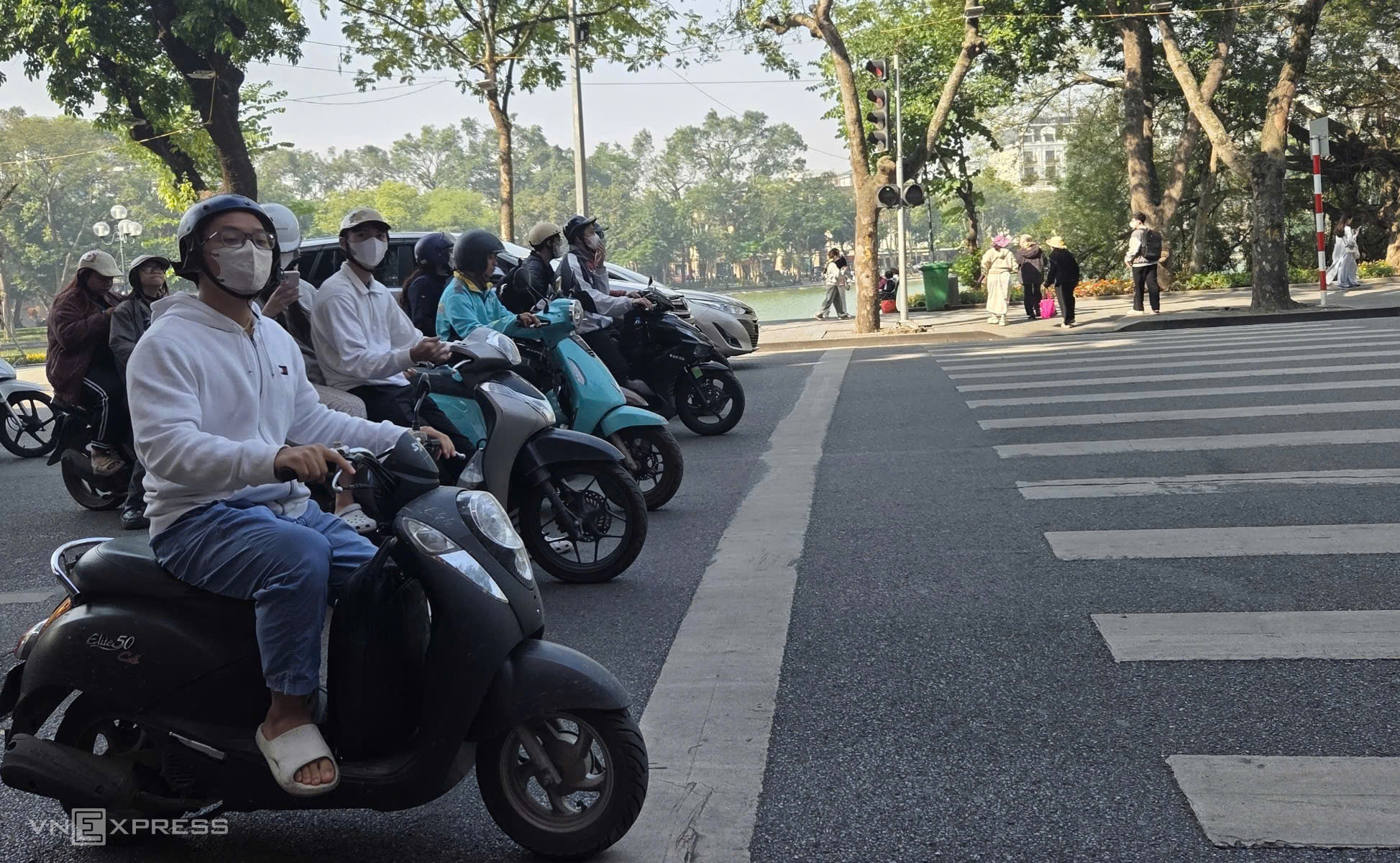 |
Motorbikes stopped at a red light in front of the Hanoi Post Office building. *Photo: Vo Hai* |
Beyond banning gasoline motorbikes, low-emission zones will implement additional measures. These include prohibiting new investments or registrations for fossil fuel vehicles when old ones are retired, particularly for those owned by organizations. Furthermore, gasoline and diesel trucks over 3,5 tons will be prohibited from entering these zones.
According to the roadmap, Hanoi will pilot low-emission zones from 1/7/2026 in several wards within Ring Road 1, including Hai Ba Trung, Cua Nam, Hoan Kiem, O Cho Dua, Van Mieu - Quoc Tu Giam, Ba Dinh, Giang Vo, Ngoc Ha, and Tay Ho. Two years later, from 1/1/2028, the scope will expand to encompass the entire Ring Road 1 and parts of Ring Road 2, including Lang, Dong Da, Kim Lien, Bach Mai, and Vinh Tuy wards. By 1/1/2030, the low-emission zone will be implemented within Ring Road 3, covering a total of 36 wards and communes across the three ring roads.
The Department of Agriculture and Environment is tasked with developing the low-emission zone project for areas within Ring Road 3. For areas outside this scope, commune-level People's Committees will draft proposals and submit them to the city People's Council for review before implementation.
Previously, a resolution on low-emission zones was approved in late 2024, with a pilot phase projected for the former Hoan Kiem and Ba Dinh districts from 2025-2030. However, no areas have been officially implemented to date.
The city also developed a resolution to support residents in transitioning to green vehicles, but this item was withdrawn from the People's Council's current meeting agenda.
 |
Ring Road 1 area, Hanoi. *Graphic: Hoang Khanh* |
According to the Hanoi People's Committee, the decision to implement hourly bans instead of full-time restrictions stemmed from feedback gathered from various departments and local communities. This feedback indicated a need to extend the roadmap to align with existing infrastructure, social welfare conditions, and residents' travel habits.
Hanoi views the establishment of low-emission zones as a crucial solution to mitigate air pollution, a challenge the city has faced for many years.
The 2016-2020 national environmental report indicated that PM2.5 dust levels in Hanoi were nearly double the national standard, while PM10 levels exceeded it by 1,3-1,6 times. Transportation vehicles are identified as the largest source of emissions, accounting for 58-74% depending on the time, with motorbikes being the primary contributors.
The city currently has over 8 million vehicles, comprising 1,1 million cars and 6,9 million motorbikes, with an additional 1,2 million vehicles from other provinces circulating daily. Hanoi also established criteria for defining low-emission zones based on environmental protection priority, traffic congestion levels, and the most recent year's air quality monitoring data.
Vo Hai