This directive was issued in response to Khanh Hoa province's request to re-evaluate the North-South high-speed railway route. The province sought to prevent impact on the Hoa Lai tower complex, as the initial proposed alignment would have run through the surrounding area, adjacent to the relic site.
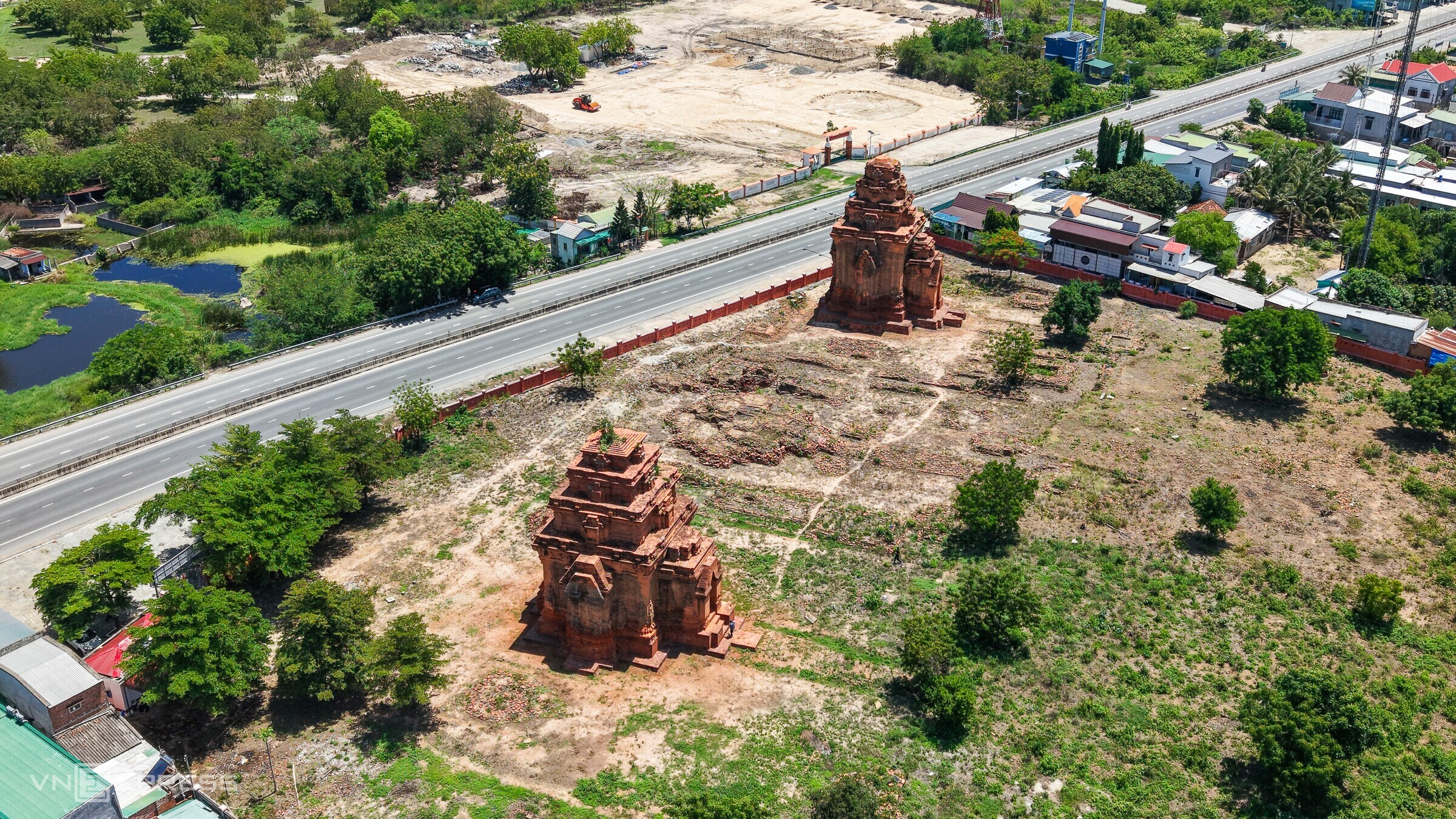 |
The Hoa Lai tower, a special national relic, Ninh Thuan (now Khanh Hoa province). Photo: Bui Toan |
The Ministry of Construction has directed the Thang Long Project Management Board to instruct its consultants to thoroughly assess the topography, geology, and site clearance requirements during the feasibility study. The investor is mandated to select the most appropriate route, minimizing disruption to residents and historical sites, while ensuring regional transport connectivity and maximizing the project's investment efficiency.
The Hoa Lai tower, also known as Ba Thap or Hakral by the Cham people, dates back to the 8th-9th centuries. Situated on a 4.9 ha site along National Highway 1 in Thuan Bac commune (formerly Ninh Thuan), the complex originally comprised three towers. The central tower has since collapsed; only the South and North towers remain intact.
Historical records link the Hoa Lai tower to the emergence and growth of Panduranga, the southernmost territory of the ancient Champa kingdom. Designated a special national relic in 2016, the site attracts numerous scholars and tourists for research and visits.
 |
The top section of Hoa Lai tower, 7/6. Photo: Bui Toan |
The North-South high-speed railway project's section through Khanh Hoa will span approximately 191 km. It is planned to include three stations: Dien Khanh, Thap Cham, and a cargo station in Ninh Hoa, which will link to the Van Phong Economic Zone.
For site clearance purposes, the local authorities plan to develop and expand 31 resettlement areas, with an estimated total cost exceeding 1,740 billion VND. This includes utilizing 13 existing areas and constructing or expanding the remainder.
Bui Toan