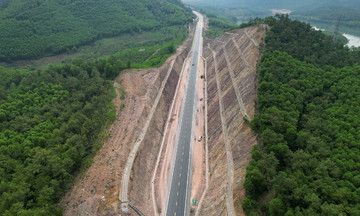
Around 9:15 AM, police set up barriers blocking vehicles as rainwater flowed down the embankment, creating a swift current carrying rocks and gravel onto the road. Some areas on the mountainside cracked, threatening to collapse the concrete upslope embankment.
After nearly one hour, to ease congestion, authorities allowed one-way traffic, alternating directions: up to Pleiku and down to Quy Nhon.
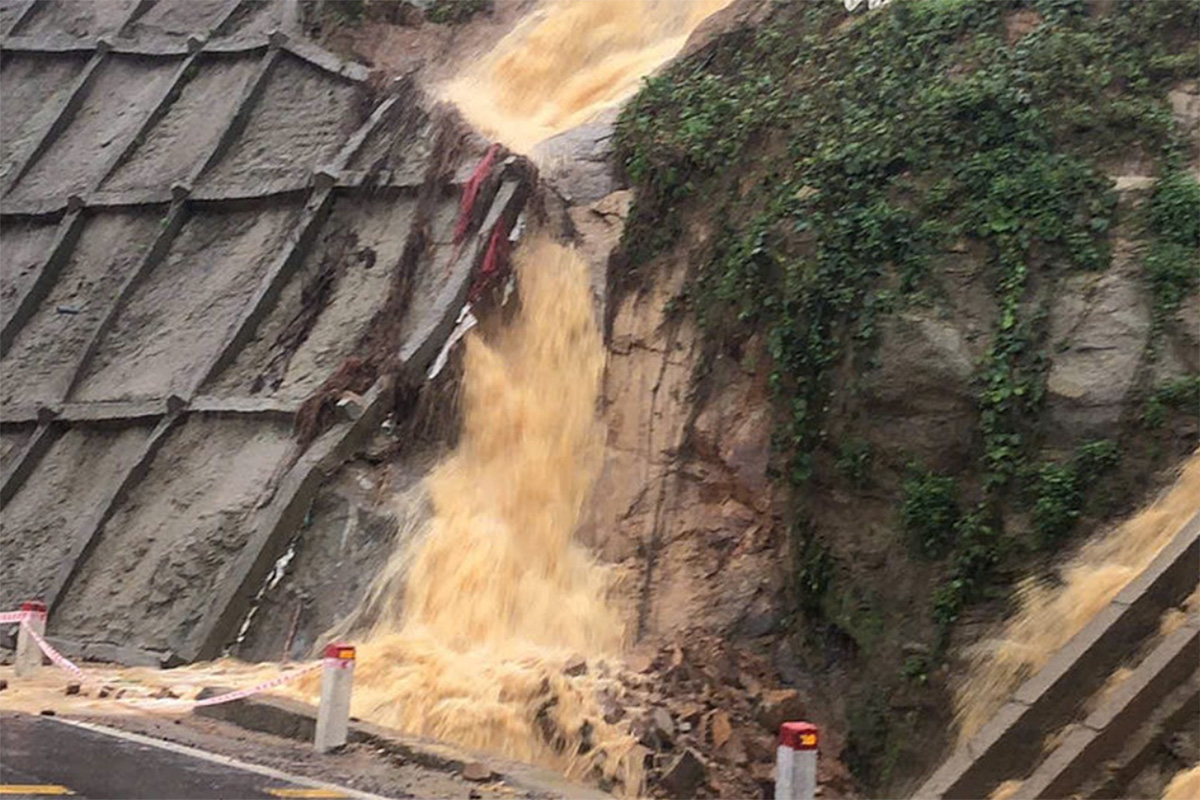 |
Water overflowing from the upslope embankment of An Khe Pass onto the road. Photo: Ngoc Oanh
An Khe Pass, 8 km long, is the most dangerous section of national route 19, prone to incidents, especially at night. The route was recently widened from 7 to 9 meters with a 600 billion VND investment. Mountain slopes have been sprayed with concrete, piled, and netted to prevent landslides, but heavy rain still poses a risk.
Over the past two days, heavy rain caused flooding and landslides in Gia Lai, Dak Lak, and Khanh Hoa. The Gia Lai Hydro-Meteorological Center stated that over the next 24-48 hours, the eastern part of the province will continue to experience moderate to very heavy rain, with total rainfall of 80-200 mm, some areas exceeding 250 mm.
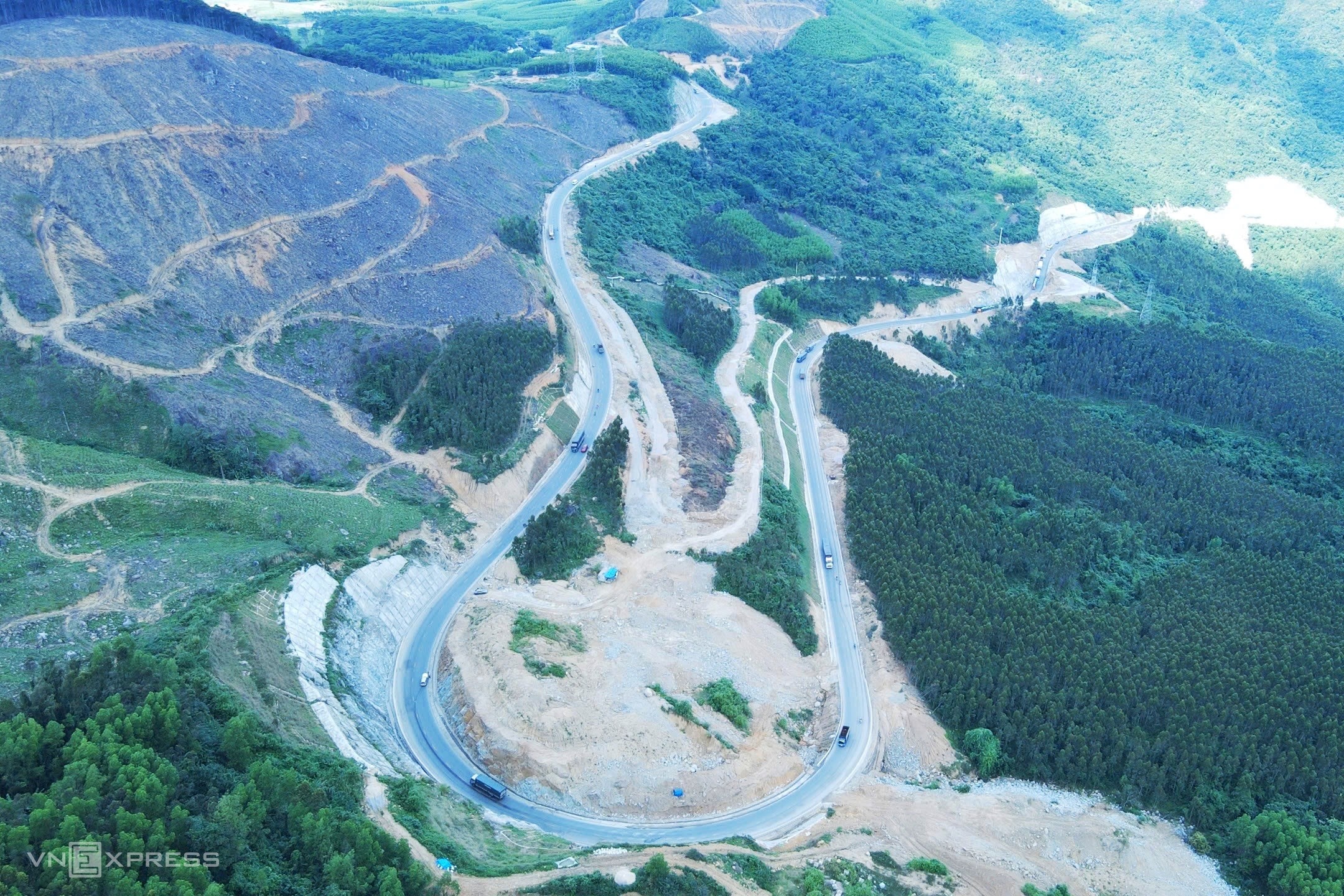 |
Section of An Khe Pass being widened. Photo: Tran Hoa
Heavy rain caused incidents in many locations. Passes like Khanh Le, Khanh Son (Khanh Hoa), Mimosa, Prenn, Ngoan Muc, and D'ran (Lam Dong) experienced landslides causing traffic disruptions. Among these, an incident on Khanh Le Pass where rocks cascaded onto a passenger bus killed 6 people and injured 19.
Tran Hoa