On the morning of 17/11, the National Assembly heard a report on the draft Resolution concerning specific mechanisms and policies to implement the Politburo's Resolution on breakthrough development in education and training.
Justice Minister Nguyen Hai Ninh stated that a major point of the draft is to resolve obstacles in the recruitment, assignment, management, and utilization of education personnel. The new proposals aim to overcome fragmented and inflexible practices that lead to localized teacher surpluses and shortages.
The draft assigns the director of the Provincial Department of Education and Training the authority to recruit and accept teachers within the province. For deployment, rotation, arrangement, assignment, and job position changes, the draft flexibly stipulates that the Provincial Department of Education and Training will implement these if the scope covers two communes or more, while commune-level People's Committees will implement them within their own management scope.
The Government stated that prior to reorganization, the decentralization of recruitment and secondment authority to district-level People's Committees resulted in fragmented workforce management, causing localized teacher surpluses and shortages among districts. Schools could not adjust or rotate teachers as needed due to differing authorities.
Furthermore, when the education sector did not lead recruitment, examinations often used general tests similar to those for other civil servants. These tests failed to assess specific pedagogical competencies and professional qualities, impacting the quality of the workforce.
The Government assessed that continuing to allow commune-level authorities to lead recruitment would not be feasible. This is because they lack specialized agencies and sufficient conditions to organize examinations. Organizing separate exams in more than 3,200 communes would be costly, increase procedures, and limit opportunities for candidates.
The decentralization and delegation of authority to the director of the Provincial Department of Education and Training will ensure consistency and synchronization in the recruitment, deployment, secondment, and utilization of the teaching workforce. This will address localized disparities and shortages, while also enabling the sector to proactively arrange and adjust human resources to meet the demands of educational reform.
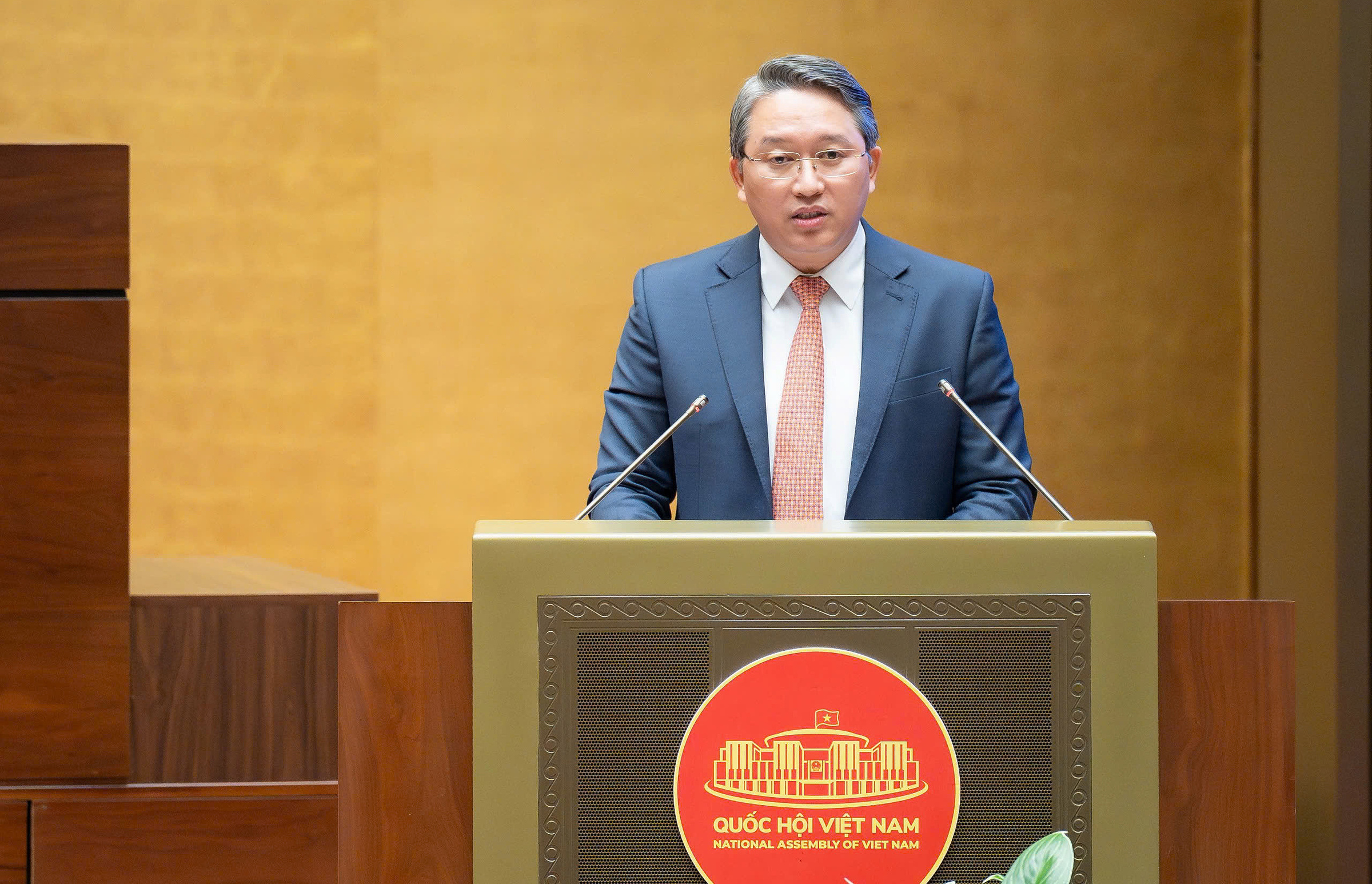 |
Justice Minister Nguyen Hai Ninh at the National Assembly. Photo: Hoang Phong
Beyond the recruitment mechanism, the State will implement special, superior incentive policies for teachers and staff in preschool and general education institutions. Professional incentive allowances are proposed to be a minimum of 70% for teachers, 30% for staff, and 100% for teachers in exceptionally difficult, border, and island regions.
Professional standards and specific remuneration schemes will apply to lecturers, coaches, artists, and healthcare personnel. Priority will be given to investing in facilities and equipment that meet regional and international standards. The draft also includes policies for identifying, nurturing, and utilizing talent in specific educational fields, as well as commissioning high-quality human resource training based on enterprise and labor market demands.
The draft ensures comprehensive autonomy for higher education and vocational training institutions. It also aims to innovate curricula for preschool, general, university, and continuing education. It mandates the unified use of a single set of textbooks nationwide and the development of an open, interconnected education system to promote lifelong learning.
The National Assembly's Committee for Culture and Social Affairs largely agreed with the policies. However, it proposed clearly defining supervision, inspection, and periodic reporting mechanisms to ensure transparency and fairness in recruitment, deployment, and personnel transfers, thereby mitigating risks of negativity and localized issues.
Additionally, the Government needs to further research regulations for decentralizing and delegating authority to qualified public educational institutions to conduct recruitment and personnel acceptance.
The verification agency also requested clarification on the coordination and human resource sharing mechanisms among higher education institutions, vocational training institutions, and science and technology organizations. It also sought clarity on the financial sources when these entities recruit and contract foreign experts, scientists, or Vietnamese nationals residing abroad.
Regarding the policy of a unified national textbook set, the Committee requested the Government to clarify the regulation that localities with sufficient conditions will implement free textbooks starting from the 2026-2027 academic year. This clarification aims to prevent misunderstandings about priority order. It also suggested considering a mechanism to mobilize social and more affluent local resources to support disadvantaged localities.
The National Assembly will discuss the draft resolution in the hall on 20/11 - Vietnamese Teachers' Day - and consider its adoption on 11/12.
Son Ha