Every morning in the Eastern Sector's intelligence room begins with a briefing. The atmosphere is almost silent, punctuated only by the projector, the rustle of documents, and concise analyses of data collected over the past 24 hours. Every lead, from fluctuations in essential commodity prices to the appearance of unfamiliar convoys, is thoroughly reviewed, cross-referenced, and verified.
"A small detail, such as an armed convoy appearing in Ndele or an unusual increase in salt prices in Kouango, can open new avenues for assessing the security situation," said Captain Nguyen Anh Tuan, a Vietnamese intelligence officer.
Captain Tuan was deployed to the United Nations Multidimensional Integrated Stabilization Mission in the Central African Republic (MINUSCA) in february, where he oversees the synthesis of intelligence data and manages surveillance and reconnaissance operations in the Eastern Sector. This area is known for significant armed group activity, particularly along the borders with Sudan and South Sudan.
He describes his work as "solving a large puzzle, with pieces scattered everywhere." A convoy passing through a town might be a daily occurrence, but if it coincides with information that an armed group leader has disappeared, it could signal an upcoming meeting or operation. A report on rising essential commodity prices triggers a series of questions: where is the supply cut off, which unit controls the route, and are any forces tightening control over the area?
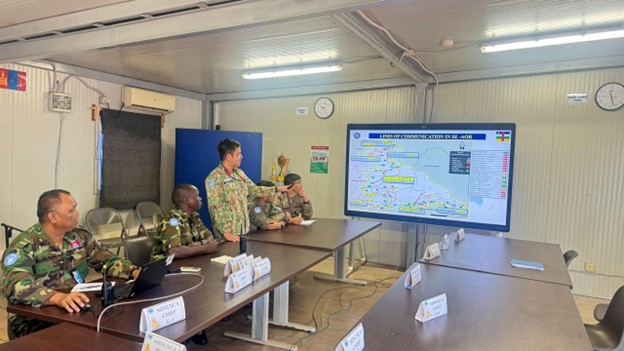 |
Vietnamese peacekeeping intelligence officer and colleagues during a morning briefing. Photo: Hoang Phong
In remote areas like Zemio, rumors of community conflicts, viewed in isolation, may not hold much significance. However, when placed within the broader context of patrol reports, civilian accounts, and armed group movement maps, the risk of conflict becomes clearer. Therefore, intelligence work extends beyond the office.
Officers must directly visit locations, meet residents, engage with local leaders, and coordinate with Nepalese and Cambodian forces to verify information. Often, a brief story from a village chief about people traveling at night or a rice truck leaving town proves more valuable than dozens of pages of reports.
Tensions escalated in december 2025, when the Central African Republic held elections amid significant instability. In the Eastern Sector, ethnic conflicts between Muslim and Christian communities became complex, with clashes causing casualties and forcing many civilians to flee their homes, seeking refuge near United Nations camps.
The intelligence room quickly processed data, analyzed developments, and assigned officers to verify every small piece of information. MINUSCA then deployed forces to hotspots, preventing violence and protecting civilians. As a result, the election proceeded safely, and disruptive plots were detected and addressed early.
During this phase, Captain Tuan directly coordinated with various departments to develop security plans, patrols, and information gathering around areas slated for disarmament events. He was responsible for analyzing armed group movements in the Southeast, assessing risks to civilians and United Nations forces, and closely collaborating with infantry, military observers, and local armies to maintain a continuous flow of information.
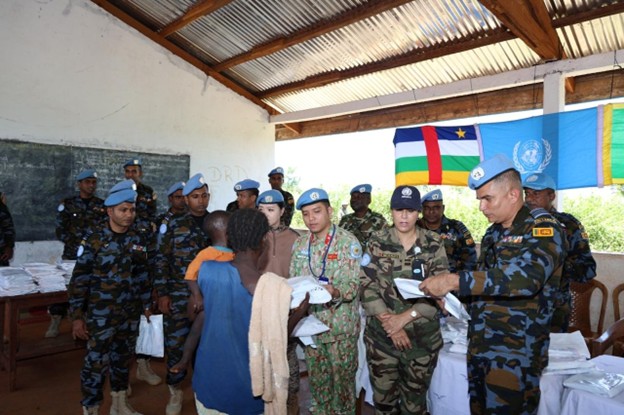 |
Captain Nguyen Anh Tuan participates in humanitarian activities at the Central African Mission. Photo: Hoang Phong
Operating conditions in Central Africa are challenging. Damaged roads and dense forests segment residential areas, making access to sites difficult. Captain Tuan noted that the biggest challenge is the lack of initial information, making trust-building with local residents crucial. Sometimes, a friendly greeting or a conversation on the road can open up more important analytical avenues than an entire dossier.
Within peacekeeping forces, intelligence officers are considered the "second brain." They are where data is collected, filtered, analyzed, and transformed into information used for force coordination, risk assessment, and civilian protection. An accurate report can prevent an attack, while a small inaccuracy can lead to negative developments.
In the Eastern Sector, the emergence of new armed groups, coupled with the risk of abuse of power in remote areas, makes intelligence a continuous task, demanding courage, patience, and multinational coordination. Beyond their professional duties, Vietnamese officers also engage in medical support, education, and community activities. These tasks help them build relationships with local people and create a positive image of Vietnam: disciplined, adaptable, attentive, and ready to cooperate.
On National Day 2025, the MINUSCA Force Commander sent a congratulatory letter to the Vietnamese contingent, acknowledging the intelligence officers' contributions to peace efforts. This recognition is not only personal but also demonstrates Vietnam's clear and growing standing in international peacekeeping operations.
Son Ha - Minh Dang