Cristiano Ronaldo faced disqualification from a 2026 World Cup qualifier against Ireland after an elbow strike to defender Dara O’Shea on 13/11. FIFA's disciplinary regulations categorize this action as "violent," typically incurring a minimum three-match ban. Ronaldo already served one match of this ban, missing Portugal's 9-1 victory over Armenia in their final qualifier. Had FIFA not intervened, he would have been unavailable for the initial two group stage matches of the World Cup.
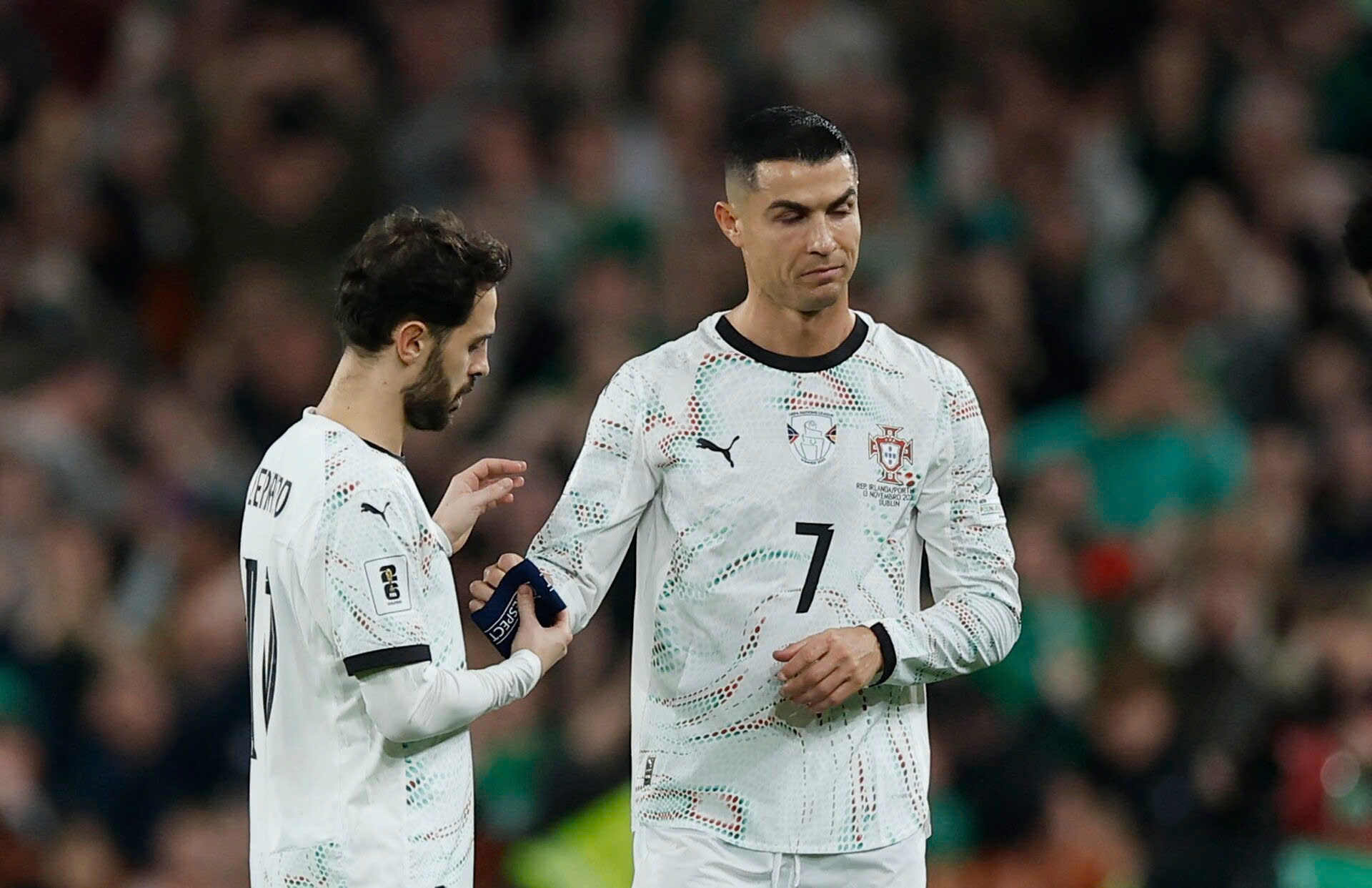 |
Ronaldo (right) leaves the field after receiving a red card during Portugal's loss to Ireland at Aviva Stadium, Dublin, Ireland, in the penultimate match of Group F of the European Qualifiers for the 2026 World Cup on the evening of 13/11. Photo: Reuters |
Ronaldo (right) leaves the field after receiving a red card during Portugal's loss to Ireland at Aviva Stadium, Dublin, Ireland, in the penultimate match of Group F of the European Qualifiers for the 2026 World Cup on the evening of 13/11. Photo: Reuters
The FIFA Disciplinary Committee, however, invoked Article 27 of its Disciplinary Regulations to suspend the remaining portion of Ronaldo's ban. This decision allows him to participate fully in the 2026 World Cup. He will only serve the remaining two-match penalty if he commits a similar offense within the next one year. In effect, the Portugal captain's ban was reduced to a single match.
According to the Daily Mail, national teams drawn into Portugal's 2026 World Cup group might appeal to the Court of Arbitration for Sport (CAS) to review FIFA's decision to reduce Ronaldo's ban. For such an appeal to be considered, these teams must demonstrate direct harm and the need to protect their legal interests. Specifically, they would need to prove that Ronaldo's participation adversely affected them. This would form the basis for CAS to assess whether FIFA overstepped its authority by applying Article 27.
Nevertheless, pursuing this legal avenue presents challenges. FIFA possesses broad authority in disciplinary matters, with Article 27 explicitly permitting the "suspension of all or part of a sanction" if the committee deems it appropriate. For an appeal to succeed, the complaining party would need to demonstrate that FIFA applied the regulation arbitrarily or inconsistently. While penalties for violent conduct are seldom overturned, they remain subject to FIFA's comprehensive discretion.
The circumstances preceding FIFA's announcement of Ronaldo's reduced ban have also sparked controversy. The 40-year-old superstar recently visited the White House as a guest of US President Donald Trump. While no direct evidence links this event to FIFA's decision, such sensitive coincidences can easily cast doubt on the disciplinary body's independence.
FIFA maintains its defense of the decision, asserting that the Disciplinary Committee operates with complete independence from the federation.
Hoang An compiled