Over 64 matches in 2025, Sinner won 713 of 775 service games, achieving a 92% hold rate. The Italian player finished the season with a nearly 3% lead over the second-best server, Taylor Fritz, who recorded 89,18%. This margin highlights the significant progress of Sinner's serve, which played a key role in his ascent.
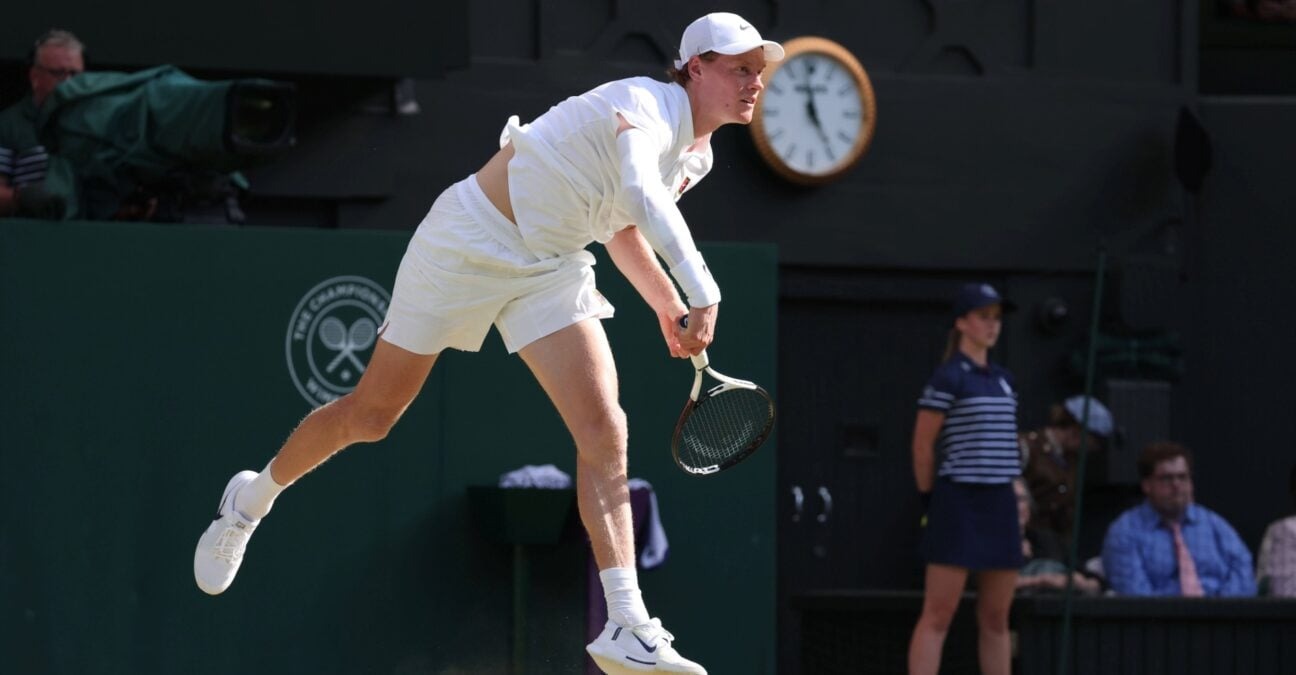 |
Sinner serving at Wimbledon, where he defeated Alcaraz in the 2025 final. Photo: AELTC |
Sinner serving at Wimbledon, where he defeated Alcaraz in the 2025 final. Photo: AELTC
The other players in the top 5 for serve hold rates in 2025 were Giovanni Mpetshi Perricard (88,97%), Novak Djokovic (88,67%), and Reilly Opelka (88,50%). Among these, Mpetshi Perricard and Opelka, both over 2 m tall, are known as "serving machines".
A strong serving foundation also directly supported Sinner's return game ability, as he won 247 of 757 return games (32,63%) in 2025. The world number two player was more than 0,75% ahead of his biggest rival, Carlos Alcaraz. The remaining players in the top 5 for return games won were Alex de Minaur (28,8%), Francisco Cerundolo (28,67%), and Sebastian Baez (28,54%).
Sinner's increase from a 28,30% return game win rate last year to 32,63% this year represents a significant leap. Combined with an increasingly consistent and powerful serve, Sinner now possesses one of the most comprehensive statistical profiles in modern tennis. The 24-year-old's superiority in both aspects helped him secure six titles, including successfully defending his ATP Finals championship on home soil in Turin.
This season, Sinner and Alcaraz were the only two players to alternate at the top of the ATP rankings, a rare occurrence in tennis history. The fact that both are under 25 years old is also uncommon in the statistics of former world number one players since the ranking system began in 1973. Sinner and Alcaraz, aged 24 and 22 respectively, form one of the youngest dominant duos in history.
The last time such a young pair dominated the rankings for an entire year was Roger Federer (23) and Andy Roddick (21) in 2004. Before that, in the 1980s, John McEnroe with Bjorn Borg and Jim Courier formed similar dominant pairs in their early twenties.
A common thread in these seasons is a clear generational transition, where veteran players experienced a decline in form while young talents established their prowess. Borg and McEnroe achieved this in the 1980s, followed by Pete Sampras in the 1990s. In the 2000s, Federer surpassed Sampras and Andre Agassi to reach the pinnacle. This season, Sinner and Alcaraz gave Djokovic no opportunities at the Grand Slams, forming a formidable rival pair that dominated the entire season.
In addition to splitting the four Grand Slams, the duo also met in most major finals, including the ATP Finals. Their race for the world number one spot was only decided in the final week, when Alcaraz won three matches at the ATP Finals to secure the top position, in a tournament where Sinner had to win to defend his points.
 |
Sinner (left) and Alcaraz after the ATP Finals final at Inalpi Arena, Turin, Italy on 16/11. Photo: Reuters |
Sinner (left) and Alcaraz after the ATP Finals final at Inalpi Arena, Turin, Italy on 16/11. Photo: Reuters
In the past, the "Big 3" of Federer, Djokovic, and Rafael Nadal created the most intense rivalry in ATP history, including competing for the world number one position. However, this occurred when they were at the peak of their careers, rarely happening at the current ages of Alcaraz and Sinner.
Federer still holds the record for most consecutive weeks at ATP number one with 237 weeks, from 2004 to 2008. During this period, Nadal was already a major star but often struggled to earn many points on hard courts, while Djokovic was just emerging. Nadal's breakthrough came in 2008 when he defeated Federer himself in the Wimbledon final, officially contending for world number one. By 2011, Djokovic took over this position at 24 years old, ushering in his own era. But the persistent rivalry of the "Big 3" continued for decades thereafter.
Currently, the high-level confrontations and superior quality between Sinner and Alcaraz signal a key change in world tennis. If the rest of the players cannot improve, they will have no chance to compete for major titles and enter the ATP number one race dominated by Sinner and Alcaraz.
Vy Anh