Across 18 Asian Cup tournaments, Southeast Asia has twice had four national teams participate. The first instance was in 2007, when Vietnam, Thailand, Indonesia, and Malaysia co-hosted. These four teams then reunited at Qatar 2023.
For the final round in Saudi Arabia in 2027, Indonesia secured the first ticket by qualifying for the third round of the 2026 World Cup qualifiers – Asian zone. Meanwhile, Singapore surprised many by claiming the second spot, marking their first appearance in 43 years since hosting the 1984 tournament.
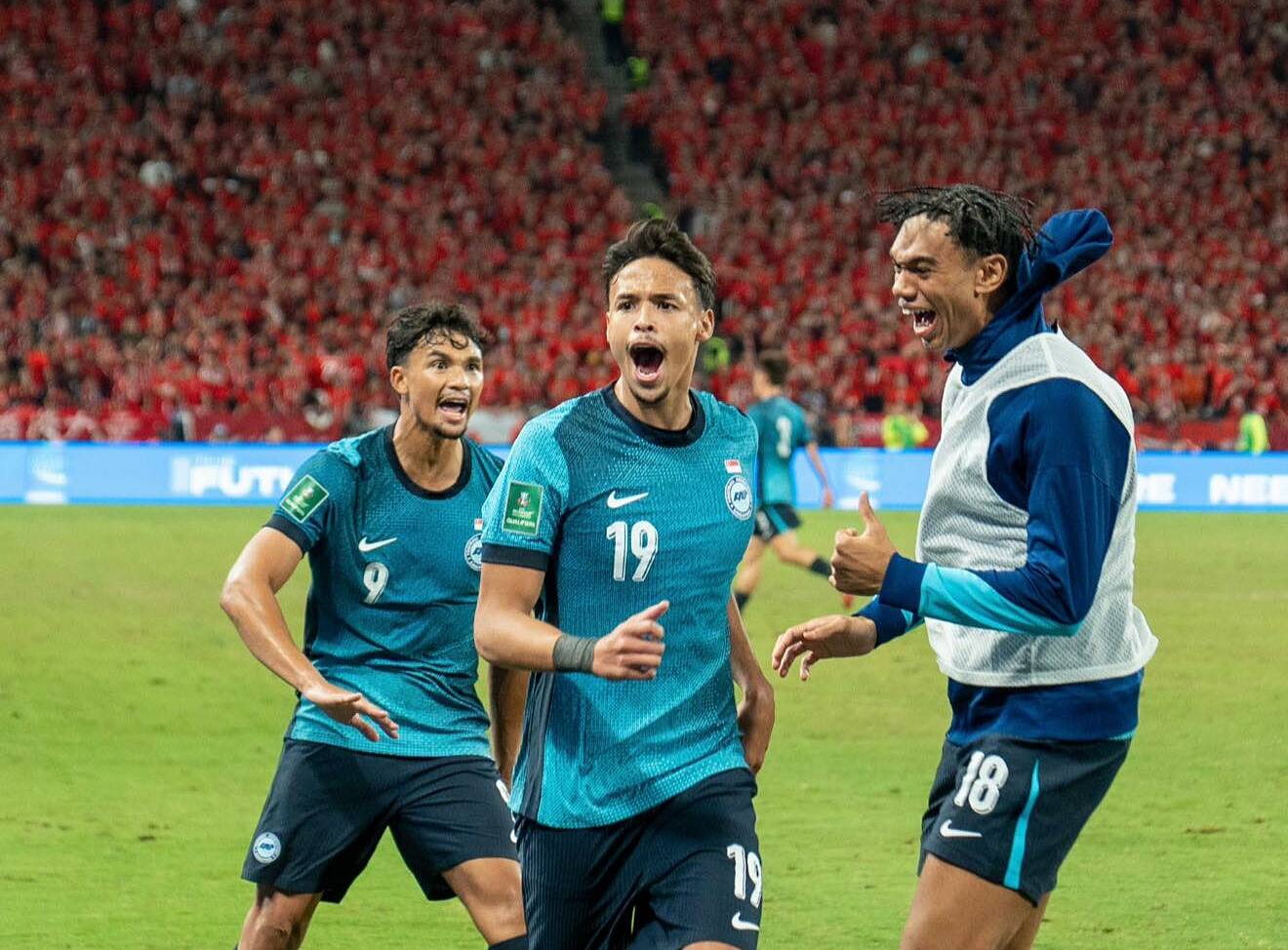 |
Singapore striker Ilhan Fandi (number 19) celebrates scoring the winning goal against Hong Kong in a 2-1 victory during matchday five of Group C in the final round of Asian Cup 2027 qualifiers, at Kai Tak Stadium, Hong Kong on 18/11. Photo: FAS. |
Singapore's achievement is historic, yet it also involved some luck in Group C of the final qualifying round. They were only a third seed, but they faced top seed India, who have been in a steep decline. After five matches, the South Asian representative remains winless, having recently lost 0-1 to neighboring Bangladesh, a team 47 places lower in the FIFA rankings.
Hong Kong was Singapore's most formidable opponent. However, under interim coach Gavin Lee, the Southeast Asian representative staged a comeback to win 2-1 on their opponent's home ground yesterday, 18/11. Singapore now has 11 points, three points more than Hong Kong and a superior head-to-head record, securing their Asian Cup spot one matchday early.
Southeast Asia will certainly have one more representative in the Asian Cup as Vietnam and Malaysia compete in Group F. Malaysia leads with 15 points, six points ahead of Vietnam, but has played one more match. If Vietnam defeats Laos tonight, 19/11, the two teams will face off in a decisive final match on Vietnam's home ground on 31/3/2026.
The final qualifying round uses head-to-head records as a tie-breaker after points. Therefore, Vietnam must win by a five-goal margin against Malaysia to claim the top spot, having lost 0-4 in the first leg. However, coach Kim Sang-sik's team could secure an early qualification if Malaysia's appeal against FIFA's allegations of fraud involving 7 naturalized players is unsuccessful. In that scenario, Malaysia would be handed 0-3 losses in their two victories against Nepal and Vietnam for using ineligible players.
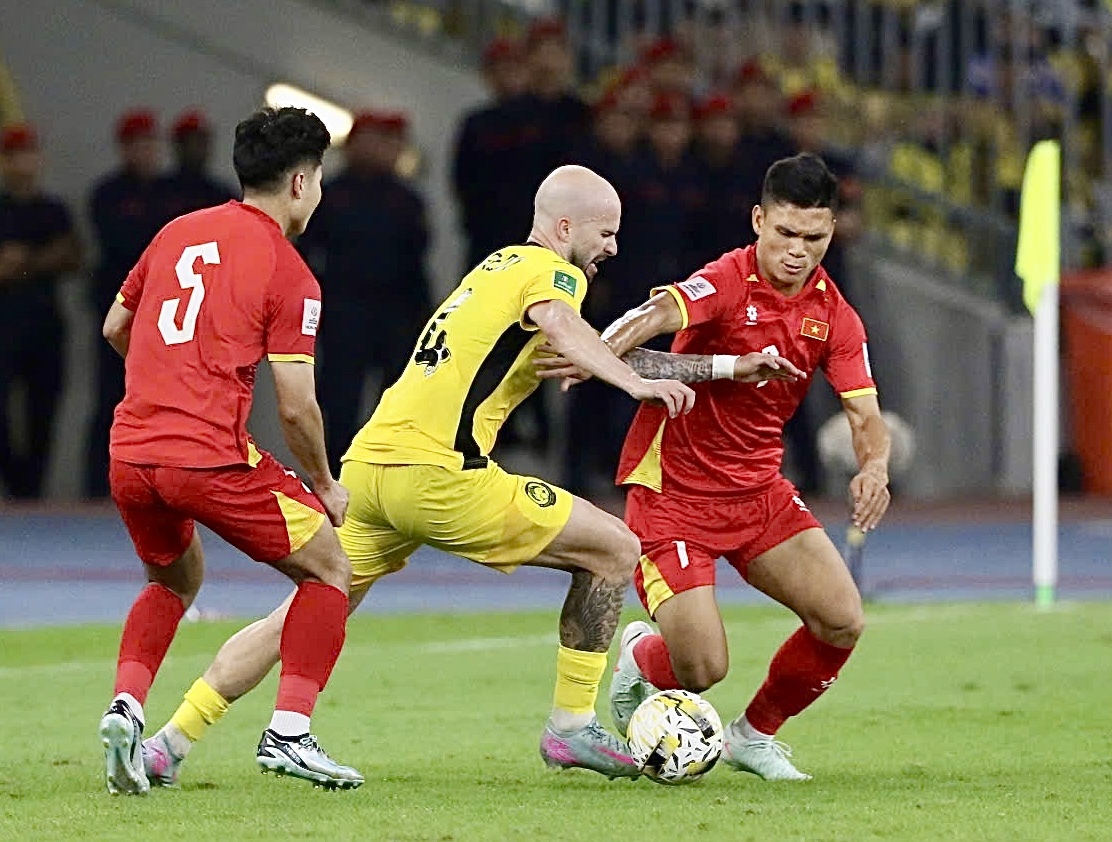 |
The Vietnam national team (in red) lost 0-4 to Malaysia during matchday two of Group F in the final round of Asian Cup 2027 qualifiers, at Bukit Jalil Stadium, Malaysia on 10/6. Photo: Hai Tu. |
The remaining two Southeast Asian national teams with a chance to qualify for the Asian Cup 2027 are the Philippines (Group A) and Thailand (Group D). Meanwhile, Cambodia was eliminated in the play-off round. Myanmar, Brunei, Laos, and Timor Leste were eliminated early in the final qualifying round.
Before matchday five, the Philippines were leading, but their narrow 2-0 victory over Maldives caused them to drop in the standings due to an inferior goal difference to Tajikistan (+10 compared to +11). Consequently, the team must win on Tajikistan's home ground in the final match. In the first leg, the two teams drew 2-2.
Thailand also faces a crucial final match and must defeat Turkmenistan. However, they have the advantage of playing at home and are considered stronger than their opponent. In the first leg, Thailand lost 1-3 to Turkmenistan, disadvantaged by playing on an artificial turf pitch.
Group B of the final qualifying round will also feature a decisive match for a spot in the final round, between Lebanon and Yemen.
The Asian Cup 2027 will take place from 7/1 to 5/2/2027. 19 national teams will participate alongside host Saudi Arabia, including: Australia, Indonesia, Singapore from the Southeast Asian Football Federation, Iraq, Iran, Qatar, UAE, Oman, Palestine, Bahrain, Jordan, Kuwait, Syria (West Asia), Uzbekistan, Kyrgyzstan (Central Asia), Japan, South Korea, China, North Korea (East Asia).
Japan holds the record for the most Asian Cup titles, with four victories in 1992, 2000, 2004, and 2011. Following them are Saudi Arabia (1984, 1988, 1996), Iran (1968, 1972, 1976), South Korea (1956, 1960), Qatar (2019, 2023), Israel (1964), Kuwait (1980), Iraq (2007), and Australia (2015).
Hieu Luong