On 20/11, the United States Federal Bureau of Investigation (FBI) issued a request for information to companies capable of manufacturing fiber optic controlled drones, while also seeking to purchase more radio-controlled drones. The FBI declined to comment on the specific uses for these drones, stating only that it employs drones in various situational responses.
This request comes as drug cartels increasingly use drones and anti-drone technology. Howard Altman, an editor at the US military specialized publication War Zone, suggests the FBI may be investigating suspects, criminal organizations, or extremist groups equipped with anti-drone devices, necessitating the acquisition of fiber optic connected vehicles. Stefano Ritondale, an expert on Latin American drug cartels, noted that anti-drone technology poses a growing challenge for law enforcement. "Anti-drone activity is increasing," he said, adding that "US drones are not the main target of cartels, but rather rivals' equipment."
Fiber optic drones are particularly noteworthy due to their ability to transmit stable, high-quality signals and images, even when operating close to the ground or in areas with many obstacles. This connectivity also makes them immune to electronic countermeasures, which significantly limit the operational capabilities of radio-controlled drones.
While offering superior signal integrity, fiber optic drones have drawbacks. They typically fly slower and require more power than radio-controlled types due to the heavier load of the cable. The fiber optic cable also carries the risk of tangling or breaking.
Drones are increasingly vital for law enforcement agencies worldwide. In the United States, law enforcement commonly uses drones for intelligence gathering before and during operations, to pinpoint suspect locations, and for reconnaissance of structures requiring entry. This capability is particularly crucial for special weapons and tactics (SWAT) teams handling complex, high-risk situations. Altman also theorizes that the agency might test and train with fiber optic drones to understand how to counter them in the field, rather than intending to purchase lethal drones.
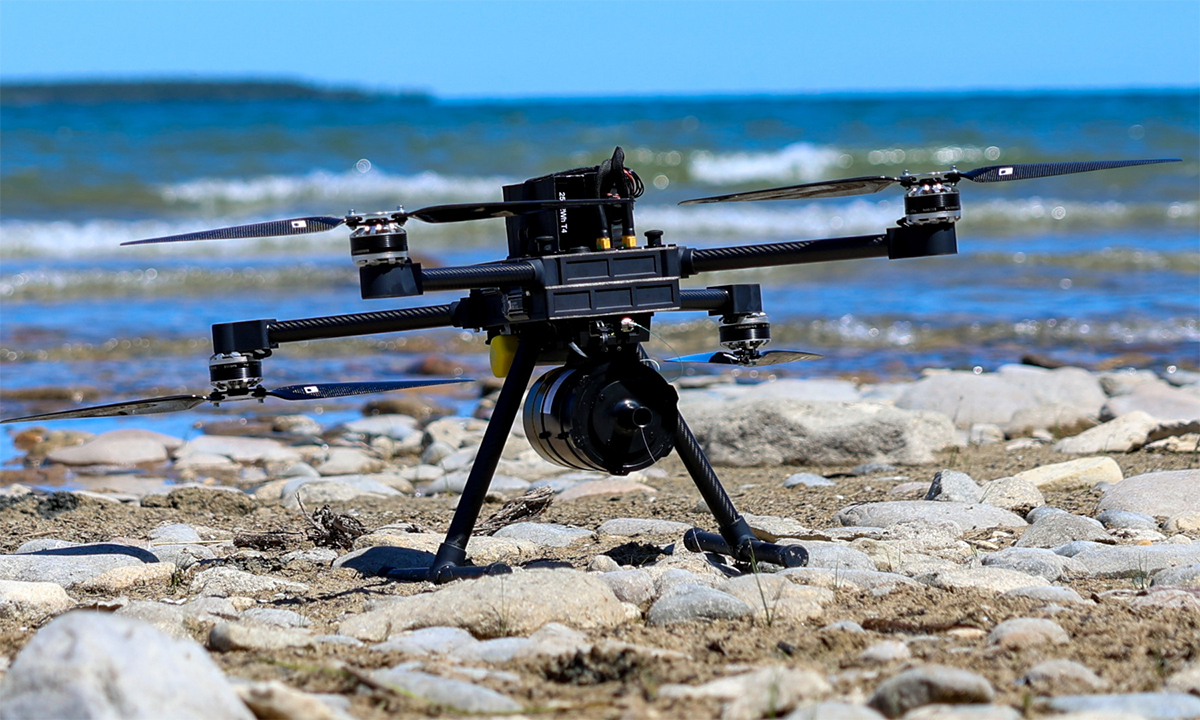 |
A fiber optic drone during a US National Guard exercise in Michigan on 21/7. Photo: USAF |
The Russian military has been a pioneer in using fiber optic drones in real-world scenarios, employing them to enhance accuracy and lethality in the Ukraine conflict.