On 25/11, US President Donald Trump reportedly urged Japanese prime minister Sanae Takaichi to avoid further provoking China during a phone call, according to unnamed sources familiar with the matter cited by Reuters.
A source indicated that Trump, aiming to preserve a fragile trade truce with China, did not issue any specific demands to Takaichi on the matter.
The Wall Street Journal also previously reported that the US president advised the Japanese prime minister to "lower the tone" with Beijing concerning Taiwan. The newspaper noted that Trump did not pressure Takaichi to retract her statement.
Japanese officials found the message "very concerning", the WSJ added. The publication explained that President Trump aimed to prevent Taiwan-related tensions from jeopardizing a trade agreement reached last month with Xi Jinping, under which China pledged to increase purchases of US agricultural products, a sector significantly impacted by the trade war.
When questioned about these reports, the Office of the Japanese Prime Minister referenced a statement on the phone call between Takaichi and Trump, which confirmed discussions on US-China relations but offered no specific details.
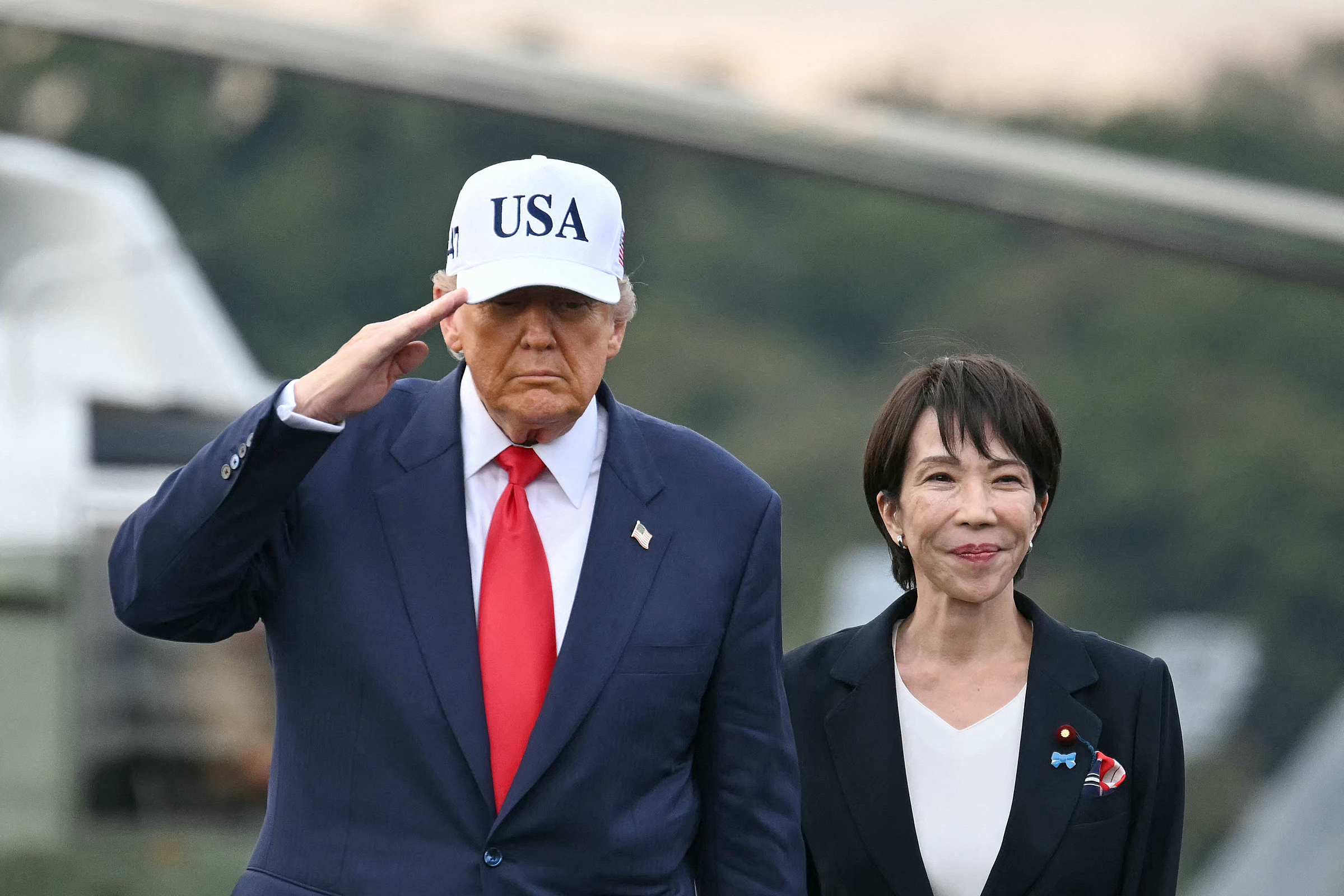 |
US President Donald Trump (left) and Japanese prime minister Sanae Takaichi on the aircraft carrier George Washington in Yokosuka on 28/10. *Photo: AFP* |
China and Japan are currently navigating their most severe diplomatic crisis in years. This follows prime minister Takaichi's statement that, should Taiwan face an attack, Tokyo might deploy self-defense forces if the conflict posed an existential threat to Japan. Taiwan is situated 100 km from Japan's nearest island.
China retaliated by demanding Takaichi retract her statement, imposing a seafood ban, halting the release of Japanese films, and issuing travel warnings to its citizens.
During a phone call between Trump and Xi Jinping this week, the Chinese president asserted that "Taiwan's return to China" forms a crucial part of Beijing's global order vision. Taiwanese officials subsequently responded that returning to China "is not the choice of the 23 million people" on the island.
An editorial published in the People's Daily, the official newspaper of the Communist Party of China, on 27/11, saw Beijing urge Washington to restrain Tokyo, aiming to prevent "actions reviving militarism".
China consistently regards Taiwan as an inalienable part of its territory, ready to employ all measures for unification. Chinese leaders have repeatedly stated that they do not rule out the use of force to reclaim the island, though their general policy favors dialogue and peaceful unification.
The US commits to the "one China" principle while maintaining relations with Taiwan and supplying the island with modern weaponry. The Taiwan Relations Act, signed by former President Jimmy Carter after Washington established diplomatic ties with Beijing in 1979, mandates US support for Taiwan's defense capabilities.
By Huyen Le (AFP, Reuters, WSJ)