Reuters reported earlier this week, citing US officials, that the F-35 fighter jets the US agreed to sell Saudi Arabia would not include advanced features found on Israel's F-35I variant, such as advanced weapon systems and electronic warfare capabilities. This decision stems from the need to avoid violating commitments to Israel under the Qualitative Military Edge (QME) agreement, which restricts Washington from transferring certain advanced weapons to Middle Eastern nations.
Despite this, the Israeli air force continues to oppose the US sale of F-35 fighter jets to Saudi Arabia. It has also warned its political leadership that the deal could compromise Israel's air superiority in the region.
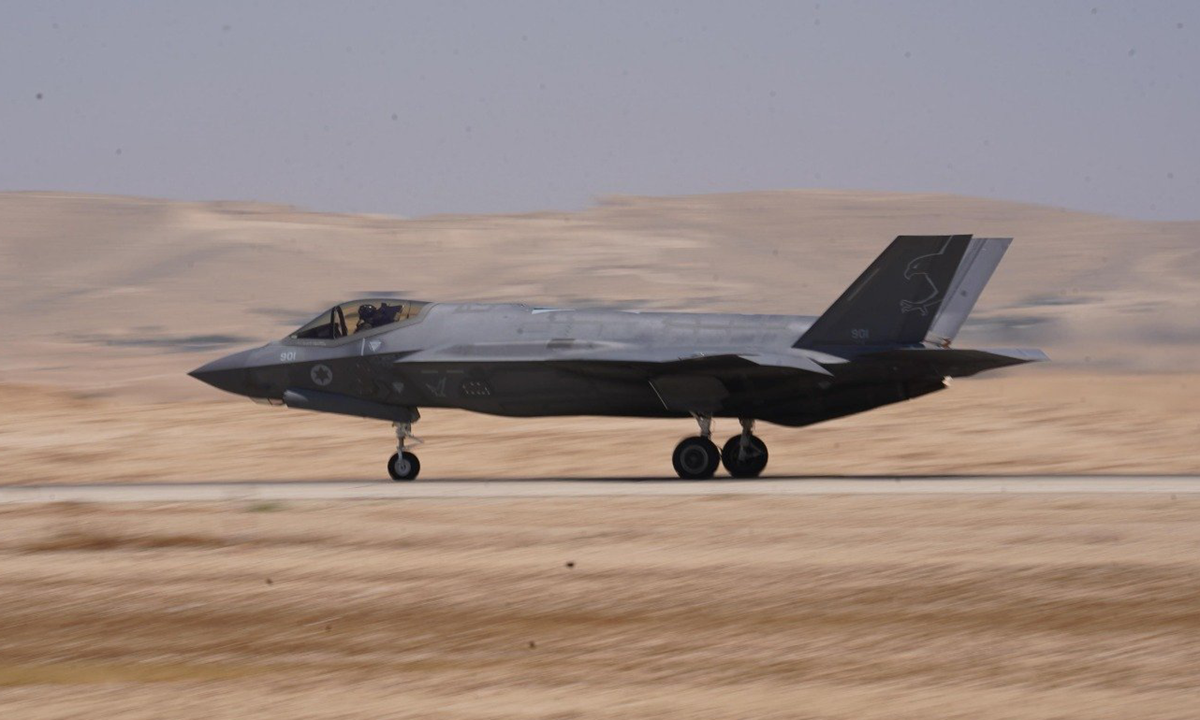 |
An Israeli F-35I fighter jet takes off for a strike in Iran in June. *Photo: IDF* |
Restrictions on the F-35 sale to Saudi Arabia would extend beyond weapons and equipment. The US could also provide Riyadh with a variant less capable than Israel's through software customization. Each F-35 fighter jet is custom-configured for its operating nation, with the US retaining the most advanced version and offering less modern models to other countries. Douglas Birkey, executive director of the US-based Mitchell Institute for Aerospace Studies, suggested that Saudi Arabia is unlikely to receive AIM-260 air-to-air missiles, a new generation weapon currently under development by the US for stealth aircraft. With a range of about 200 km, the AIM-260 represents one of the most sensitive technologies associated with the F-35 fighter jet, and Israel is likely to be prioritized for its purchase.
Israel already possesses significant advantages beyond potential feature limitations on Saudi Arabia's F-35s. Israel plans to acquire approximately 100 F-35I aircraft, while Saudi Arabia, by contrast, appears limited to purchasing no more than 48 jets and faces a multi-year wait for delivery. Furthermore, Israel has operated F-35 fighter jets for around eight years, accumulating significant operational experience compared to Saudi Arabia, which has yet to receive the aircraft.
US officials stated that a QME assessment must be completed before finalizing any deal to sell F-35 fighter jets to Saudi Arabia. One official noted that significant support for Israel within the US Congress could impede this deal, as all foreign arms sales contracts require congressional approval. However, to override a presidential veto on such an agreement, Congress would need to secure two-thirds of the votes in both chambers, a threshold considered difficult to meet.
Should the deal be approved, Saudi Arabia would become the first Arab nation and the second country in the Middle East to operate the F-35 fleet. US and Saudi Arabian officials have not yet commented on this information.
Pham Giang (According to Reuters)