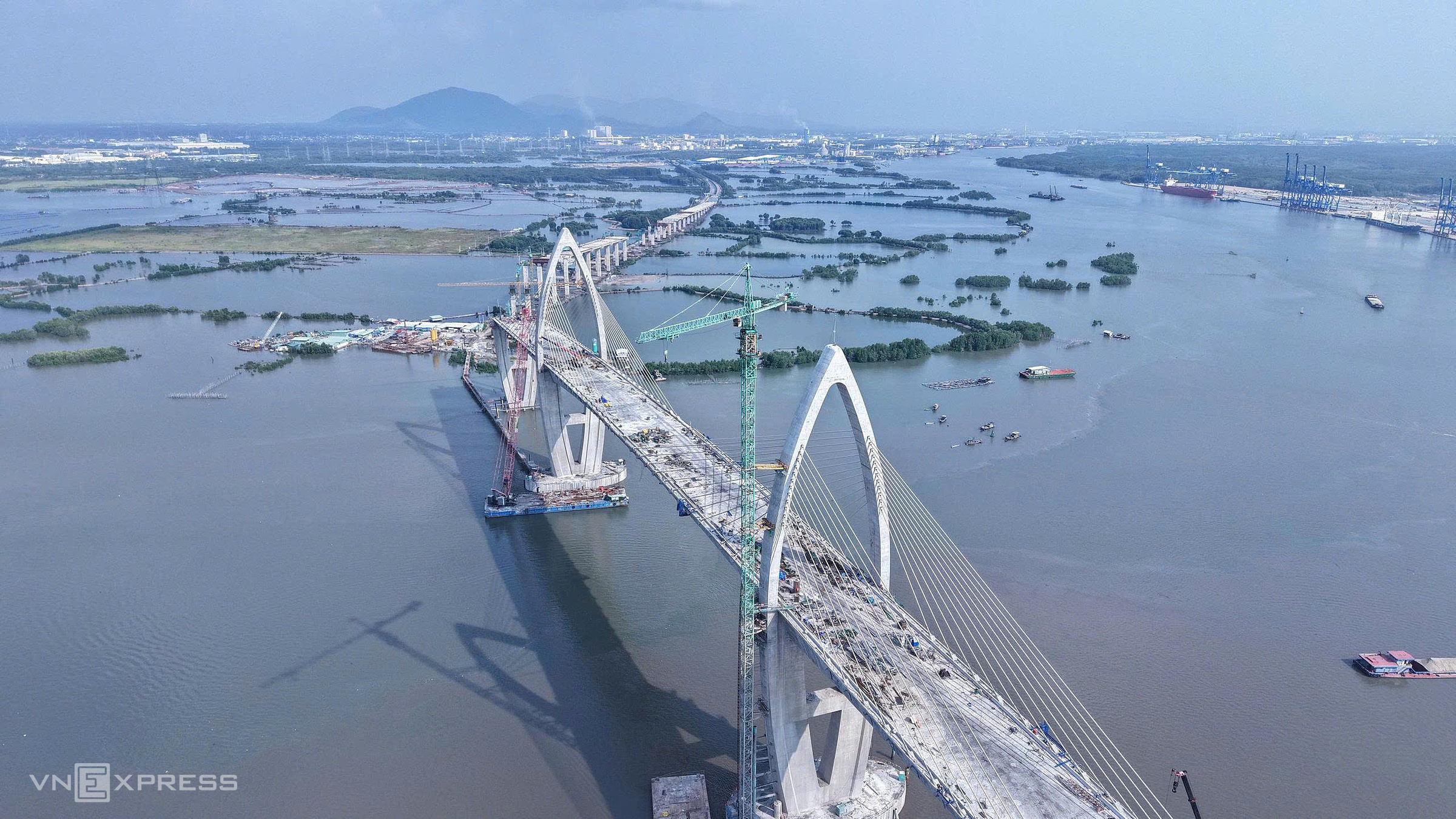
According to a report by the City People's Committee, Hai Phong's economic indicators reached high levels in the first 9 months. Gross Regional Domestic Product (GRDP) increased by almost 12%, the industrial production index rose by 15%, exports reached nearly 44 billion USD, and foreign direct investment (FDI) attraction surpassed 3,6 billion USD. The city's total budget revenue recorded over 162 trillion VND.
However, the business landscape revealed a discrepancy. At a meeting to gather feedback from city enterprises, organized by the Hai Phong People's Committee on the morning of 13/10, Mr. Tran Van Thang, Chairman of the Hai Phong Business Association, posed the question: "Why are growth indicators so good, yet businesses still face difficulties?"
According to Mr. Thang, on one side are large enterprises, FDI enterprises, export industries, and seaports "running very fast", while on the other side, mostly small and medium-sized enterprises, are slowing down, with some even shrinking.
 |
Business import-export activities contribute about 50% of Hai Phong City's budget revenue. *Photo: Le Tan* |
Data from the first 6 months in Hai Phong shows approximately 5,100 new businesses established, but concurrently, nearly 3,600 businesses temporarily suspended operations and about 3,000 businesses ceased tax operations. "For every ten businesses established, nearly thirteen either temporarily suspend or cease operations", Mr. Thang cited.
A representative from the Hai Phong Business Association stated that the primary reasons hindering the competitiveness of small and medium-sized enterprises are financial burdens and input costs. According to him: loan interest rates at times fluctuated from 10% to 15% per year, disrupting cash flow; diesel prices sometimes exceeded 30,000 VND per liter, creating pressure on transport and logistics businesses; and land price tables and land price adjustment coefficients increased much faster than what production and business could bear.
Additionally, the legal system changes frequently and rapidly. Some changes offer significant opportunities, such as Resolution 68 on private economy, specific mechanisms for Hai Phong, and the Free Trade Zone, but there are also tightening regulations. Many businesses haven't even had time to understand old regulations before having to comply with new ones, not to mention inspections.
"To be frank, legitimate businesses are not afraid of inspections", he shared. "Businesses only fear two things. One is not knowing how long or how many times they will be inspected. The second is not knowing the boundary between an administrative error and a criminal violation. When this boundary is unclear, people choose the safest approach: not daring to act. And if they don't dare to act, there will be no growth."
Mr. Vu Van Tu, representative of HPTECH and SMV, a precision mechanics business, expressed a desire for local businesses to have opportunities to access orders, meet standards, and possess the resources to fulfill those orders.
According to him, when small and medium-sized enterprises develop based on their true capabilities, the city will gain more suppliers. He proposed that the city appoint a focal unit to connect with FDI and large manufacturing enterprises, gradually forming a list of purchasing needs they agree to share. This information could be categorized into groups such as: mechanical parts, fixtures, molds, technical plastic products, surface treatment, and assembly clusters.
Additionally, Mr. Tu proposed that local businesses should be able to submit capability profiles, receive sample requests, be evaluated, and clearly understand what needs improvement. The program's effectiveness should be measured by the number of samples tested, approved suppliers, and actual orders.
Meanwhile, Mr. Nguyen Ngoc Anh, Deputy General Director of HTM Investment Group Joint Stock Company, reported delays in site clearance compensation, along with prolonged investment, land, construction, environmental, and fire prevention and fighting procedures across multiple levels. HTM proposed that the city establish a "working group to support investment projects in industrial clusters".
Mr. Hoang Manh The, General Director of Hang Kenh Corporation, argued that the key to further promoting and improving the investment environment is to enhance the quality of professional staff from ward and commune levels to departments and agencies, ensuring they are professional, skilled, knowledgeable about legal regulations, and possess dedication and vision. Mr. The proposed that authorities process procedures in parallel instead of sequentially to shorten project preparation times.
Sharing with the business community, Mr. Le Ngoc Chau, Secretary of the Hai Phong Party Committee, stated that state-owned enterprises, private enterprises, and foreign-invested enterprises each have their own position, role, and strengths, but all are important components of the economy, contributing to the rapid and sustainable development of the city and the country.
Acknowledging businesses' feedback, Mr. Chau requested that all levels of government strongly shift from a management mindset to one of creation and service, using business satisfaction as a measure of administrative effectiveness.
 |
Secretary of the Hai Phong Party Committee shared with the business community, morning of 13/10. *Photo: Le Tan* |
According to him, the city will research and propose a fully authorized investment promotion focal point to support businesses throughout the entire process, from surveys to resolving land, construction, environmental, and fire prevention and fighting procedures, to expedite project operations. Concurrently, planning must have a long-term vision, using it as a tool to guide new development areas such as: the Southern Coastal Economic Zone, specialized economic zones, and the Free Trade Zone.
Regarding the business community, the Party Committee Secretary urged FDI corporations to strengthen connections, creating conditions for domestic businesses to participate in supply chains; and for domestic businesses to proactively innovate technology and improve management capabilities to standardize products according to international standards.
With the motto "harmonized benefits, shared risks", the Party Committee Secretary assigned the Department of Finance to compile and advise on definitively addressing businesses' requests, clearly outlining responsibilities and completion deadlines.
Le Tan