The Massachusetts Institute of Technology’s (MIT) Computer Science and Artificial Intelligence Laboratory (CSAIL) launched MathNet on 21/4. This archive, featuring international math practice problems, is currently the world's largest dataset of its kind, five times larger than comparable repositories.
MathNet covers 143 exams from 47 countries and territories, utilizing 17 languages, spanning approximately 40 years. The archive includes 259 exam problems from Vietnam.
Shaden Alshammari, a doctoral student at MIT and the lead author, stated, "Each country possesses a collection of creative and unique math problems. However, no one had previously attempted to collect, clean, and digitize them for widespread sharing."
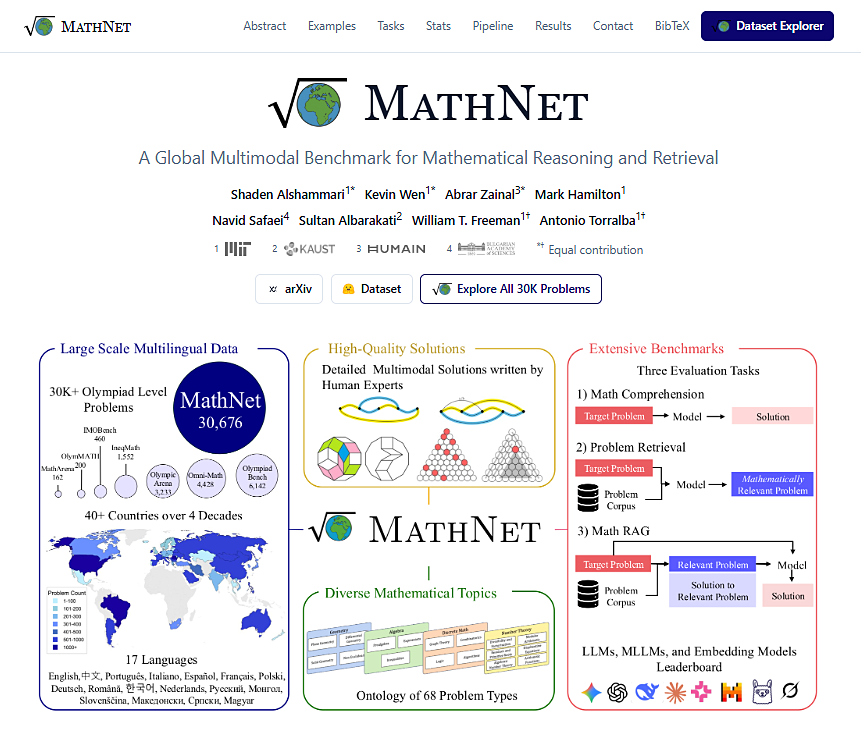 |
MathNet website interface. Photo: Khanh Linh |
MathNet website interface. Photo: Khanh Linh
To build MathNet, the research team had to track down nearly 1,600 PDF files, totaling over 25,000 pages of documents, including old scans from decades ago.
A significant portion came from Navid Safaei, a veteran of the International Math Olympiad (IMO) community. Since 2006, Safaei has diligently collected and scanned competition documents, forming the backbone of this extensive dataset.
Unlike online math forums that often provide brief or unofficial solutions, MathNet's problems are extracted from official national exam materials. Each solution is written and thoroughly vetted by experts, often spanning multiple pages and presenting various approaches.
MathNet also serves as a benchmark for artificial intelligence (AI) capabilities. While current large language models are promoted as being able to solve IMO gold medal-level math problems, test results on MathNet indicate a more complex reality.
Even GPT-5, the most powerful model tested, achieved an average accuracy of only 69.3% on 6,400 problems. This means AI still struggles with nearly one-third of the Math Olympiad problems. Notably, AI performance significantly declines for problems involving diagrams or less common languages like Mongolian.
Sultan Albarakati, a co-author and IMO board member, stated that the research team mobilized over 30 experts from various countries, including Russia, Poland, and Vietnam, to verify thousands of solutions.
"We hope this will be a cornerstone, helping all students access the world's highest quality math problems and solutions," Alshammari shared.
Khanh Linh