Le Minh Quoc's new book compiles over 60 articles exploring the Vietnamese language found in folk songs, proverbs, and Southern dialects. It also addresses intricate expressions common in daily Vietnamese communication.
The publication consists of three parts: Speaking with Books, Showing with Evidence; Some Southern Vietnamese Words; and Intricate Stories. The author opens the book by highlighting a paradox: even Vietnamese people may not fully grasp the beauty of their mother tongue. He prompts readers to consider why specific words are used in particular contexts and why certain expressions best convey thoughts and feelings.
In the first part, the author guides readers through familiar words, proverbs, idioms, and folk songs such as: "cap ke", "cua chien", "lien anh lien chi", "an noi co thep", "co bac la bac thang ban", "giay rach giu lay le", "bot dong thi bot cu lao", "lam tho giay trang, em gan con co xanh". He also discusses the correct spelling of commonly confused phrases like "tai vach mach dung/rung" and "thuoc dang da tat".
Beyond linguistic analysis, the poet delves into historical and cultural narratives. Through the saying "giay rach giu lay le" (a tattered piece of paper still keeps its edge, meaning even in hardship, one must maintain dignity), readers gain insight into the nation's traditional papermaking craft, learning about Yen Thai village, Cau Giay, and Nguyen Tuan's work "Xac Ngoc Lam".
In the next section, Le Minh Quoc analyzes Southern dialects, exploring the meaning of words and phrases like: "do mam", "lo noi", "tam hoanh", "vi dau", "giong". For each term, the author places it within the historical and daily life context of the ancient Southern region, helping readers understand the culture and lifestyle of the people at that time. For example, regarding "tam hoanh", he suggests it might derive from a real person—Mr. Tam Hoanh—whose name became integrated into daily speech, linking this to other examples of this Vietnamese custom.
Moving to the third part, the poet discusses Vietnamese words that are both strange and familiar, such as: "ca ke", "cha ba lua", "con cop", and wordplay like "ngum cu toi". For instance, when discussing "con cop" (tiger) in folk songs, the author explores folk beliefs about the Year of the Tiger, and names like "Ong Ca Um" and "Ong Ba Muoi" which reflect the ancient people's reverence for tigers during their exploration of nature.
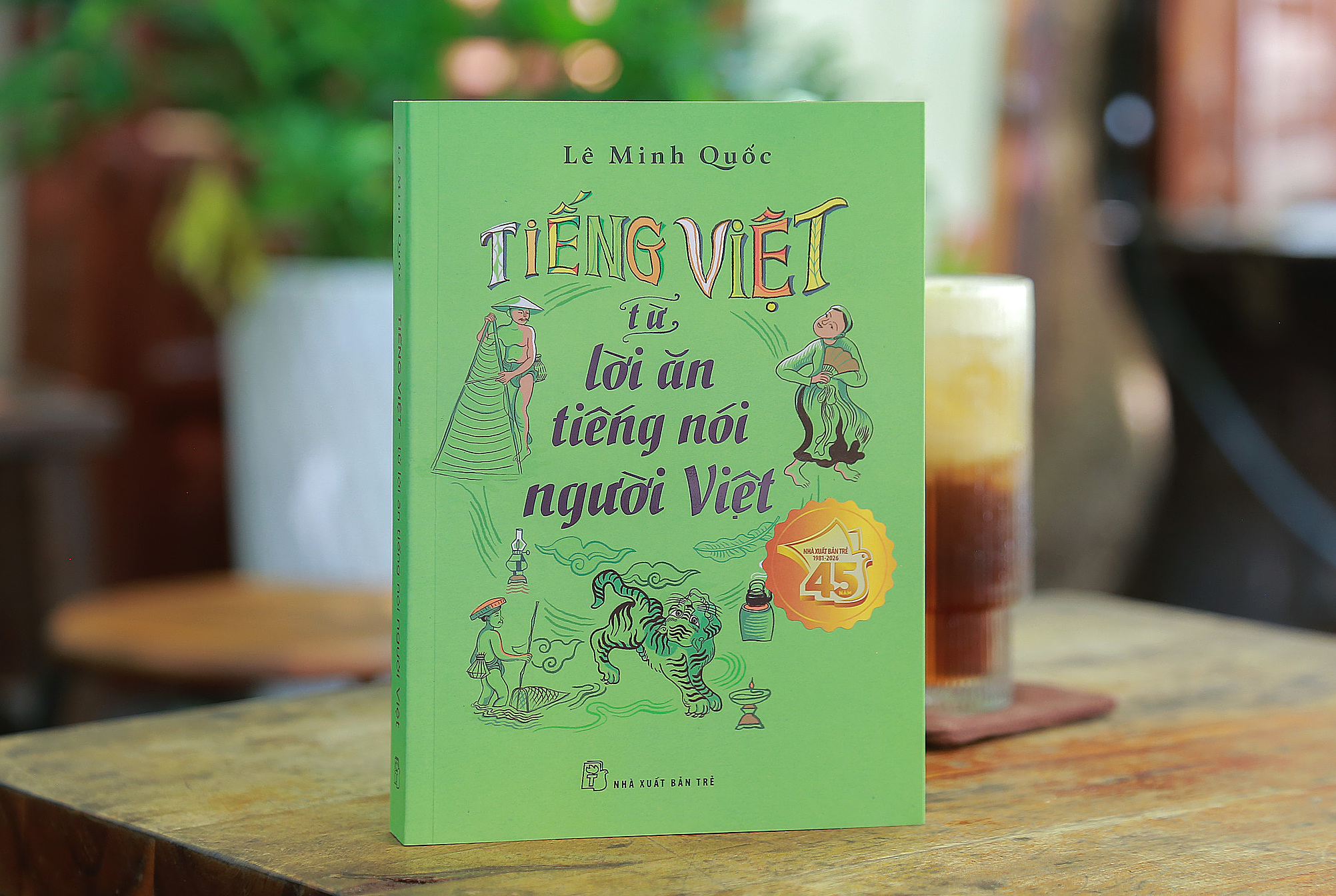 |
The book was released by Tre Publishing House on 3/7. *Photo: Publisher provided*
To complete the work, author Le Minh Quoc consulted about 50 different dictionaries and research books. These included: common Vietnamese dictionaries, ancient Vietnamese dictionaries, regional dictionaries (Northern, Central, Southern, and specific areas), spelling dictionaries, proverbs, idioms, folk songs, slang, and professional dictionaries. Additionally, he utilized extensive linguistic data from folk songs, proverbs, Truyen Kieu, and ancient and modern Vietnamese literature.
The author writes: "Through historical ups and downs, the Vietnamese language itself has changed; some words have faded in meaning over the years, now we read or hear them but no longer grasp their clear meaning. Other words have not 'stood still' and are now understood differently. And like all global languages, the Vietnamese vocabulary will continue to 'grow' over time, becoming even richer...". He asserts, "to understand Vietnamese, Vietnamese people themselves must keep learning, keep studying", viewing the preservation of the mother tongue as a shared responsibility.
Le Minh Quoc, a 67-year-old poet and journalist born in Da Nang, is Chairman of the Poetry Council of Ho Chi Minh City Writers' Association for the 2020-2025 term. He has authored over 50 books across various genres, including: poetry, novels, essays, and research. Some of his works published by Tre Publishing House include the poetry collections "Ngay mai con lai mot minh toi" (1990) and "Toi chay theo tho" (2003), the novel "Bach Thai Buoi - Khang dinh doanh tai nuoc Viet" (2007), and research works "Nguoi Quang Nam" (2007), "Nguoi Ben Tre" (2020), "Lat leo tieng Viet" (2017), and "Tieng Viet - Lat leo va lich lam" (2024).