Japanese author Rie Kudan shared her experience using artificial intelligence (AI) in writing at a reader event on 30/11, part of a series organized by San Ho Books and the Japan Cultural Exchange Center in Vietnam. Kudan stated that after two years of applying this technology, she considers herself an "AI expert."
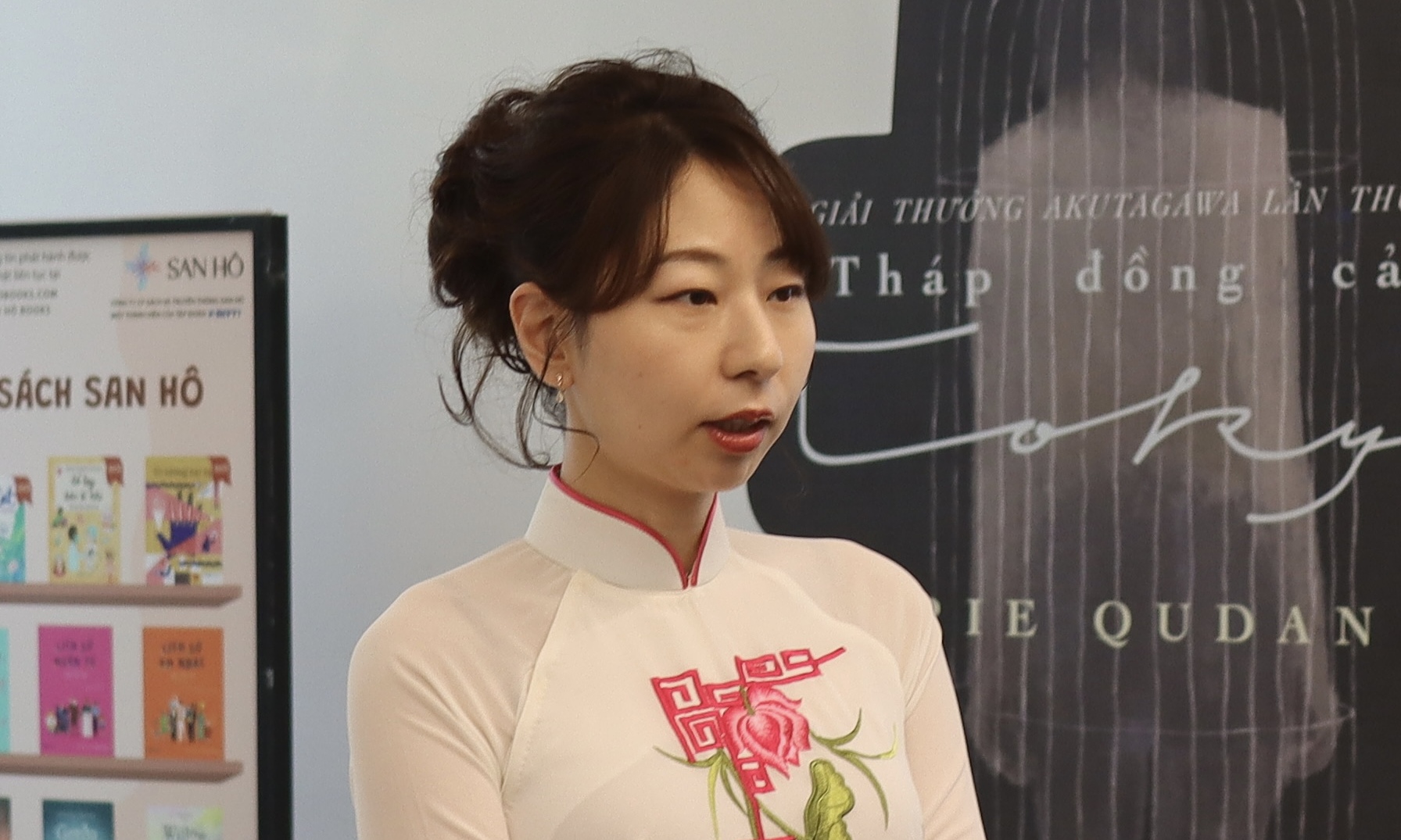 |
Rie Kudan at the event on 30/11. Photo: Organizers
Rie Kudan gained prominence with her work *Tokyo Empathy Tower*, which won the 170th Akutagawa Prize in 2024. The Vietnamese version was released in mid-October. This novel is considered one of the most controversial in the prize's history, as 5% of its text was written by ChatGPT. Kudan explained that she only used AI for the dialogue sections where the main character interacts with ChatGPT to resolve conflicts.
Following the attention garnered by *Tokyo Empathy Tower*, an advertising company proposed she create another work, with 95% of its content completed by AI. This book, titled *Cloud Shadow Rain*, was published in Japan in 2024. The story's content and plot were AI-generated, while Kudan reviewed, directed, and edited the beginning and end, also contributing the remaining 5% of the content. The creation process lasted about two weeks. "I collaborated with AI to produce a 20,000-word work, which I then edited into a 4,000-word short story," the author stated, adding, "I disclosed any sections written by AI on social media."
Kudan described the creation process as a collaboration between the writer and the AI tool, noting that AI sometimes produced unsatisfactory results. After the project concluded, she and her team determined that artificial intelligence offers advantages in terms of time and energy, as it can operate 24/24 without exhaustion. Users also have the right to demand answers from AI until they are satisfied.
However, Kudan believes that artificial intelligence cannot yet surpass humans in creative fields, as it lacks intrinsic desires. "The essence of AI's answers is a distillation from humanity's knowledge bases," the author explained. "Therefore, when we interact with artificial intelligence, we see a reflection of humanity within it. We write driven by a creative urge, whereas artificial intelligence only writes when requested, lacking desire and emotion."
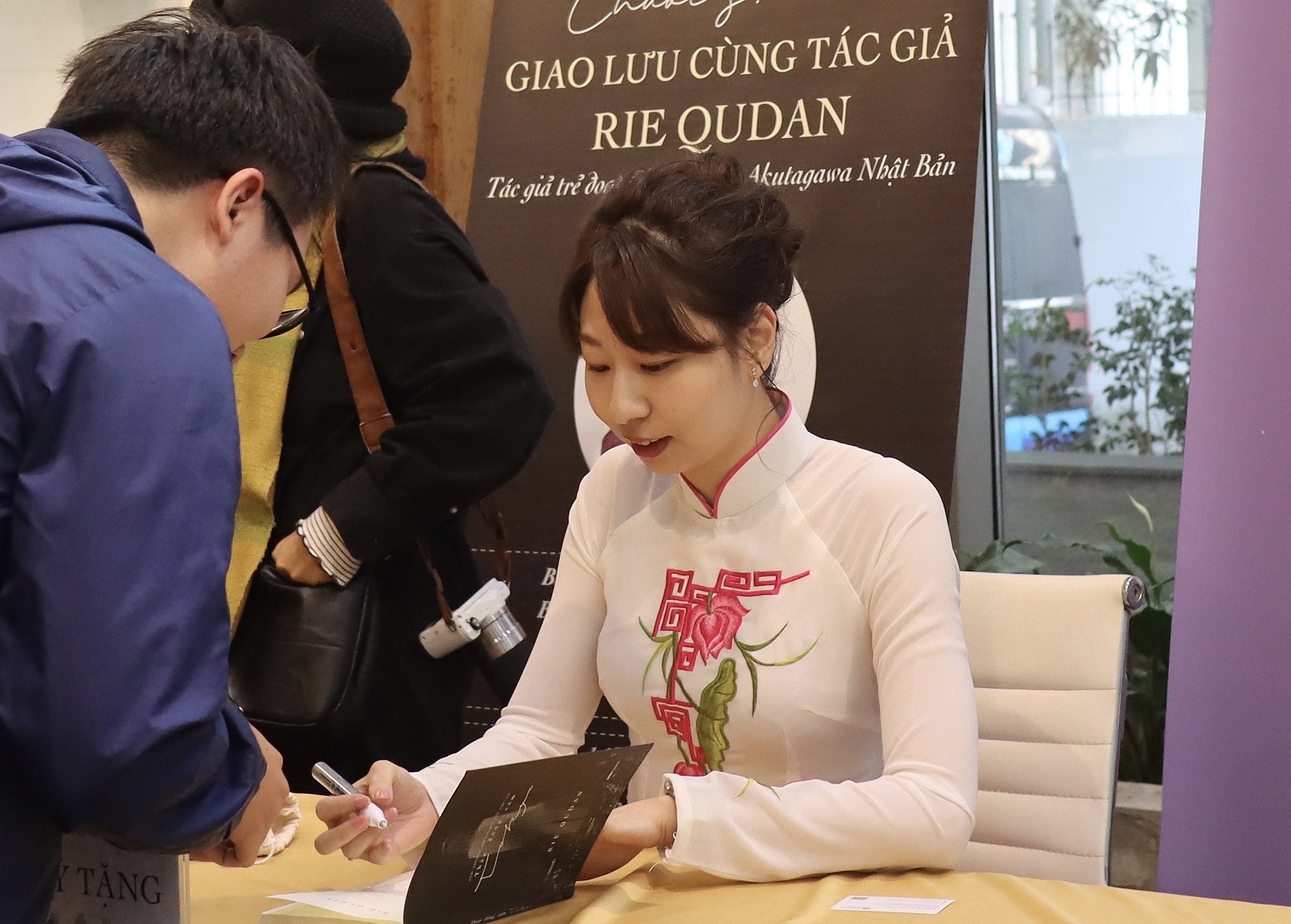 |
Writer signing books for readers. Photo: Organizers
During the exchange, Rie Kudan and readers also discussed feminism. The writer expressed admiration for Vietnamese women, noting their numerous opportunities for work and social participation even after marriage and childbirth. "In my opinion, this is rare in Japan," she remarked. Believing that absolute gender equality does not exist, Kudan suggested that instead of demanding perfect uniformity, the focus should be on discussing and addressing existing inequalities.
Rie Kudan, 35, was born in Saitama, Japan. She debuted in 2021 with *Bad Music*, which won the 126th Bungakukai Literary Prize for new authors. Her work *Schoolgirl*, released the same year, was nominated for the 166th Akutagawa Prize and the 35th Mishima Yukio Prize. In 3/2023, with *Schoolgirl*, she also won the 73rd Selected Art Prize for new artists.
Chau Anh