


During her Christmas 2025 trip, Kieu and her sister underwent antibody testing for hepatitis B, guided by their grandmother. With antibody levels below protective thresholds and only a one-month stay in Vietnam, Kieu opted for a rapid four-dose regimen: three doses within one month, and the fourth after 12 months.
Kieu also received the HPV vaccine, protecting against nine strains, following a rapid three-dose schedule: the first two doses one month apart, and the third completed within one year. Her sister, already immune to hepatitis B, also received the rapid HPV regimen, along with pneumococcal 20 and flu vaccines.
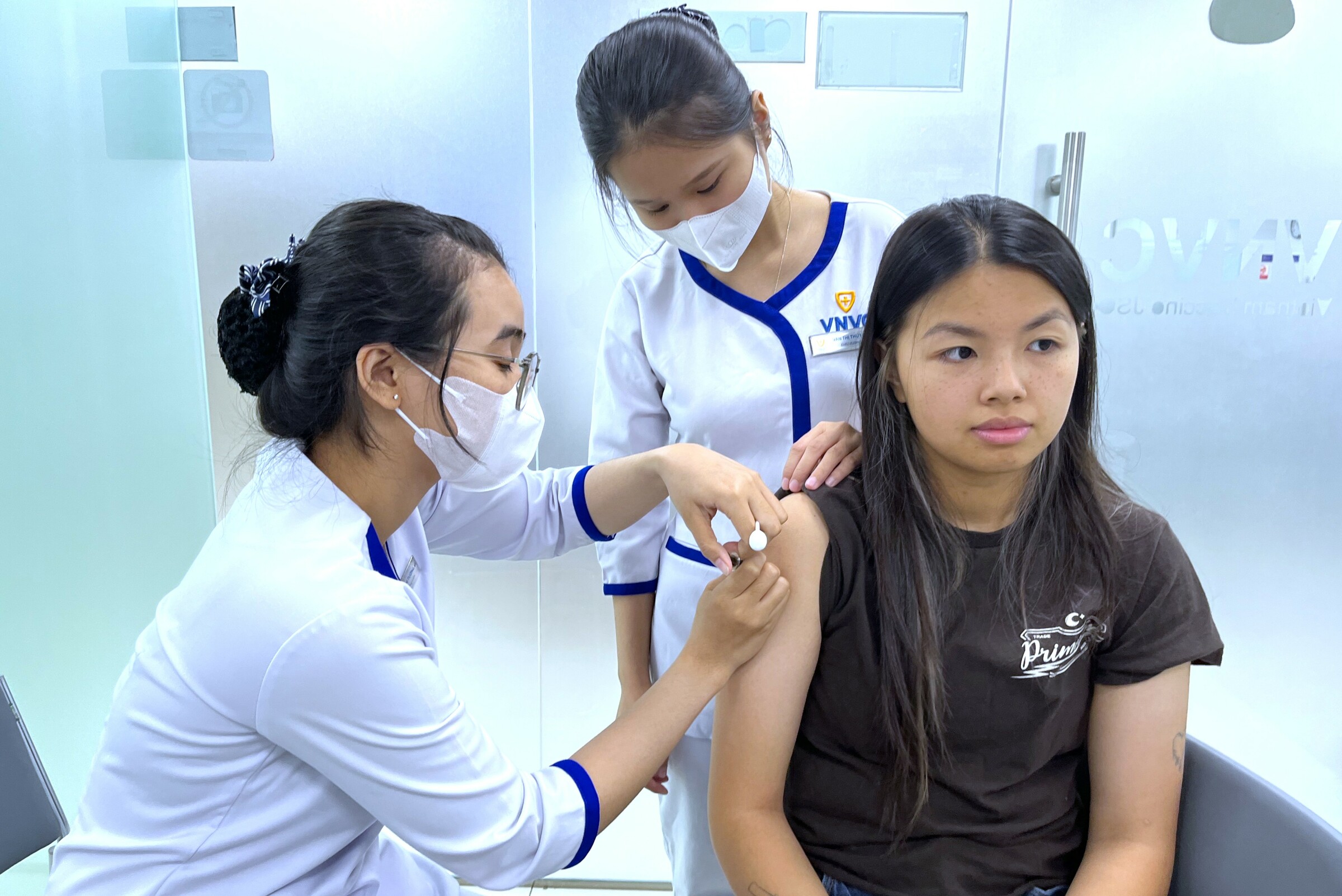 |
Jennifer Kieu receives HPV and hepatitis B vaccines at VNVC Binh Thanh, Binh Thanh ward, Ho Chi Minh City on 18/12/2025. *Photo: Dieu Thuan* |
Kieu highlighted the substantial difference in vaccination costs between the United States and Vietnam. For instance, a single dose of HPV 9 in the United States costs approximately 300 USD, whereas in Vietnam, it is only 3 million dong. Pneumococcal vaccines in the United States range from 82–222 USD per dose, compared to 1-2 million dong at VNVC. This significant price disparity is why her family chooses Vietnam for vaccinations, benefiting from both savings and shorter waiting times.
Similarly, My Duyen, 18, from Ho Chi Minh City (TP HCM), who has been studying in Australia since 10th grade, returns home every summer break for health checkups and vaccinations. In 2024, Duyen received a rapid hepatitis B regimen and a flu booster. In 2025, she added the rapid HPV regimen to her flu shot. Duyen noted that while vaccines are available in Australia, their high cost makes Vietnam a more appealing option, also allowing her to be with her parents.
According to Doctor Huynh Tran An Khuang, a medical specialist at the VNVC Vaccination System, most international students are required to be vaccinated before traveling to countries like the United States, Australia, Japan, Korea, and Europe. Upon returning home, they often receive booster shots or additional vaccines for diseases such as flu, pneumococcal, hepatitis B, meningococcal, and HPV. These vaccinations help protect their health while studying and living in crowded environments.
 |
Many international students get booster shots or new vaccines in their home country to save costs. *Photo: Vecteezy* |
These vaccines are readily available in Vietnam, enabling international students to receive comprehensive vaccination early and at more reasonable costs. For example, the flu vaccine is administered to children from 6 months old and adults; individuals 9 years and older only need one dose annually. There are five types of pneumococcal vaccines, protecting against pneumonia, meningitis, otitis media, and sepsis. Adults can receive pneumococcal 13, 15, 20, or 23, with doctors advising on a suitable schedule based on age and vaccination history.
HPV vaccines come in two types: Gardasil, which prevents four types (6, 11, 16, 18), and Gardasil 9, which protects against nine types (6, 11, 16, 18, 31, 33, 45, 52, and 58), preventing genital warts and HPV-related cancers. Gardasil is for females aged 9-26, while Gardasil 9 is for both males and females aged 9-45, offering over 90% protection. Hepatitis B vaccines are available as single doses or combined with hepatitis A. Adults typically receive three doses over six months, with antibody levels tested before vaccination and booster shots given if antibody levels decrease.
Due to the short duration of international students' breaks, typically one to three months, doctors often recommend rapid vaccination regimens to fit their schedules. For vaccines requiring precise timing, such as those for dengue fever or chickenpox, doctors advise on suitable options available in either Vietnam or the students' host countries.
Cong Nguyen


