Answer:
Radiofrequency ablation and transarterial chemoembolization are non-surgical methods for treating liver tumors. Doctors will recommend the most suitable approach based on the disease's stage, tumor size, number of tumors, and the patient's overall health.
Radiofrequency ablation is a minimally invasive technique that uses thermal energy to destroy tumors. A doctor delivers a high-frequency electrical current directly into the tumor's core, guided by ultrasound or computed tomography (CT). This current generates ionic friction, producing high temperatures ranging from 60 to 100 degrees Celsius, which causes malignant cells to dehydrate and undergo coagulative necrosis. A radiofrequency ablation procedure typically takes about 60 minutes, with the actual ablation time lasting approximately 10 to 15 minutes.
 |
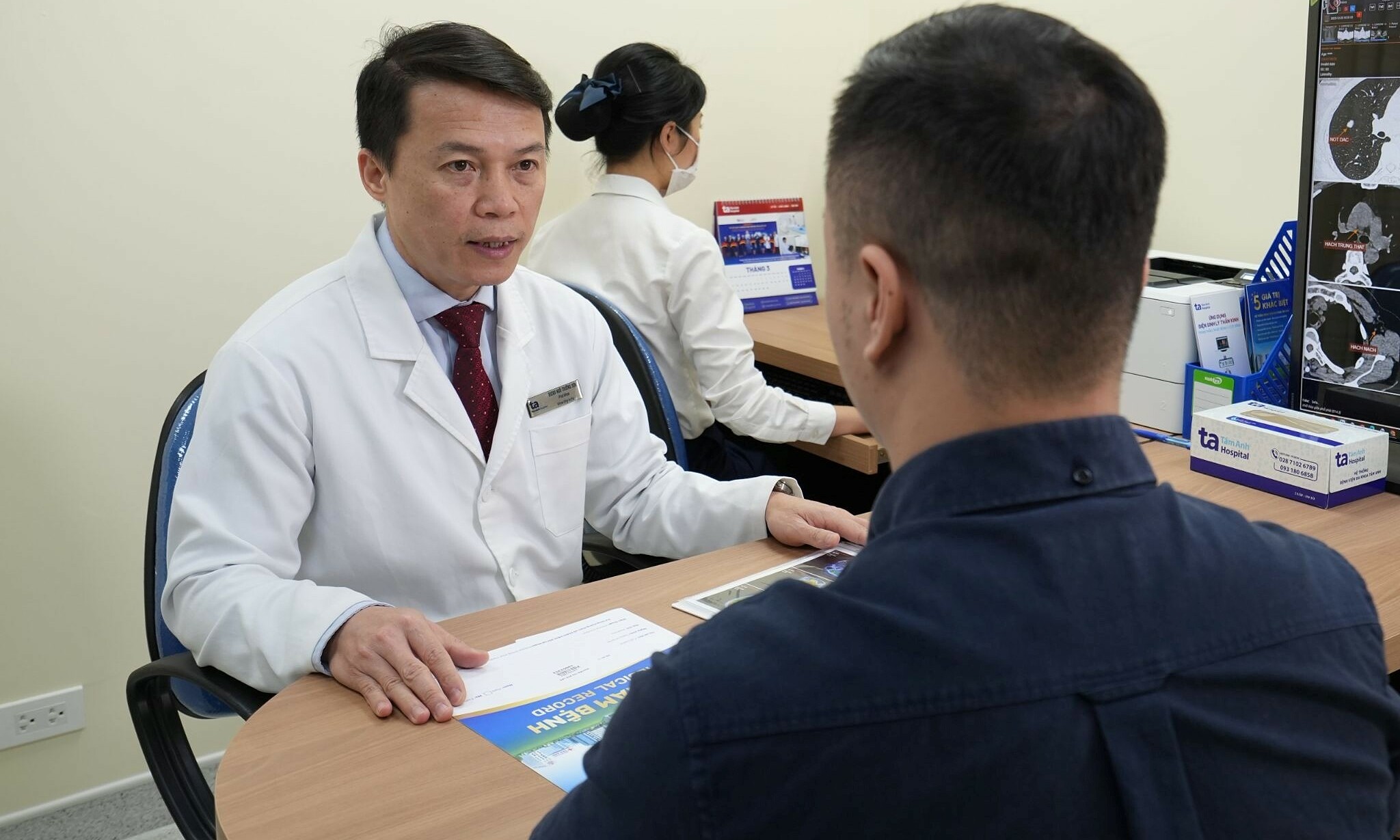
Doctor Uan advises patients on liver tumor treatment methods. Illustration: Tam Anh General Hospital
Radiofrequency ablation allows patients to avoid surgery, experience less pain, recover quickly, and have minimal impact on liver function. This method is indicated for patients with malignant liver tumors up to 3 cm, with a maximum size of 5 cm, and without extrahepatic metastasis. Doctors may also consider it for benign tumors that pose a risk to the patient's health. Patients with varicose veins can also receive this method to occlude pathological venous branches, in addition to laser ablation or biological glue injection.
Transarterial chemoembolization (TACE) works by cutting off the tumor's blood supply and destroying it. This method is indicated for intermediate-stage liver cancer cases without extrahepatic metastasis, portal vein thrombosis, or severe impact on the liver and overall health.
Doctors create a small entry point on the patient's body to access the femoral or radial artery. They then thread a catheter through the artery to reach the liver tumor. Guided by a digital subtraction angiography (DSA) system, the doctor injects a mixture of embolic materials into the tumor.
Transarterial chemoembolization for liver cancer is a minimal intervention that maximally preserves healthy liver tissue, helping to control tumor growth and prolong survival. Simultaneously, patients can maintain essential liver function for bodily activities and improve their quality of life. This method is not suitable for patients with severe coagulation disorders, hepatic encephalopathy, or severe allergies to contrast agents.
Both radiofrequency ablation and transarterial chemoembolization have distinct advantages and specific indications. You should visit a hospital for a thorough examination, accurate diagnosis, and timely, appropriate treatment recommendations.
Doctor CKI Nguyen Cong Uan
Liver Tumor Unit, Oncology Center
Tam Anh General Hospital TP HCM
| Readers can submit questions about digestive diseases here for doctors to answer |