The Ministry of Public Security is currently developing a Law to amend and supplement several articles of the Law on Management and Use of Weapons, Explosives, and Support Tools; and the Law on Fire Prevention, Fighting, and Rescue.
Among the proposals is the abolition of the procedure for specialized management agencies to inspect fire prevention and fighting (FPF) acceptance testing.
Why the proposal to abolish the acceptance testing step
Under current regulations, a construction work or vehicle subject to FPF management must undergo two consecutive administrative procedures: design appraisal and FPF acceptance testing inspection, before being put into operation.
However, a review of actual practice reveals that both procedures share a single objective: to assess and evaluate compliance with legal regulations and the application of technical standards and codes in construction and design.
According to the drafting agency, maintaining both procedures simultaneously is no longer necessary. If authorities perform the design appraisal thoroughly and assign implementation responsibility to the investor, state management objectives will still be fully ensured.
This duplication leads to administrative waste, delays project operation, and impacts business efficiency.
Under the new mechanism, construction works and vehicles will only be required to complete one administrative procedure before operation: FPF design appraisal.
After investors organize construction and conduct acceptance testing themselves, they will be authorized to put the works into operation.
>>See more: List of types of construction works and vehicles requiring design appraisal
Investors assume full legal responsibility
At this point, the management agency will conduct actual post-inspections, evaluating the level of FPF safety based on the operational status of the work with all equipment, personnel, and goods, rather than relying solely on paper-based acceptance testing documents as before.
The management agency will also combine this with FPF safety inspections after the construction work or vehicle is put into operation.
Investors, owners of construction works, or vehicle owners must fully and comprehensively fulfill their responsibilities and be legally accountable for construction, construction supervision, and acceptance testing in accordance with the applied technical standards and codes.
This will compel investors to enhance their self-awareness, eliminating the mindset of waiting for or "entrusting" safety inspections to public security agencies.
An investor signing an acceptance document for their own work signifies a commitment to the law and the community regarding the safety of that construction.
If violations are discovered during post-inspection, or if a fire or explosion occurs due to faulty acceptance testing not conforming to the design, the investor will face severe penalties, including criminal liability.
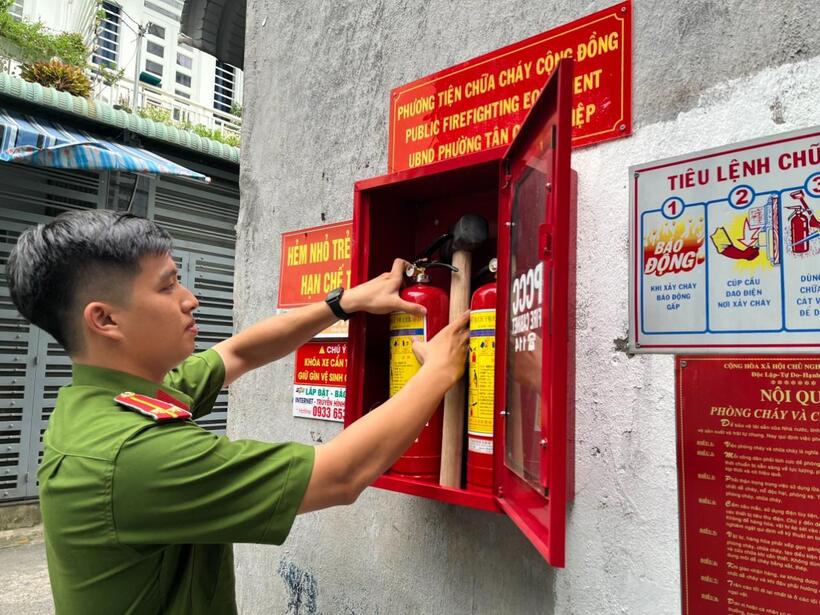 |
Public security officers inspecting community fire fighting equipment. *Government Electronic Newspaper* |
What benefits for citizens and businesses?
According to the Ministry of Public Security, abolishing this procedure benefits the State, businesses, and society.
For businesses and investors, it will shorten the time to put construction works into use. Investors will not face the pressure of preparing for acceptance testing inspections by specialized agencies, allowing businesses to focus resources on improving construction quality.
For state management agencies, this reduces pressure on FPF police officers and soldiers. The force will have more opportunities to focus on inspection and safety checks during actual operation.
The draft is open for public comment until 24/6.
Hai Thu