The Ministry of Justice is seeking public feedback on a draft decree detailing electronic interlinked processes for two groups of administrative procedures. The key proposal introduces identity card issuance for children under 6 years old, integrated with birth registration, permanent residency, and health insurance card issuance. The second group covers death registration, funeral expense settlement, and survivor benefits.
This draft significantly amends current regulations under Decree 63/2024 by incorporating the "issuance of identity cards for children under 6 years old" into the interlinked process.
This addition aims to streamline administrative procedures for citizens. The Ministry of Justice explained in its submission that the new process allows parents to complete multiple administrative tasks for newborns with a single declaration. This approach enhances data synchronization and minimizes redundant information provision across population data, civil status, social insurance, and identity card systems.
However, the expanded process will extend the processing time for interlinked administrative procedures. The Ministry of Justice proposes increasing the maximum processing time from 3 working days to 9 days. For cases requiring verification, the time will increase from a maximum of 5 days to 12 working days. If applications are received after 15h, processing begins on the next working day.
The draft also introduces several new amendments for birth registration application processing. If an application is complete, civil status officials will register the birth on the Ministry of Justice's administrative procedure processing information system. They will then transfer the information to the National Population Database to issue a personal identification number. Birth registration processing will occur "on the same working day" from when the system receives complete applications.
After birth registration is complete, the Ministry of Justice's system automatically transfers the electronic birth certificate to the National Public Service Portal. This action finalizes electronic records for subsequent administrative procedures in the interlinked process. Results are sent to citizens via the National Public Service Portal or VNeID.
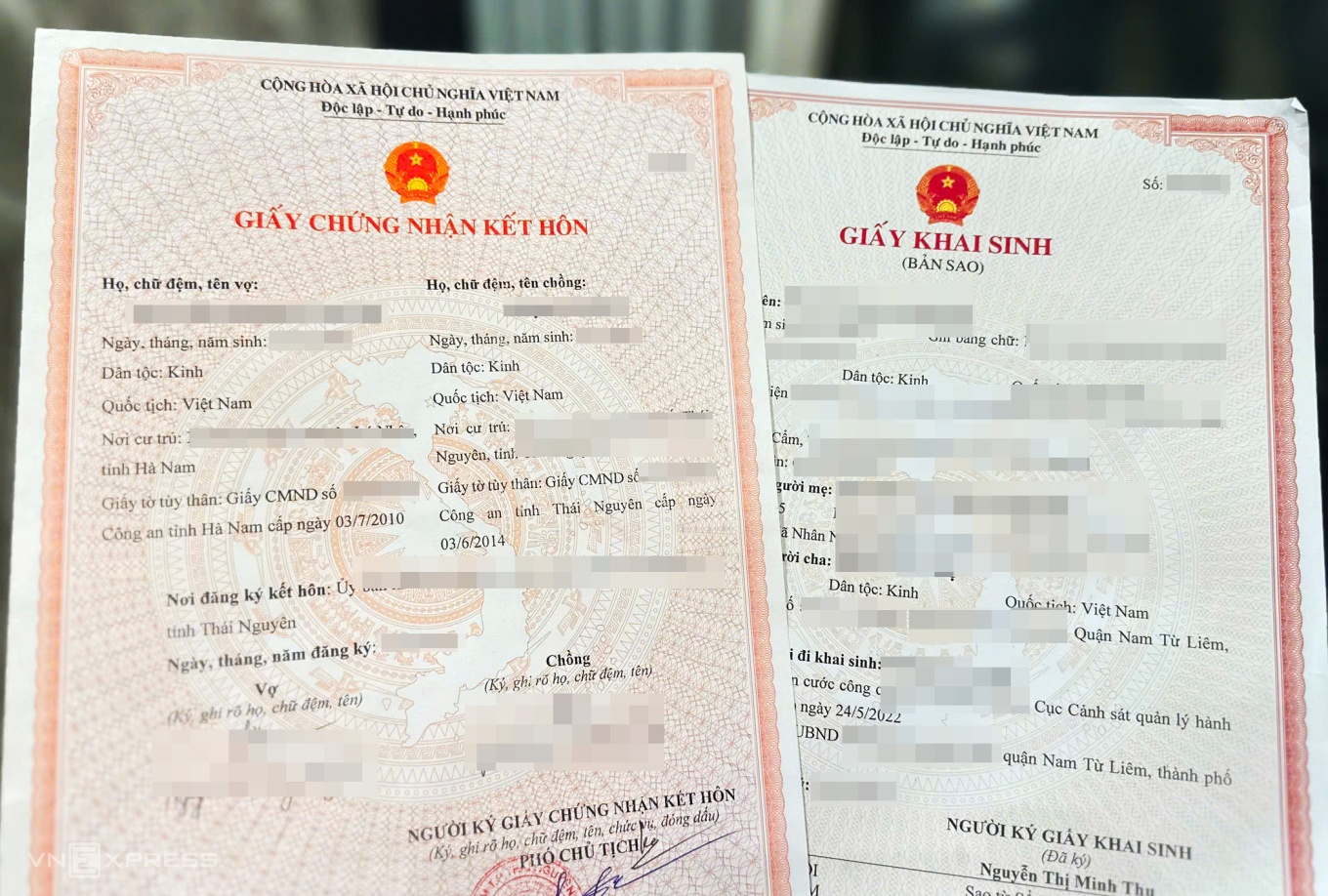 |
Birth certificates will be interlinked with permanent residency, health insurance card issuance, and identity cards. Photo: Pham Du
Identity card issuance process for newborns
The draft decree includes a new regulation for processing identity card applications, specifying that the issuance of identity cards for children under 6 years old within the electronic interlinked process "will only be carried out upon the applicant's request."
After the Ministry of Public Security's residency management system transfers the permanent residency registration results to the National Public Service Portal, the system will separate and transfer the citizen's electronic records to the identity card issuance, production, and management system for card issuance. Subsequently, police officers will perform the identity card issuance operations on this system.
For children under 6 years old, the identity card management agency does not collect facial recognition or biometric information. The processing time for identity card issuance is a maximum of 5 working days from receiving complete applications.
Immediately after the identity card issuance is complete, the system will extract data from the electronic birth certificate and health insurance card, previously issued within the interlinked process. This information is then integrated into the identity card and the child's electronic identification account. Citizens can also request a physical identity card for children under 6 years old within the interlinked process. The physical identity card will then be returned at the commune-level identity card management agency or via postal service as requested.
If an administrative procedure processing agency misses a deadline, it must apologize and reschedule the result delivery via the National Public Service Portal or the VNeID application. The notification must clearly state the reason for the delay and the new delivery date. Compared to current regulations, the draft proposes eliminating SMS replies and removing a step that involved "sending replies via interlinked public service software."
 |
Many administrative procedures are conducted via the VNeID application. Photo: Pham Du
No longer requiring permanent residency deletion when processing funeral expenses
Under current regulations, an interlinked group of administrative procedures includes death registration, permanent residency deletion, funeral expense settlement, and survivor benefits. However, the Ministry of Justice proposes abolishing the "permanent residency deletion" requirement within this interlinked administrative procedure process in the draft.
The Ministry of Justice states that after civil status registration agencies perform death registration and update information into the electronic civil status database, "the citizen's death status is shared and synchronized with the National Population Database." Consequently, police agencies can automatically adjust and update residency information without citizens needing to undergo a separate interlinked process for permanent residency deletion. The reduction of this procedure simplifies the process, decreases the number of procedures citizens must complete, and reduces required documents, processing time, and travel costs.
Under current regulations, the Ministry of Justice is only responsible for ensuring seamless connectivity between software and systems. However, in the draft, the government assigns the Ministry of Justice primary responsibility for managing and operating systems to ensure seamless connectivity. This facilitates the sharing of electronic birth certificates for processing residency, health insurance card issuance, and identity card issuance for children under 6 years old.
The draft also proposes that the Ministry of Public Security is responsible for upgrading VNeID and the residency management information system, as well as the identity card issuance, production, and management system. The Ministry of Public Security must also ensure that consent from household heads and legal accommodation owners is obtained via VNeID or digital signature.