"The pain initially manifested in a specific muscle group, and I didn't believe it was a cramp," Alcaraz explained at the post-match press conference on 30/1, following his 6-4, 7-6, 6-7, 6-7, 7-5 win against Zverev. "I wasn't sure what it was exactly, as I simply ran to hit a forehand and then felt discomfort in my right adductor muscle. That's why I requested a physiotherapist."
Key moments from the Alcaraz - Zverev match on 30/1.
The incident occurred at 15-15 in the 11th game of the third set, when Alcaraz exhibited pain in his right thigh and groin. Opponent Zverev expressed dissatisfaction after chief umpire Marijana Veljovic did not initiate the serve clock for Alcaraz. "I need to see if he's okay," Veljovic told Zverev. The German player insisted, "He has cramps," to which Veljovic responded, "But I cannot be certain of that."
Despite his limited movement, Alcaraz managed to hold his serve with a string of winners. The Spanish player then requested medical attention. After the umpire's approval, Alcaraz received physical therapy and consumed pickle juice to alleviate what appeared to be cramps. Zverev voiced his displeasure, citing rules that typically prohibit medical timeouts for cramps without an accompanying injury. "This is ridiculous, unbelievable," Zverev exclaimed.
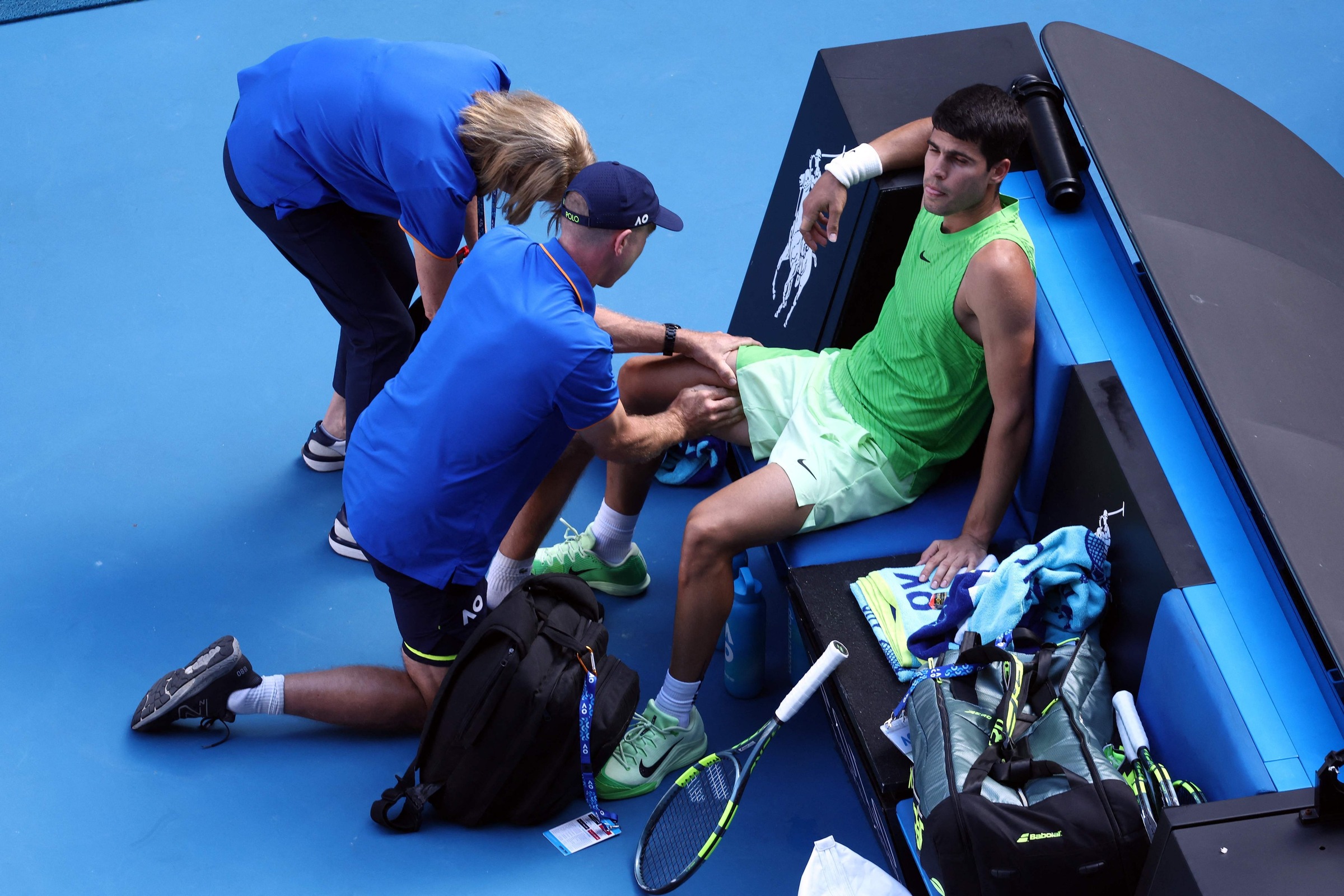 |
Alcaraz receives medical attention during the Australian Open semi-final at Rod Laver Arena, Melbourne, Australia, on 30/1. *Photo: Reuters*
Alcaraz struggled with movement for approximately 30 minutes before his condition improved. Though he lost rhythm following the pain, he recovered to win four consecutive games, ultimately taking the deciding set 7-5 after being down 3-5. Post-match, Alcaraz stressed that he did not feign injury due to cramps, but rather the doctor approved the medical timeout.
"The pain was momentary," Alcaraz clarified. "My left leg felt acceptable, though not perfect. Under pressure, I was unsure if the issue would worsen. I communicated my situation to the doctor, who then decided to grant a medical timeout. I subsequently applied some treatment during changeovers."
Zverev later confirmed his disapproval of the umpire's decision, but emphasized he did not want the controversy to overshadow the match, which at 5 hours 27 minutes, was the longest Australian Open semi-final in history.
"I believe he had cramps, and typically you cannot request a medical timeout for that reason," Zverev stated. "What could I do? I didn't like it, but it wasn't my decision. The incident is over, and I don't recall all the details. I prefer not to discuss this further, as I consider this one of the best matches ever played in Australia. It doesn't deserve to be the main topic now."
Alcaraz is now concentrating on recovery for the final against Novak Djokovic on Sunday 1/2. He will seek his first Australian Open title and the opportunity to become the youngest male player in history to achieve a career Grand Slam.
"I'm tired, but that's normal after five and a half hours of play," Alcaraz acknowledged. "I hope there are no serious issues, though I expect muscle stiffness after such a long, intense match. I will do everything necessary to be in optimal condition for the final."
Vy Anh