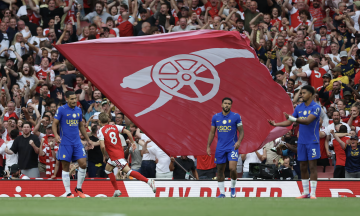
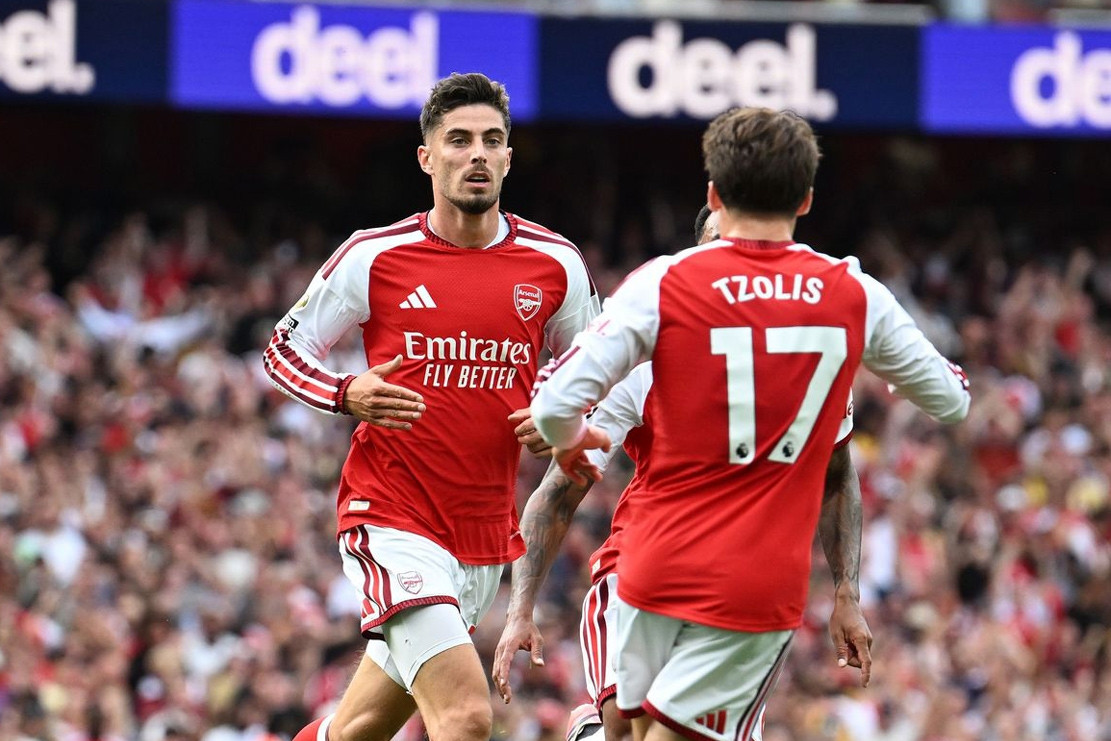
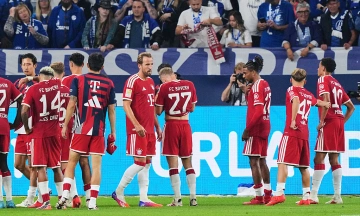
Arsenal topped the 2025-2026 league stage, becoming the first team in history to win all 8 matches. For the new season, the "Gunners" have an 18,5% probability of finishing first in the league stage, according to 10.000 simulations by the Opta supercomputer.
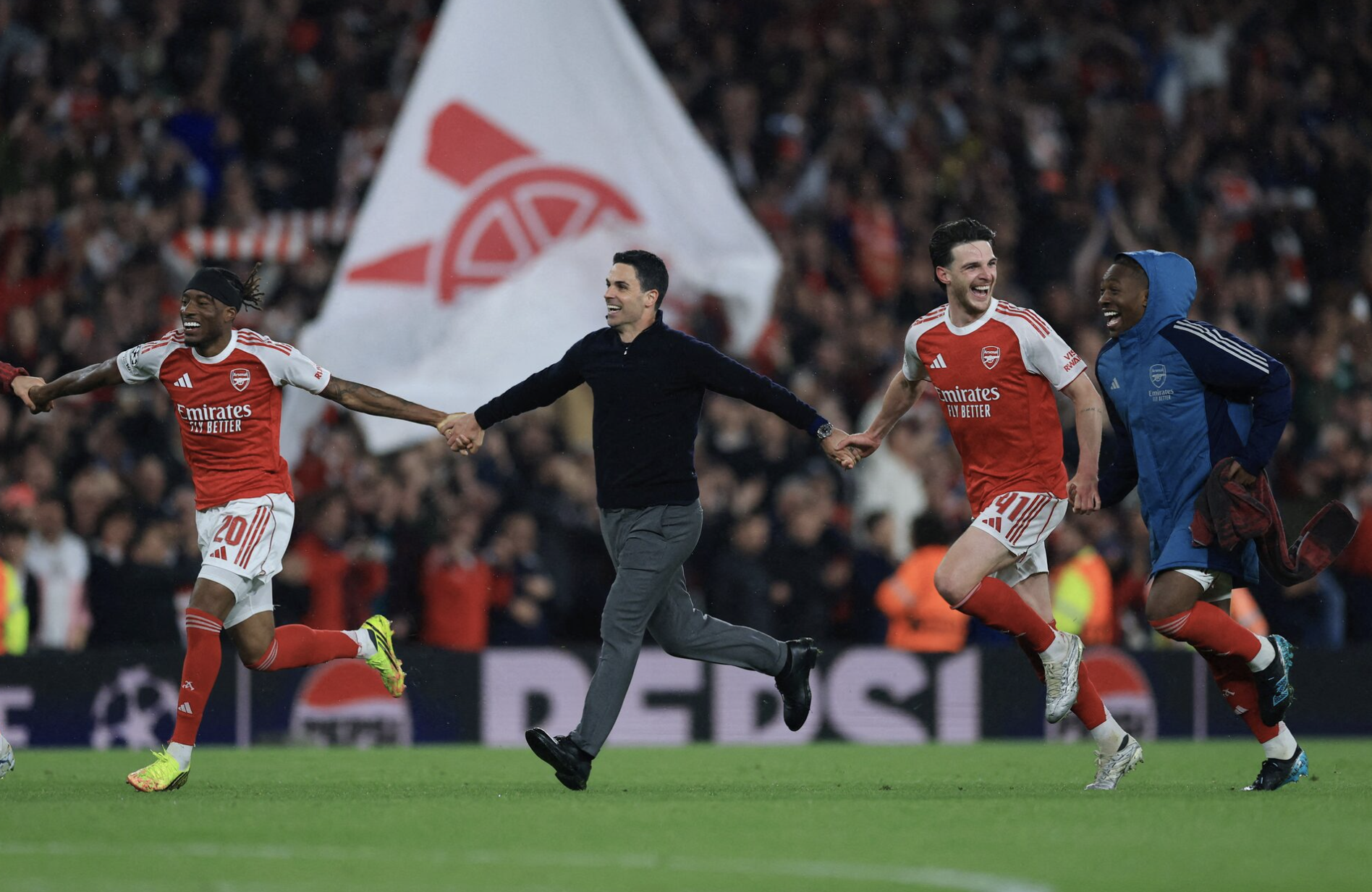 |
Noni Madueke, coach Mikel Arteta, Declan Rice, Eberechi Eze (from left) celebrate after Arsenal's 1-0 victory over Atletico in the Champions League semi-final second leg at Emirates Stadium, London, England on 5/5. *Photo: Reuters*.
Last season, Arsenal's league stage schedule was relatively favorable based on Opta's analysis, but this season is significantly more challenging. Mikel Arteta's squad will face Real Madrid (home), Bayern Munich (away), Borussia Dortmund (home), Real Betis (away), Lille (home), Napoli (away), Sabah (home), and Slavia Prague (away). Nevertheless, Arsenal is almost certain to qualify for the knockout stage, with a 93,1% probability in the simulations.
Playing away at Bayern's stadium puts Arsenal at a disadvantage in the race for the top spot. The "Bavarians" finished first in 19,8% of simulations – higher than any other team – and also have the highest probability of reaching the knockout stage, at 93,5%.
However, Bayern ranks second in championship probability with 19,9%, trailing Arsenal at 21,2%. This is because Arsenal is currently ranked as the strongest team in the world by Opta Power Rankings.
Arsenal's performance has also improved season by season. The London club reached the quarter-finals in the 2023-2024 season, the semi-finals in the 2024-2025 season, and the final in the 2025-2026 season, where they lost to PSG in a penalty shootout.
The third contender is Man City, with a 12% chance of winning their second Champions League title, following their first in 2023. Man City's league stage schedule is also considered one of the most difficult among the main contenders. Therefore, they will need to perform well from their opening match at Porto if they want to reach the top 8. Nevertheless, the supercomputer still estimates Man City's chances of reaching the round of 16 at 86,3%.
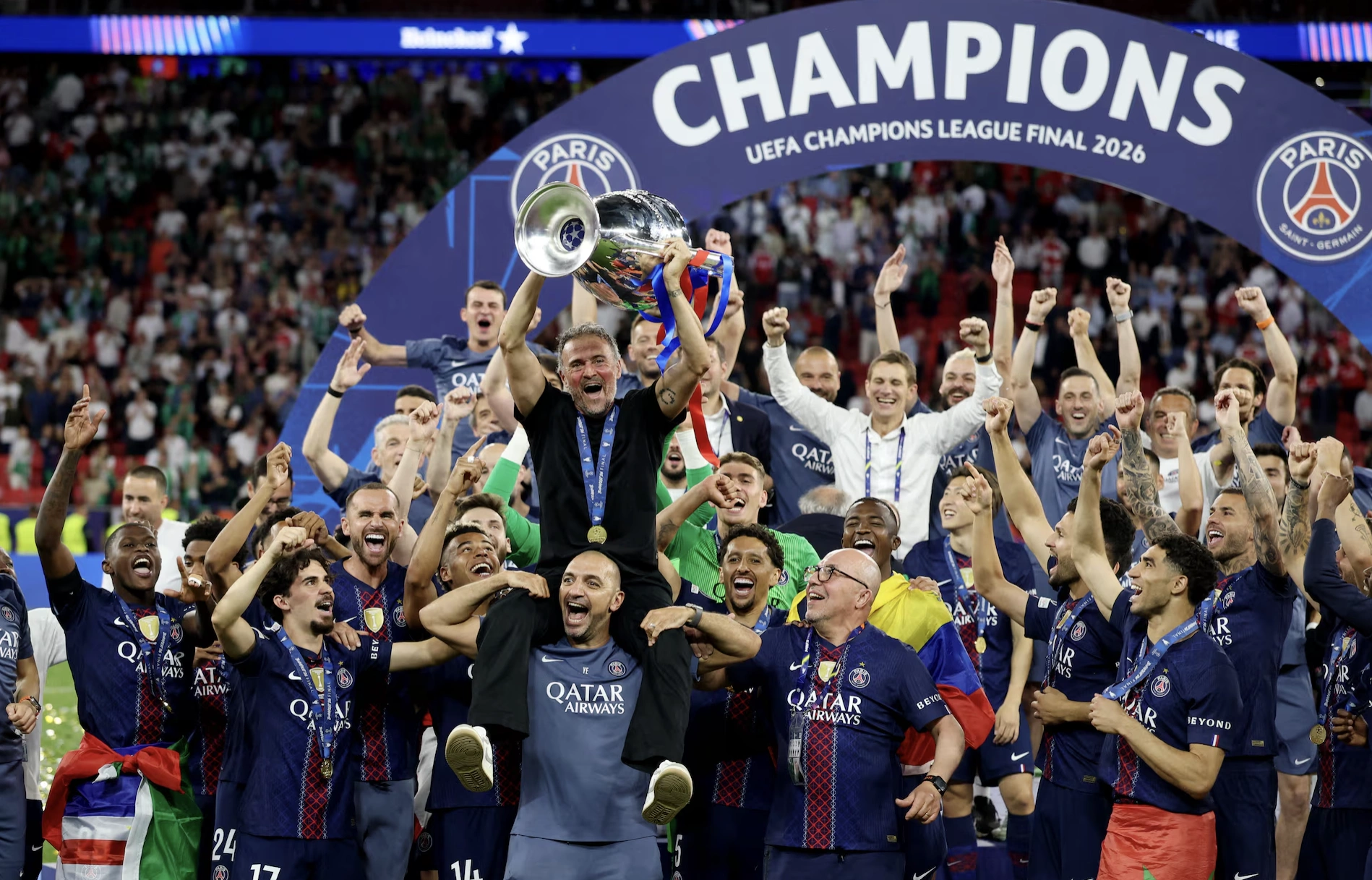 |
Coach Luis Enrique and PSG members celebrate after defeating Arsenal in the Champions League final in Budapest, Hungary on 30/5. *Photo: Reuters*.
PSG, the champions of the last two seasons, rank fourth among the contenders. The French team has a 7,7% chance of achieving a Champions League title hat-trick, replicating Real Madrid's feat (2016, 2017, 2018). Following them are Barca with 7%, and Liverpool, Real Madrid, both with 5,1%.
Man Utd, returning to the Champions League after a two-year absence, is estimated to have a 37,4% chance of reaching the quarter-finals, a 19,1% chance of making it to the semi-finals, and a 3,7% chance of winning the title. The "Red Devils" have won the tournament three times, most recently in the 2007-2008 season. Since finishing second in the 2010-2011 season, the English team has not advanced past the quarter-finals.
Other teams with a championship probability above 1% include Inter Milan (3,4), Aston Villa (2), Dortmund (1,8), Roma, Sporting (1,4), and Club Brugge (1). Thus, 22 teams are predicted to win in less than 1% of the simulations.
The quality gap between strong and weak teams in the Champions League is significant. However, across 10.000 season simulations, the Opta supercomputer still saw all 36 teams win the title at least once.
Shakhtar Donetsk, Slovan Bratislava, and Sabah – a team from Azerbaijan making their Champions League debut – are the weakest teams in the tournament. Nevertheless, all three won the championship exactly one time in 10.000 simulations, equivalent to a 0,01% probability. LASK and Feyenoord both won in 0,03% of simulations, while AEK Athens achieved a rate of 0,06%.
Last season, the Opta supercomputer predicted Liverpool to win the Champions League. In reality, the English team was eliminated by PSG in the quarter-finals. PSG – then the number one contender – won the title, while Arsenal, who lost to PSG in the final, was the number two contender.
Therefore, Opta's predictions were not far from reality, but they were not entirely accurate. Can the supercomputer "correct its mistakes" by accurately predicting this season's champion?
Hong Duy (according to Opta Analyst)