FIFA announced this decision after reaching an agreement with the global players' union (FIFPro) and other stakeholders. Effective 1/1/2027, all professional player contracts worldwide must clearly specify a buyout or release clause fee.
This mechanism has existed in Spain for decades but will be applied globally for the first time. FIFA believes the new rule will facilitate greater player mobility and reduce lengthy transfer negotiations or legal disputes over player valuations.
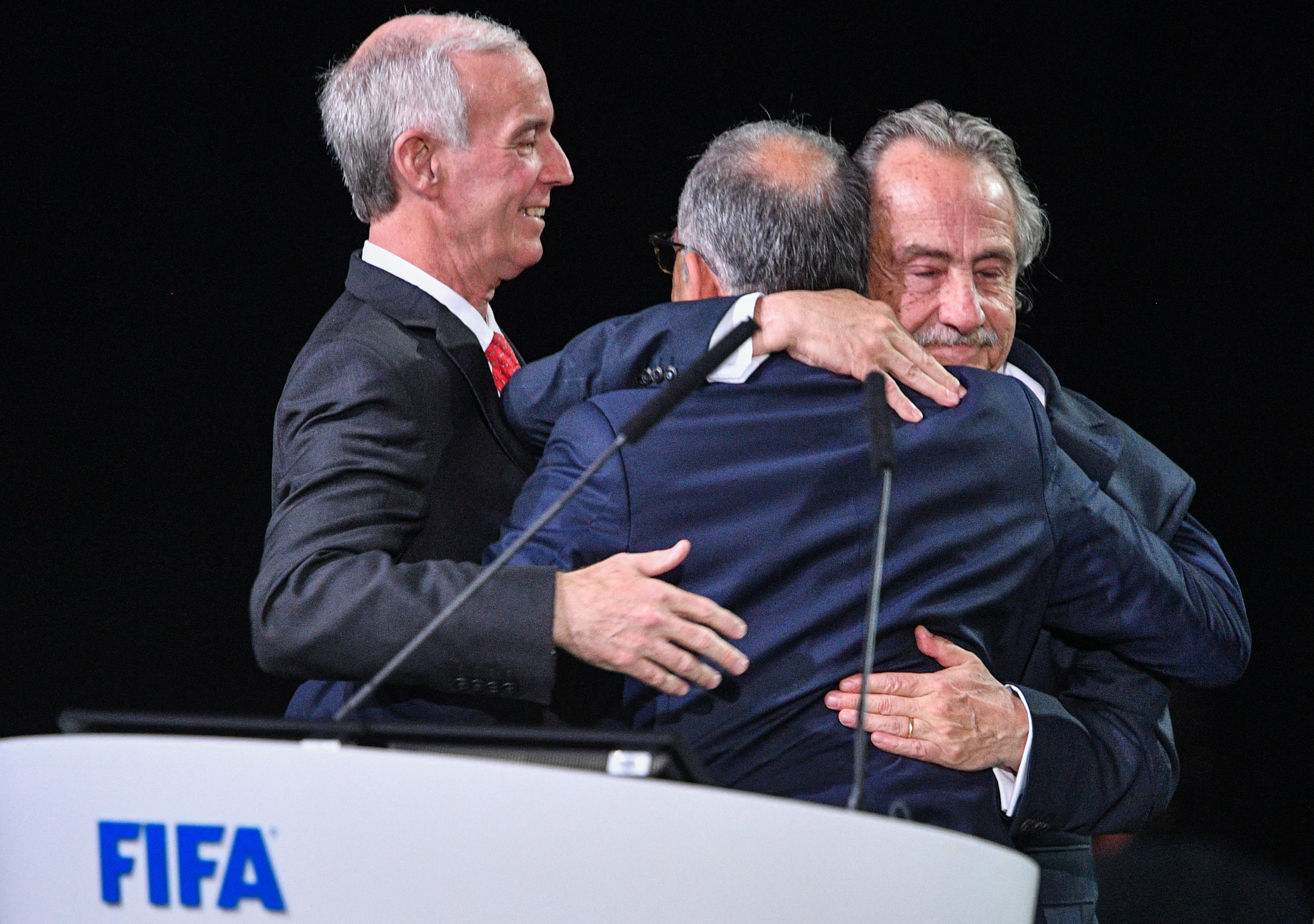 |
Officials from the 2026 World Cup joint bid (Canada – Mexico – US), including Carlos Cordeiro (center), President of the US Soccer Federation, Decio de Maria Serrano (right), President of the Mexican Football Federation, and Steve Reed, President of the Canadian Soccer Association, congratulate each other after FIFA announced the 2026 World Cup host at the 68th FIFA Congress in Moscow on 13/6/2018. Photo: Mladen Antonov / AFP
A release clause allows an employee to unilaterally terminate a contract by paying a predetermined fee to the employer. In football, the club seeking to sign the player typically pays this fee.
Normally, when a player is under contract, the parent club is not obligated to sell. If two teams cannot agree on a transfer fee, the buying team can activate the release clause by paying the exact amount specified in the contract. In such cases, the parent club cannot prevent the transfer.
In Spain, release clauses have been mandatory in football contracts since 1985. Many major clubs often set extremely high fees to deter rivals from approaching players. As of 4/2025, 11 players have release clauses up to 1 billion euros (1.2 billion USD), including Pedri, Gavi, Lamine Yamal, Ferran Torres, Ansu Fati, and Jules Kounde from Barca, along with Vinicius Junior, Jude Bellingham, Kylian Mbappe, Eduardo Camavinga, and Rodrygo from Real Madrid.
The most famous case involving a release clause was Neymar's move from Barca to PSG in 2017. The French club activated a 222 million euro (257 million USD) clause in the Brazilian forward's contract, creating the most expensive transfer in football history.
 |
Neymar (left), Kylian Mbappe (center), and Lionel Messi before the Ligue 1 match between PSG and Troyes at Parc des Princes, Paris on 29/10/2022. Photo: AFP
According to FIFA, this reform decision stems from a lawsuit by former France international midfielder Lassana Diarra. In 2014, Diarra had a contract dispute with Lokomotiv Moscow. The Russian club terminated his contract, accusing the midfielder of breach of duty, while FIFA's dispute resolution body ordered him to pay approximately 10.5 million euros (12.1 million USD) in compensation.
Subsequently, Belgian club Charleroi wanted to sign Diarra but abandoned the idea, fearing joint liability for the aforementioned compensation. Under FIFA regulations at the time, a club wishing to sign a player could not receive legal assurance regarding financial obligations arising from previous disputes.
Diarra then sued FIFA and the Belgian Football Federation, arguing that existing transfer regulations restricted players' freedom of movement within the European Union.
In 10/2024, the Court of Justice of the European Union (CJEU) ruled that certain FIFA regulations concerning contract breaches and player transfers were incompatible with EU law. The court stated that these rules could impede workers' freedom of movement and reduce market competition.
The ruling compelled FIFA to review its entire transfer system. After nearly two years of negotiations with stakeholders, world football's governing body decided to implement a mandatory global release clause model.
 |
Midfielder Nguyen Hoang Duc during the second leg of the ASEAN Cup 2024 final between Vietnam and Thailand at Rajamangala Stadium, Bangkok, Thailand on the evening of 5/1/2025. Photo: Duc Dong
Additionally, FIFA is changing how benefits are distributed in transfer deals. Under the new regulations, players will directly receive 5% of the transfer fee when moving to another club. The selling club will pay this amount.
For players with a fixed annual salary below 150.000 euros (173.000 USD or 4.6 billion VND), this 5% share will be mandatory. FIFA stated that players can waive part of their entitlement, but the received percentage must not be lower than the fixed salary of the final year of their contract or 2.5% of the transfer fee value, whichever is higher.
Furthermore, FIFA is tightening penalties for late payments. Cases brought before the Football Tribunal will incur an 8% interest rate if financial obligations are not met on time.
For Vietnamese football, FIFA's new regulations could bring significant changes to the transfer market. If implemented from 2027, all professional player contracts in the V-League must specify a release clause fee. This means national team players like Nguyen Quang Hai, Nguyen Hoang Duc, or Nguyen Xuan Son could have a specific price that other clubs can activate, rather than relying entirely on negotiations between teams.
This mechanism is expected to increase market transparency, reduce disputes, and shorten the time required to complete transfers.
Xuan Binh compiled