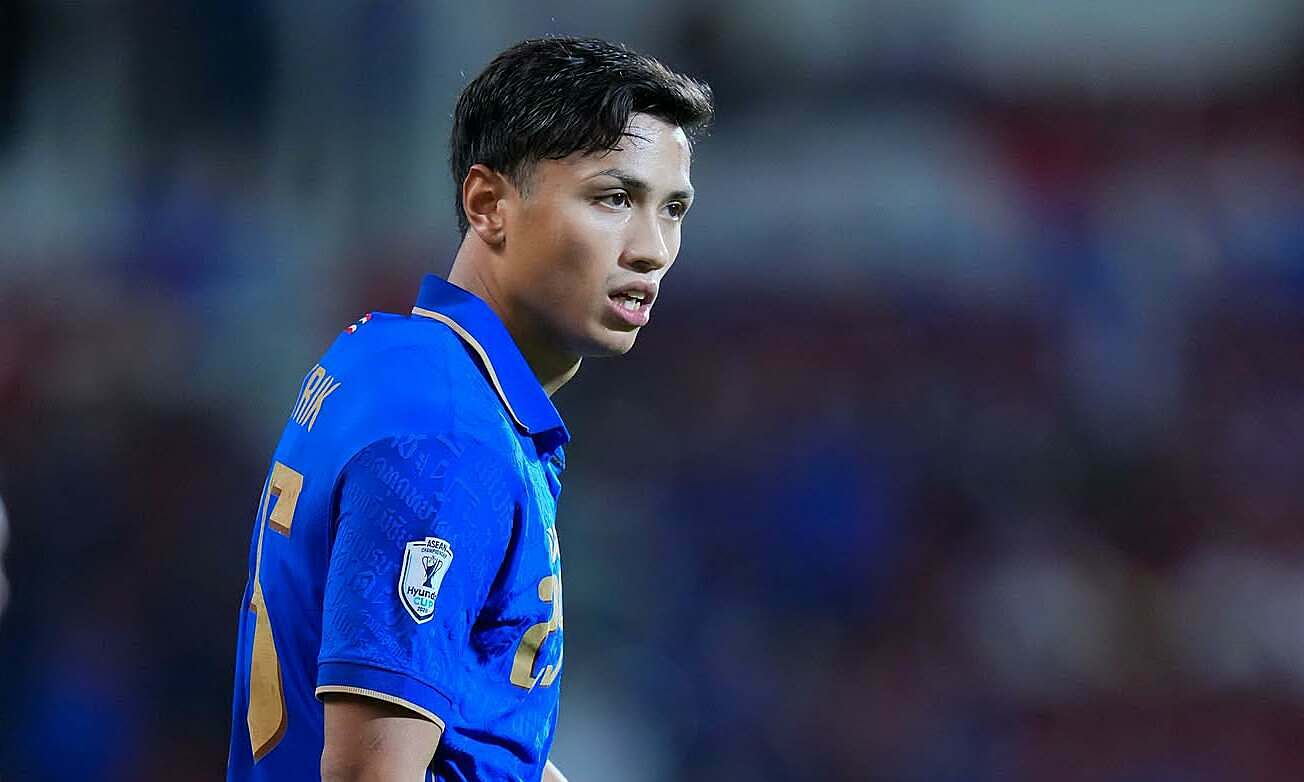
According to Bild, the German national team faced immediate difficulty finding a player for the sixth penalty kick. After five initial rounds, both teams were tied 3-3, entering a knockout penalty shootout. Center-back Jonathan Tah stepped up to take the next shot, despite it being the first penalty kick of his career.
 |
Jonathan Tah missed his penalty during the shootout in Germany's loss to Paraguay in the round of 16 of the 2026 World Cup at Foxborough, Massachusetts, US on 29/6. Photo: AP
Tah's shot went over the bar, giving Paraguay an advantage before their opponent capitalized to secure a spot in the quarterfinals. The 30-year-old center-back became Germany's most unfortunate player in the match. Earlier in extra time, he had headed a goal against Paraguay, but it was disallowed after VAR determined Waldemar Anton fouled goalkeeper Roberto Gill in a challenge.
Tah's decision to take the penalty was not pre-planned. Sources indicated that the coaching staff struggled to find a sixth taker as some players on the field hesitated, unwilling to take the responsibility.
At that moment, besides Tah, Germany still had Leon Goretzka, Waldemar Anton, Nathaniel Brown, Malick Thiaw, and goalkeeper Manuel Neuer who had not yet taken a penalty. Before them, Kai Havertz missed, Joshua Kimmich, Jamal Musiala, and Nadiem Amiri all scored, while Nick Woltemade also failed to beat the Paraguay goalkeeper.
Key match developments
According to a video recorded by ZDF channel, Kimmich directly discussed with his teammates to determine the next penalty order. Through a microphone on the camera system, the Germany captain asked Nathaniel Brown if he would take the eighth kick. The defender only nodded, without speaking.
Kimmich then turned to ask Goretzka: "How about Leon, will you take it?"
Goretzka did not answer, only shook his head. Kimmich then listed the Bayern midfielder for the ninth spot.
This detail further fueled public questions about why experienced or leadership players were unwilling to step up in the most pressured moments. Although Goretzka had only taken one penalty kick in his career, he was still a more reasonable choice than Tah.
The lack of decisiveness in the shootout reflected a larger issue for the German squad: a lack of winning mentality in decisive moments. A similar case occurred with Bayern in the 2012 Champions League final. At that time, many players also did not want to take responsibility for penalty kicks against Chelsea, which forced Neuer to take the third kick and score, before Bastian Schweinsteiger missed the fifth kick, leading to Bayern's defeat on home turf.
 |
Nick Woltemade left the field after Germany's loss to Paraguay in the penalty shootout of the round of 16 of the 2026 World Cup at Foxborough, Massachusetts, US on 29/6. Photo: AP
Germany had never lost a World Cup penalty shootout until the match against Paraguay. They had won all four previous matches: against France (1982), Mexico (1986), England (1990), and Argentina (2006).
The defeat to Paraguay extended a forgettable World Cup streak for German football. After being eliminated from the group stage in two consecutive tournaments in 2018 and 2022, the four-time world champions were again eliminated in the round of 16 in the first 48-team tournament.
Sports Director Rudi Voller publicly defended Nagelsmann, stating he remained the right person to lead the national team. However, legend Lothar Matthaus held an opposing view. The 1990 World Cup champion believed Germany needed to start a new cycle with a different coach after this tournament. According to Matthaus, the failure stemmed not only from professional performance but also from internal instability within the team.
He revealed disputes had occurred regarding the policy for relatives to travel to the US with the team. Many players had mothers or wives flying over on private flights, while relatives of other teammates had to take commercial flights. This disparity caused dissatisfaction among some members and created a negative team atmosphere.
The former Germany captain also criticized the coaching staff for organizing too many "family days" early in the World Cup. This distracted focus, when players should have devoted their full attention to conquering the tournament. Matthaus believed families should only come to support when the team has progressed deep into the tournament, instead of appearing continuously from the group stage.
Hoang An (according to Bild, Krone)