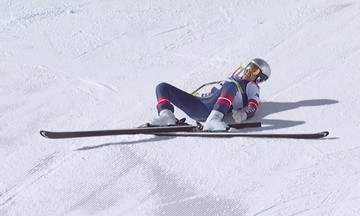
After winning the two opening sets with scores of 6-4 and 7-6 (7-5), Alcaraz unexpectedly showed signs of pain during his service game with the third set score at 4-4. The match briefly paused at 15-all as the world number one player limped, clearly in pain in his right thigh and groin area.
Head umpire Marijana Veljovic immediately became the target of Zverev's criticism. The German player was furious because she decided not to start the serve clock countdown for Alcaraz.
 |
Alcaraz in pain, leaning on the barrier during his victory over Zverev in the men's singles semi-final at the 2026 Australian Open on 30/1. Photo: AFP
"Why aren't you starting the 15-second countdown?", Zverev shouted loudly. "I need to see if he's okay", Veljovic replied. Zverev continued, "He's cramping!", and received a final response from the umpire: "But I can't be sure of that".
Despite the pain, Alcaraz managed to successfully hold his service game by hitting drop shots to finish points as quickly as possible. Immediately after, the 22-year-old requested a medical timeout (MTO).
While Alcaraz received care from a physical therapist and drank pickle juice, Zverev continued to complain to both the head umpire and the match supervisor about his opponent receiving extra recovery time. "How can you let him treat cramps? That's ridiculous and nonsense! You always protect those two guys over and over again!", the 28-year-old publicly stated during the match.
The "two guys" Zverev was referring to were Alcaraz and Jannik Sinner. For a long time, Zverev has believed that these two players receive special favoritism from tournament organizers. He previously mentioned Sinner benefiting in the third round when organizers applied the heat rule to close the roof just as the Italian player was struggling and experiencing physical issues.
Former American player Jim Courier, commentating live on Nine, sympathized with Zverev, stating it was a clear error by the umpire. "This is a disaster. They handled it completely wrong. That's why Zverev is going crazy like that", Courier remarked.
Zverev furious as the umpire stops the match for Alcaraz to treat cramps.
Despite the controversy, Alcaraz received treatment and gradually recovered. Zverev then won the third set in a tie-break, but Alcaraz made a spectacular comeback to win in the fifth set in the third longest match in Australian Open history (5 hours 27 minutes), with set scores of 6-4, 7-6 (5), 6-7 (3), 6-7 (4), 7-5, thereby reaching his first Grand Slam final.
Speaking after the match when asked about his dissatisfaction with Alcaraz's MTO request, Zverev was more restrained. However, the German player maintained his stance that his opponent should not have been granted that right.
"He was cramping, but according to the rules, you're not allowed an MTO just for that reason, right?", Zverev said, still not fully appeased. "But what can I do? The decision is not mine. I don't like the decision, but I can't intervene. I did complain that it was unreasonable... but I don't remember clearly anymore".
"But surely someone recorded it, you can verify it. Now I don't want to discuss it further, because this is one of the best matches in Australian Open history. It doesn't deserve to be overshadowed by such controversies", Zverev concluded.
Grand Slam rules on cramp treatment
According to the rules, players are not allowed to receive care from a physical therapist solely for cramps, which are considered a natural physical decline rather than an injury. Instead, each player is only allowed to treat cramps during a maximum of three changeovers, with each lasting 60 seconds of rest.
The regulation states: "A player may only be treated for cramps during the allotted time at changeovers and/or during set breaks. A player may not receive an MTO for cramping. In situations where there is doubt as to whether a player is suffering from an acute medical condition or a non-acute condition (including cramping), the decision of the physical therapist in conjunction with the tournament doctor will be final".
 |
Medical staff massage Alcaraz as the Spanish player suffers pain during his victory over Zverev in the men's singles semi-final at the 2026 Australian Open on 30/1. Photo: AP
Also, under this rule, if the physical therapist believes the player is suffering from heat shock, and cramps are one of the manifestations of heat shock, then the cramps can be treated as part of the heat shock treatment protocol.
However, even if a player appears to be cramping, they may have sustained an actual muscle injury. This is what Alcaraz feared and argued with the umpire when he stopped, claiming he was experiencing a muscle problem.
The Grand Slam rules manual adds: "A player who stops play with a claim of an acute medical condition but is subsequently determined by the physical therapist to be suffering only from cramping will be instructed by the head umpire to resume play immediately".
In the post-match press conference, Alcaraz continued to assert that the pain made him believe he had a muscle injury. The Spanish player told this to the medical staff, who then determined he could receive an MTO.
When asked about Zverev's frustration, Alcaraz explained: "Initially, the pain was concentrated in a specific muscle area, so I didn't think it was cramps at all. I didn't know exactly what was happening. I just felt pain in my right adductor muscle when hitting a forehand. That's why I called the medical staff. My left leg was fine then, or at least acceptable. He was the one who decided to take the MTO".
Alcaraz seemed to be mistaken, as in the same press conference, he admitted he did not have an injury. But the feeling on the court was not fake. In fact, as the player from Murcia recounted, the physical therapist treating Alcaraz initially did not confirm he was only suffering from cramps.
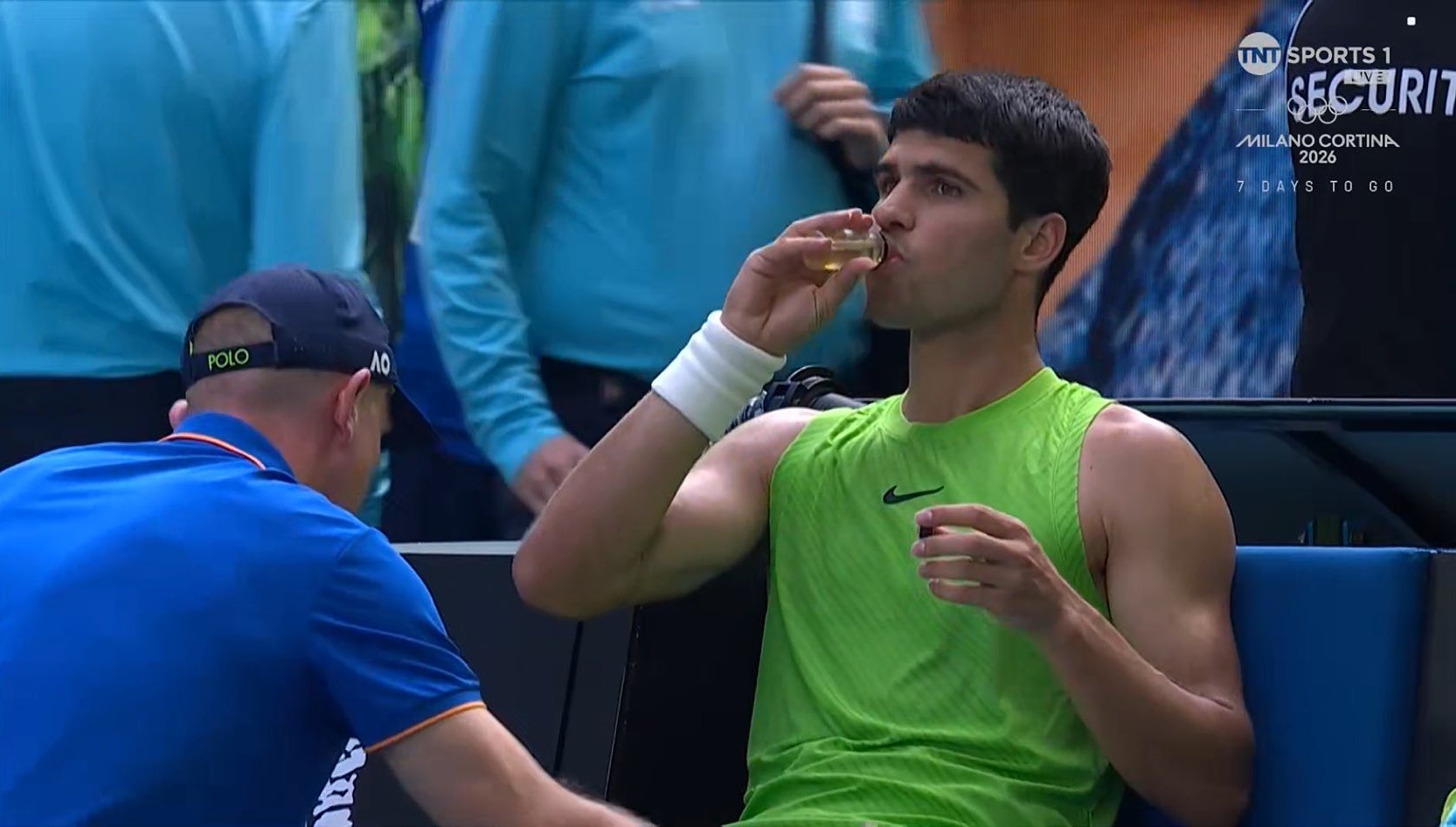 |
Alcaraz drinks pickle juice while being treated for cramps. Screenshot
Alcaraz's choice of beverage during the next break, as well as the massage he received on his other leg, further supported the theory that he was experiencing cramps. The six-time Grand Slam champion drank pickle juice – a beverage known to quickly relieve cramps.
What are cramps and why do athletes often experience them?
Cramps are sudden, involuntary contractions of one or more muscles. They cause pain, lasting from a few seconds to several minutes, and leave muscles sore for hours or even days afterward.
Geoff Scott, former head of medical and sports science at Tottenham Hotspur Football Club, explained that in hot playing conditions, athletes lose water and electrolytes through sweat. The deficiency of substances such as sodium, chloride, and potassium is significant, while muscles need these substances to function normally. As a result, athletes can experience dizziness, fatigue, and severe cramps.
According to experts, cramps reduce an athlete's ability to run at high intensity and affect technical skills due to faster fatigue. In the match against Zverev, Alcaraz's mobility was noticeably limited, and he constantly grimaced in pain, allowing his opponent to equalize before he had to push himself to win 3-2.
Before tournaments held in hot climates, athletes often train in heat tents or high-temperature simulation rooms. During competition, as a preventive measure, athletes often adjust their tactics, reducing the distance traveled. Yesterday, after the cramps, Alcaraz applied this: he only tried to anticipate and read his opponent's shots, minimizing sprints and trying to finish from the baseline.
Rehydration is a vital factor. Pickle juice is often used because it directly affects the nerves causing cramps rather than just the muscles, providing immediate pain relief due to its rich salt and potassium content.
Hoang Thong