In 1957, Chinese archaeologists excavated the tomb of Li Jingxun in Xi'an, Shaanxi province, north-central China. This site stands as the most intact and highest-ranking Sui dynasty tomb preserved to date. Li Jingxun, a young noble, died at just 9 years old and was interred in a grand, palace-shaped sarcophagus alongside a wealth of valuable grave goods, reflecting her significant status and the profound grief surrounding her early demise.
Li Jingxun was born in 599 in Longxi, now Gansu province, northwest China. She was a descendant of a prominent family, with her maternal grandmother, Yang Lihua, being the empress of Emperor Xuan of Northern Zhou and the eldest daughter of Emperor Yang Jian, the founder of the Sui dynasty. Li Jingxun was born during the Sui dynasty's (581-618) unification of the country following the fractured Southern and Northern Dynasties period (386-581), a crucial precursor to the glorious Tang dynasty (618-907).
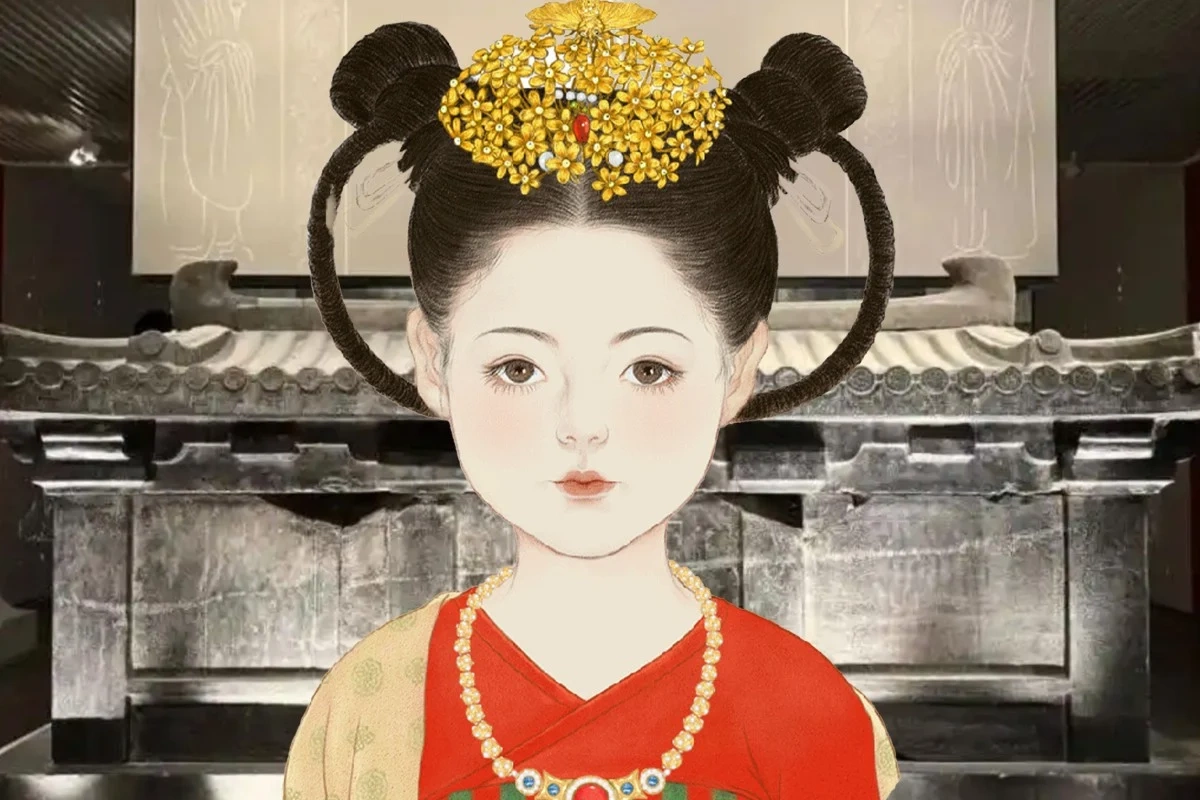 |
Portrait of Li Jingxun. Photo: SCMP |
Her grandmother raised and educated her, fostering an obedient and filial nature. While no original portrait exists, modern reconstructions depict her as a noble young lady with round double buns and smooth, porcelain-white skin.
In 608, Li Jingxun fell ill and died at the age of 9 at Fen Yuan imperial retreat, the Sui royal family's summer resort in Shanxi province. The reigning Emperor Yang of Sui, her maternal uncle, ordered her coffin to be brought to the capital with the highest honors, halting music and dance in the palace and observing a period of fasting and mourning.
Driven by sorrow, her grandmother violated a reigning imperial decree that mandated burials occur 3,5 km outside the capital. She ordered Li Jingxun to be interred at Wan Shan Temple within the capital, commissioning a magnificent multi-story pagoda above it. In traditional Chinese belief, constructing temples helped pacify the souls of short-lived children.
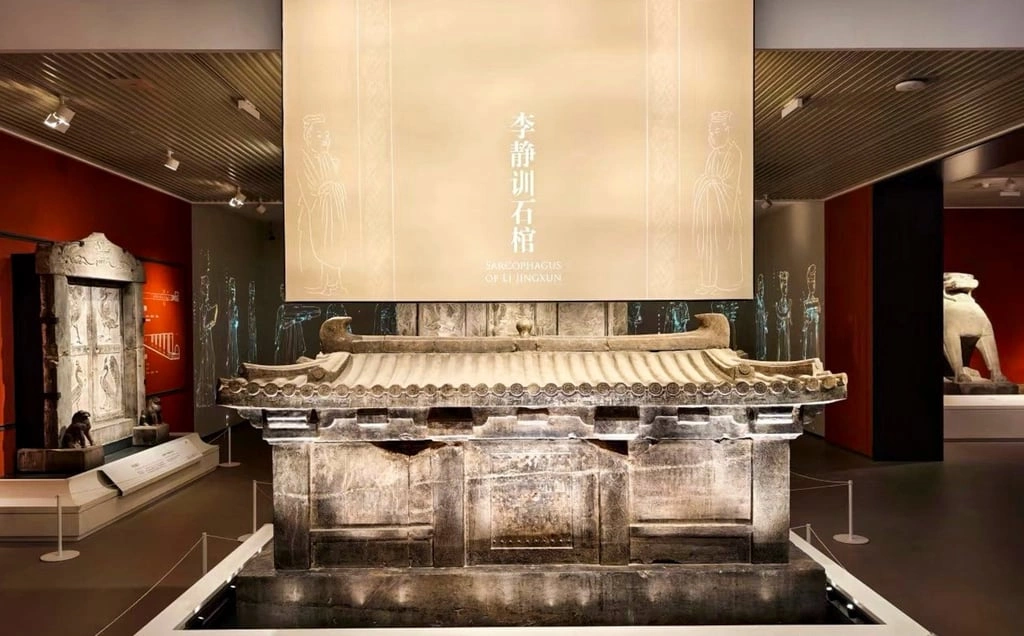 |
The 1:1 scale reconstruction of Li Jingxun's three-chamber palace-shaped stone sarcophagus on display at the National Museum of China in Beijing. Photo: SCMP |
Li Jingxun was laid in a three-chamber palace-shaped stone sarcophagus, inscribed with a warning: "Whoever opens this coffin shall die." Carvings of male guards, servants, lotus flowers, dragons, and vermilion birds adorned the doors, windows, and columns. The tomb epitaph recorded Li Jingxun's identity, birth and death dates, family lineage, funeral rites, and her grandmother's lament: "Like an orchid branch plucked too early, its beauty and future withered before blooming."
The tomb contained over 240 grave goods, including glass items, gold and silver jewelry, and daily necessities she might have used in life, such as: toys, cups, clothes, and silk textiles. Exquisite figurines of people and animals were likely placed by her grandmother to accompany her granddaughter in the afterlife. This abundance led Chinese media to call Li Jingxun "China's most cherished child." Among the notable artifacts were a crown crafted from gold wire, gold leaf, pearls, and gemstones, shaped like a cluster of flowers with a moth hovering above. The tomb also contained foreign items, such as Persian gold bracelets and perfumes.
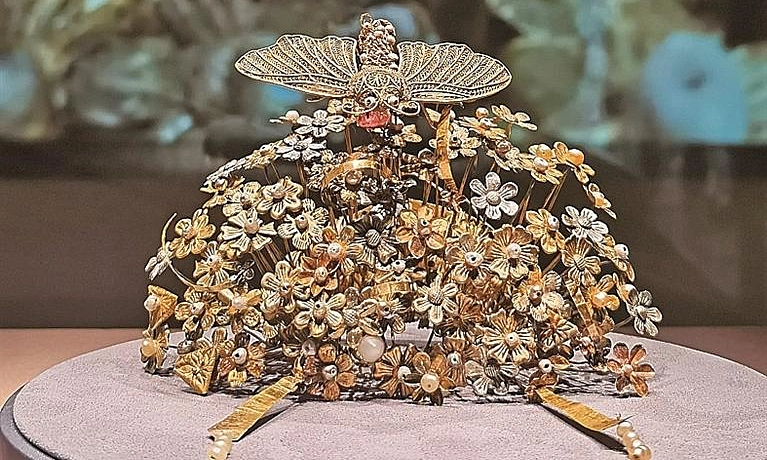 |
Li Jingxun's crown (headwear) made of gold, pearls, and gemstones. Photo: SCMP |
In April, the National Museum of China in Beijing opened an exhibition of Li Jingxun's artifacts, attracting millions of visitors. One visitor expressed, "I can feel the bond between grandmother and grandchild across millennia. After seeing the exhibition, I miss my late grandmother even more." Another commented, "Those who are loved never truly disappear, no matter how much time passes."
Hong Hanh (Source: SCMP)