The Faberge Easter Egg named "Winter Egg", commissioned by Tsar Nicholas II as a gift for his mother in 1913, was sold during a three-minute auction at Christie's in London on 2/12.
The 30,2 million USD price marks the highest ever paid for a work by Russian jeweler Peter Carl Faberge at auction.
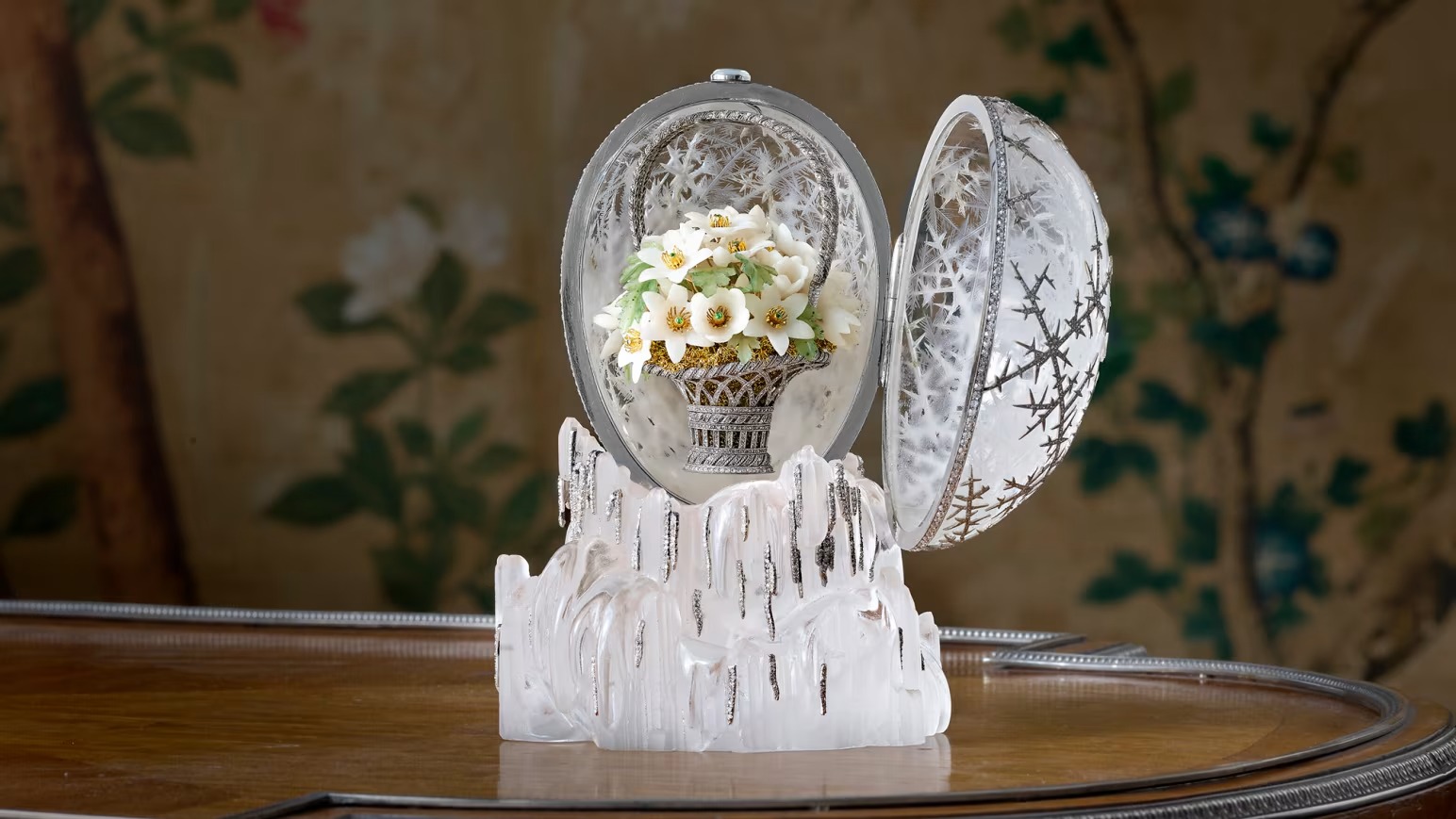 |
The Winter Egg. Photo: CNN |
The Winter Egg. Photo: CNN
This price reflects collectors' interest in the Imperial Eggs crafted by Faberge. This is the first such egg to be auctioned in over 23 years. Faberge created only 50 eggs, and the Winter Egg is one of seven privately owned; the whereabouts of others are unknown, or they are held by museums and institutions.
Margo Oganesian, head of Russian art at Christie's, stated that the record auction price underscores the significance, rarity, and technical and artistic excellence of the work.
These eggs were crafted for Nicholas II and his predecessor, Tsar Alexander III, serving as Easter gifts for family members from 1885 to 1916. Each egg took about one year to design and craft.
The Winter Egg is considered "the most artistic, the most distinct" among the 50 eggs, according to Oganesian. She noted that other eggs primarily feature French Rococo designs from the 1700s or Neoclassical styles from the mid-18th century, but the Winter Egg's design is "very modern, with a timeless style".
The egg is made of rock crystal, resembling a block of frosted ice, adorned externally with platinum snowflake patterns and 4.500 diamonds. Inside, it contains a miniature basket of anemones crafted from white quartz, demantoid garnets, and rhodolite garnets.
The Winter Egg was designed by a female jeweler named Alma Pihl, a rarity at the time. Pihl, granddaughter of Faberge's head jeweler Albert Holmström, conceived the idea after observing ice crystals forming on a window near her workbench.
The Winter Egg. Video: CNN
Nicholas II purchased the egg for 24.600 rubles, according to an invoice released by Christie's. After Nicholas II's overthrow during the Russian Revolution in 1917, jewelry and antique dealer Wartski acquired it in the late 1920s or 1930s for 450 British pounds (equivalent to 30.000 USD today). It then passed through several private collectors in England before disappearing in 1975.
The egg reappeared in 1994 at a Christie's auction in Geneva, selling for 5,6 million USD, a record for a Faberge Easter Egg at the time. It then changed hands again, setting a new record at a New York auction in 2002 for 9,6 million USD.
By Hong Hanh (According to CNN)