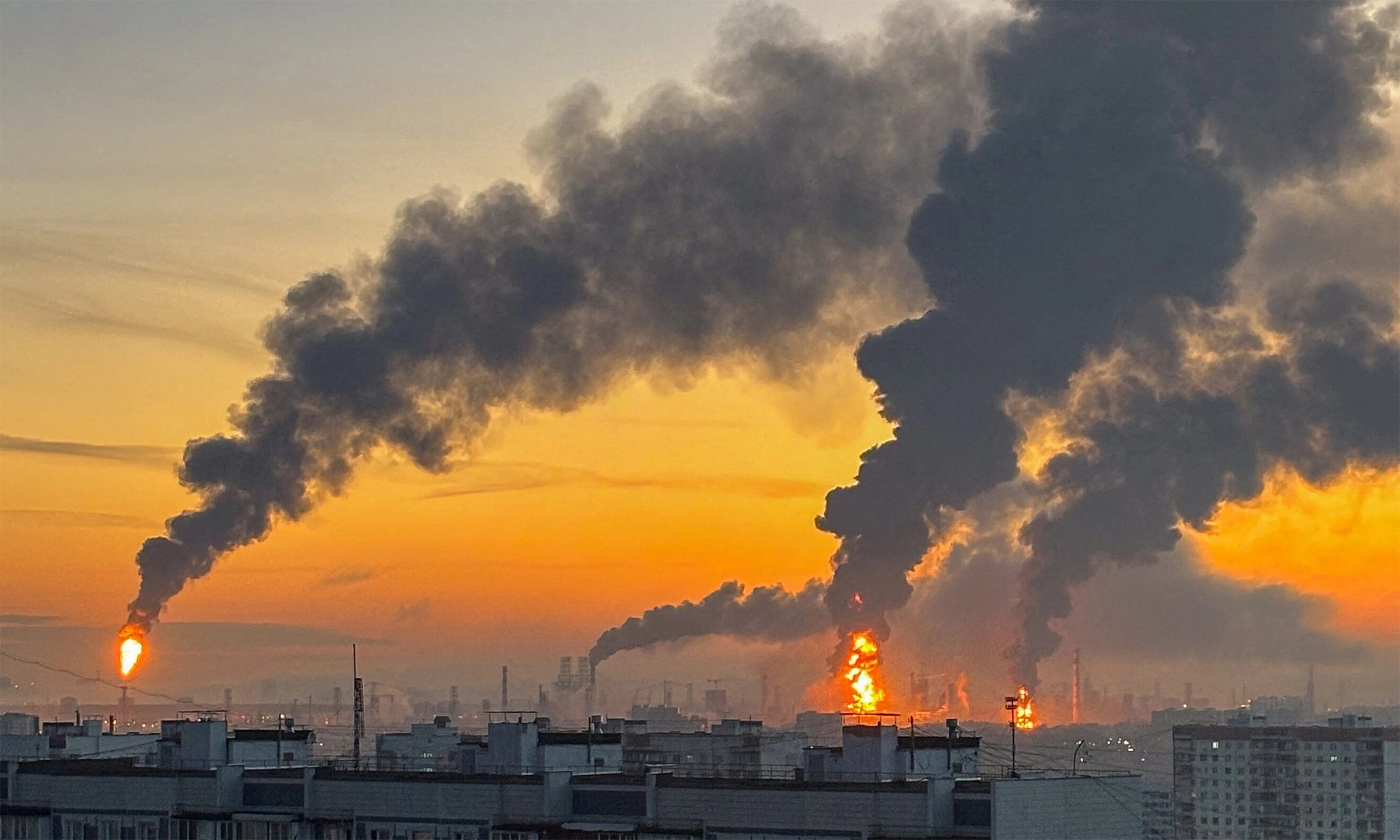
The Ukrainian Navy stated in an announcement today that it used the Neptune coastal missile system to strike the Borisoglebsk military airfield in Voronezh province on the night of 14/10. Secondary explosions and fires occurred at the airfield.
Initially, the force claimed to have destroyed 6 Su-34M fighter-bombers and supporting technical equipment. However, it later adjusted its statement to "hitting" the aircraft. The Ukrainian Navy emphasized that the attack weakened Russian air power and would reduce the intensity of tactical aircraft deployment, adding that "information is being clarified."
President Volodymyr Zelensky later declared that Ukraine used an extended-range version of the Neptune missile in the attack. He claimed the strike "destroyed 4 Su-34M fighter-bombers and hit two aircraft of the same type," adding that these aircraft were armed and ready for deployment.
Satellite images posted by President Zelensky showed damage at one of the parking areas at Borisoglebsk airfield after the attack, including two objects believed to be Su-34 wreckage.
AMK Mapping, an X account monitoring open-source intelligence on the Ukraine conflict, earlier published images of explosions and fires at the area believed to be Borisoglebsk airfield. Based on satellite images released by the open-source intelligence group AviVector, AMK Mapping assessed the attack destroyed 3 Su-34s.
 |
Debris (circled in red) believed to be Su-34 fighter-bomber wreckage in a satellite image posted on 15/10. Photo: X/ZelenskyyUa |
Fighter Bomber, a social media account of a Russian fighter pilot, confirmed the Borisoglebsk base was attacked but denied Ukraine destroyed six aircraft. The account stated, "I truly don't understand where they got that number. The important thing is there were no casualties in the incident."
The Russian Ministry of Defense has not commented on the information.
The Borisoglebsk base hosts the 783rd Aviation Training Center and units of Russia's 105th Combined Air Division. This division operates Su-34, Su-35, and Su-30SM aircraft, often deployed for strikes against Ukraine.
According to Ukrainian media, no Russian fighter jets were permanently stationed at Borisoglebsk airfield this summer. The facility often serves as a transit point for aircraft to refuel and receive ammunition before striking Ukrainian targets.
 |
Satellite image of Borisoglebsk airbase on 15/10. Photo: X/avivector |
The Su-34 fighter-bomber, developed during the Soviet era, began mass production in 2004 and entered service with the Russian air force in 2014.
The Su-34 primarily conducts bombing missions and launches guided missiles at ground targets but can also carry air-to-air missiles for air combat. The upgraded Su-34M variant features significant improvements in control systems, radar, sights, and communication equipment, alongside a substantial increase in guided weapon range.
During the Ukraine conflict, Su-34 squadrons primarily deploy glide bombs equipped with UMPK guidance kits and Kh-38 tactical cruise missiles against targets along enemy defense lines.
 |
Russian Su-34 fighter-bomber on a mission in 2022. Photo: RIA Novosti |
By the end of 2025, the Novosibirsk Aircraft Plant had produced a total of 212 Su-34 fighter-bombers, including 7 prototypes and pre-production versions. Recent annual production remained consistent, with 16 aircraft in 2024 and 18 in 2025, suggesting Western sanctions had little impact on Su-34 manufacturing.
Oryx, a Netherlands-based open-source intelligence tracking site, estimates at least 43 Russian Su-34 aircraft have been destroyed since the conflict began. Including non-combat incidents before and during the conflict, analysts estimate the Russian air force operates around 140 Su-34s, with about 85-90 aircraft combat-ready.
Pham Giang (According to Reuters, Ukrainska Pravda, RBC Ukraine)