On 29/1, global spot gold prices closed down USD 34 to USD 5,379 per ounce. During the session, prices at one point approached USD 5,100. Currently, the precious metal's price has recovered to USD 5,444 per ounce.
"We have seen strong sell-offs after the precious metal's recent consecutive new highs", stated David Meger, Director of Metal Trading at High Ridge Futures.
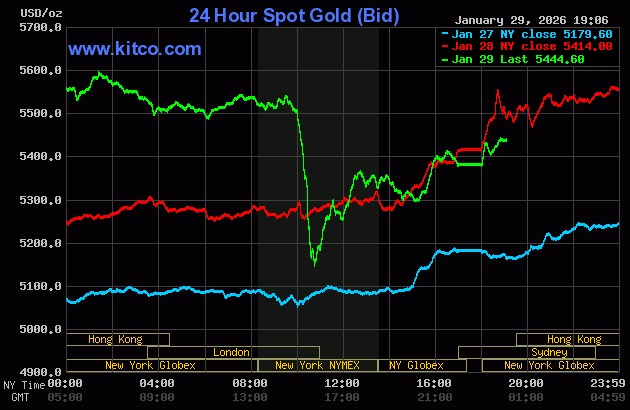 |
Spot gold prices fell sharply on 29/1. *Chart: Kitco* |
Despite this dip, prices still rose 7% from the beginning of the week and 24% this month. This could be the best performing month since the 1980s.
UBS bank raised its gold price forecast to USD 6,200 by the end of Q3 this year. However, prices could retreat to USD 5,900 by year-end.
Global gold demand has recently surged due to economic and geopolitical instability. US President Donald Trump urged Iran to negotiate a nuclear weapons deal, warning that upcoming attacks "will be worse" otherwise. Tehran responded by stating it would retaliate against the US, Israel, and their supporters if attacked.
The CEO of Tether, the world's largest stablecoin issuer, announced on 28/1 that it would allocate 10-15% of its portfolio to gold. The planet's largest gold trust, SPDR Gold Trust, also recorded its highest gold reserves in four years.
Spot silver prices lost 2.1% to USD 114 per ounce. Since the beginning of the month, silver prices have increased more than 60% due to supply shortages and investor buying.
Spot platinum prices fell 3.2% to USD 2,602 per ounce. Palladium also lost nearly 4%, reaching USD 1,996.
Guy Wolf, Director of Market Analytics at Marex, noted that these markets are relatively small compared to gold or US stocks. Therefore, silver, platinum, and palladium are vulnerable to speculative capital flows. "Their prices do not move according to actual physical demand", he concluded.
Ha Thu (according to Reuters, Kitco)