Closing the trading session on 8/4, all three key US stock market indices rose. The DJIA gained over 1,300 points, or 2.85% – its highest increase since 4/2025. The S&P 500 and Nasdaq Composite added 2.5% and 2.8% respectively.
Over 70% of sectors within the S&P 500 index saw gains of 2% or more, with industrials leading the rally. Energy was the sole declining sector, falling 3.7%, pulled down by a drop in crude oil prices.
Sectors most affected by the conflict also saw improvements. Airline, travel, and construction stocks all added 4.9-5.7%.
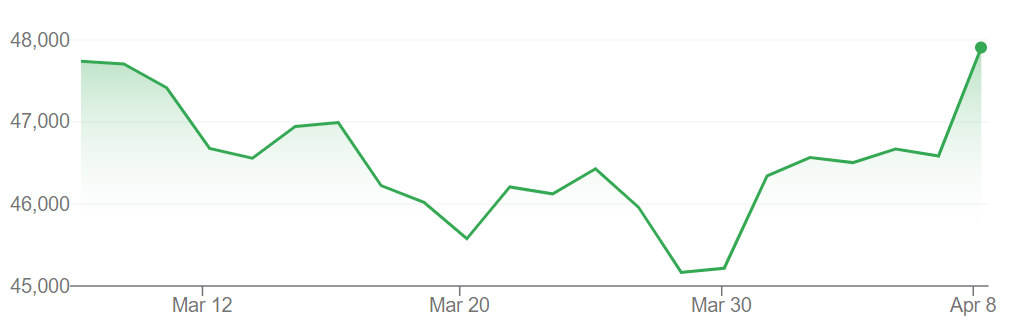 |
DJIA index performance over the past month. Chart: Google Finance |
The US stock market surged immediately after opening, as investors welcomed news of the US-Iran two-week ceasefire. The Middle East conflict, ongoing since 28/2, had disrupted financial markets, interrupted global oil and gas flows, and fueled inflation concerns.
A senior Iranian official told Reuters that the Strait of Hormuz – which transports about 20% of global oil – could reopen on 9/4 or 10/4, ahead of peace talks, if parties reach a ceasefire framework. On 8/4, Iranian media reported the country was suspending vessel transit through the Strait of Hormuz and threatened to withdraw from the ceasefire agreement due to continued Israeli attacks on Lebanon.
"There's still a lot of work to be done, but I think the market is seeing a recovery in the hardest-hit sectors", said Mike Dickson, Portfolio Manager at Horizon Investments.
Not only the US, but European stocks also gained. The Stoxx 600 index, which tracks regional stocks, added 3.9%, its highest in one year.
"Most countries are more vulnerable to an energy shock than the US. Therefore, the ceasefire provides short-term relief for global investors", stated Ross Mayfield, Investment Strategy Analyst at Baird.
Brent and WTI crude oil prices closed yesterday's session down 16.4% and 13.3% respectively, falling below USD 100 per barrel. However, prices rebounded this morning, 9/4, currently at USD 97 per barrel.
Ha Thu (according to Reuters)