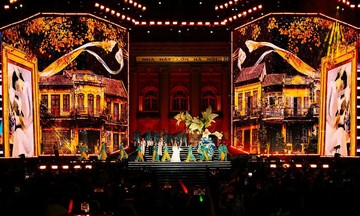
Mai Tuyet Hoa, a renowned xam artist, has embarked on a unique musical journey, collaborating with her 19-year-old son, bamboo flute artist Nam Khanh, for the first time. Their joint effort culminates in the new album, "Xam trong coi doi", which blends traditional xam art with a contemporary touch. The album was launched in Hanoi on 3/2.
A highlight of the album is "Tranh xa te nan", composed by Nguyen Quang Long. This piece serves as a mother's heartfelt warning to her child about life's temptations. Structured as a dialogue, Mai Tuyet Hoa performs the xam vocals while Nam Khanh responds to his mother's questions and provides harmonies at the song's conclusion.
Nguyen Quang Long's arrangement for "Tranh xa te nan" incorporates "xam tau dien" (tram xam) at the beginning and end, emphasizing the mother's concerns. For the climax, the music shifts to "dieu Sai" (Sai tune), aiming to symbolically "exorcise" negative influences like drugs. Initially, Mai Tuyet Hoa was hesitant about the collaboration, fearing Nam Khanh might find xam challenging. However, she was surprised by his studio performance, which captured a youthful spirit while honoring the traditional art form. "Listening to the recording, Nam Khanh also felt excited", she shared.
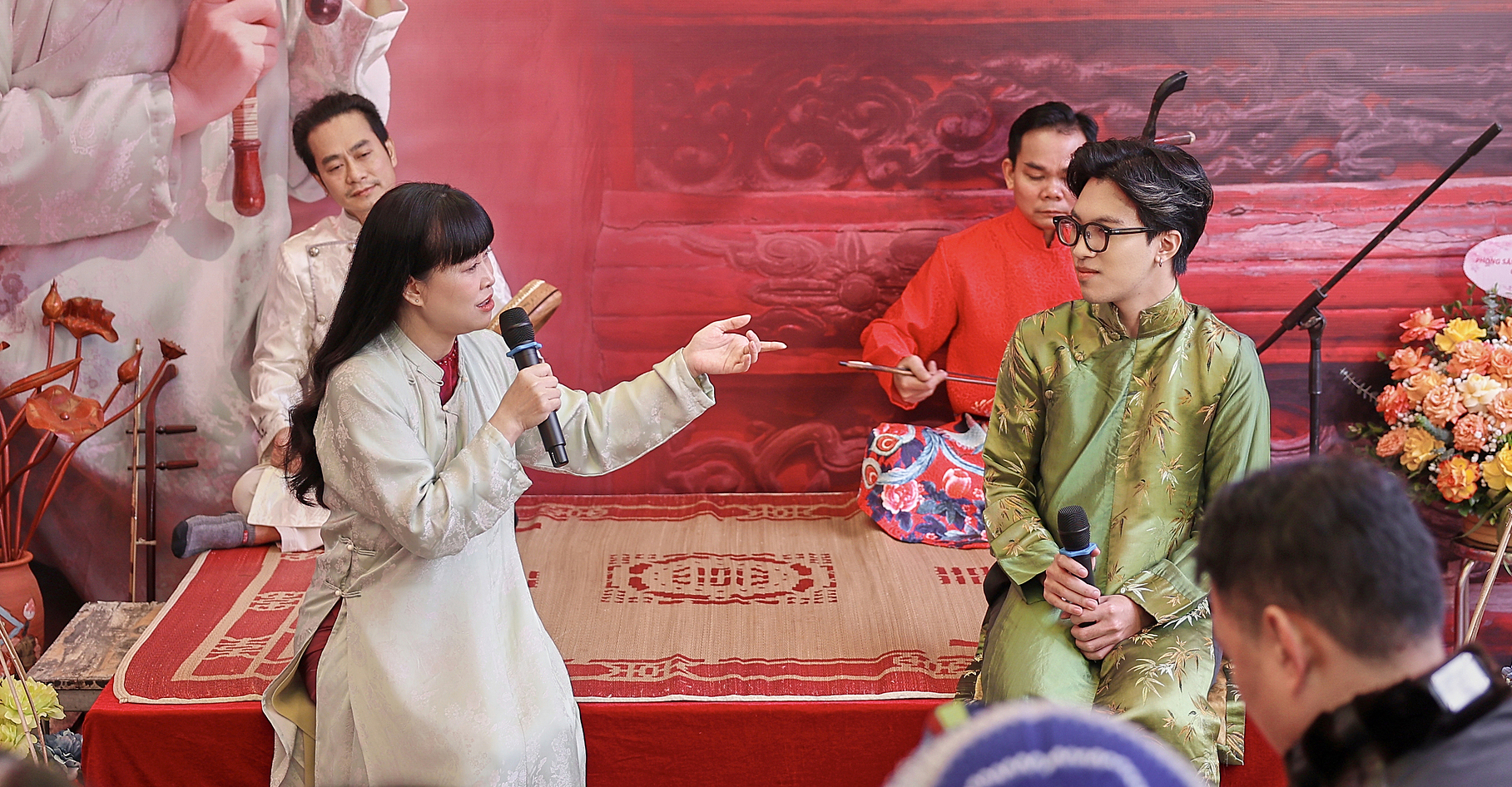 |
Mai Tuyet Hoa and her son at the album launch in Hanoi, on 3/2. Nam Khanh is currently a 5th-year student, majoring in bamboo flute at the Traditional Instruments Department, Vietnam National Academy of Music. Photo: Hoa Nguyen |
"Xam trong coi doi" features nine works, including the ancient xam piece "Dat nuoc canh beo", chosen by Mai Tuyet Hoa as a tribute to her esteemed teacher, the late xam artisan Ha Thi Cau. The album also reintroduces two other ancient xam songs, "Vo chong co bac" and "Mot quan la sau tram dong", which Mai Tuyet Hoa helped restore alongside notable figures such as Professor Doctor Pham Minh Khang, musician Thao Giang, Hanh Nhan, and People's Artist Thanh Ngoan. Mai Tuyet Hoa explained her choice to interweave ancient and contemporary xam, hoping to evoke a sense of connection to their roots and promote these melodies in modern life. She adapted her singing style in the album for a fresh sound, for instance, performing "Mot quan la sau tram dong" and "Tranh xa te nan" with a faster "xam tau dien" tempo.
The remaining songs in the project were composed by Nguyen Quang Long. He shared that he entrusted these Hanoi-themed compositions to Mai Tuyet Hoa because her voice, while distinct from her mentor's folk depth or the poignant delivery of pre-revolutionary xam artisans, embodies a modern Hanoi street xam singer. He noted that each of his pieces tells a unique story, preserving the spirit of traditional xam while incorporating a contemporary feel.
Mai Tuyet Hoa, 50, is widely recognized as an outstanding successor to the late xam artisan Ha Thi Cau. Despite not being born into an artistic family, her father guided her toward the "dan nhi" (two-stringed fiddle) from a young age. At 8, she enrolled in Hanoi College of Arts, pursuing elementary and then intermediate studies in "dan nhi". What began as an imposed study gradually became a serious pursuit, leading her to specialize in "dan nhi" at the Traditional Instruments Department of the Hanoi Conservatory of Music (now Vietnam National Academy of Music).Mai Tuyet Hoa's deep connection to xam began in 1996 while collaborating with the Institute of Music, part of the Vietnam National Academy of Music, where she discovered Ha Thi Cau's voice on old recordings. Her interest deepened in 1998, leading her to Ninh Binh in 2000 to meet Ha Thi Cau. She spent weeks immersing herself in the artisan's rhythms, phrasing, and vocal delivery. She continued her learning journey, seeking guidance from experts such as Tru Nguyen, Than Duc Chinh, researcher Dang Hoanh Loan, musician Hanh Nhan, People's Artist Xuan Hoach, and Meritorious Artist Van Ty. Since 2005, she has actively promoted xam, co-founding the Xam Ha Thanh group with Nguyen Quang Long, which has brought this art form to various venues in Hanoi. She currently serves as the Director of the Center for Research, Preservation and Development of Ethnic Music.
Phuong Linh