* Article for the "My Favorite Book" column
Many generations of Vietnamese children grew up nurtured by fantastical stories: the kind Tam emerging from a fragrant market apple, the magic crossbow firing a thousand arrows at once, or the three-year-old Phu Dong Thien Vuong riding an iron horse to quell invaders. While these may seem like products of imagination, the nation's history truly saw a generation live lives even more vibrant and epic than fairy tales. These were the teenagers who stepped from the pages of Phung Quan's prose.
I discovered 'Fierce Childhood' quite by chance. It was on a cold winter evening, the weather in Northern Vietnam biting. While browsing a used bookstore, I stumbled upon this book, tucked away amidst countless brightly colored covers. As a used book, its pages were naturally yellowed, even stained with dark spots. Frankly, at the time, I had no idea what treasures lay within, but the moment I saw it, I decided I had to buy and read it.
'Fierce Childhood' is a novel by author Phung Quan, which he "began writing by West Lake in 1968" and "completed in a grass hut by Tinh Tam Lake in 1986." The book chronicles the truly "fierce childhood" of teenagers, merely 12, 13, and 14 years old, belonging to the Tran Cao Van Regiment's Youth Scout squad. The edition published by Kim Dong Publishing House divides this novel into two parts. While part one records the combat and daily lives of over 30 squad members, part two largely focuses on the escape of the character Luom-sut from Thua Phu prison, as well as stories centered on the friendship and family of close companions Mung and Quynh-son-ca.
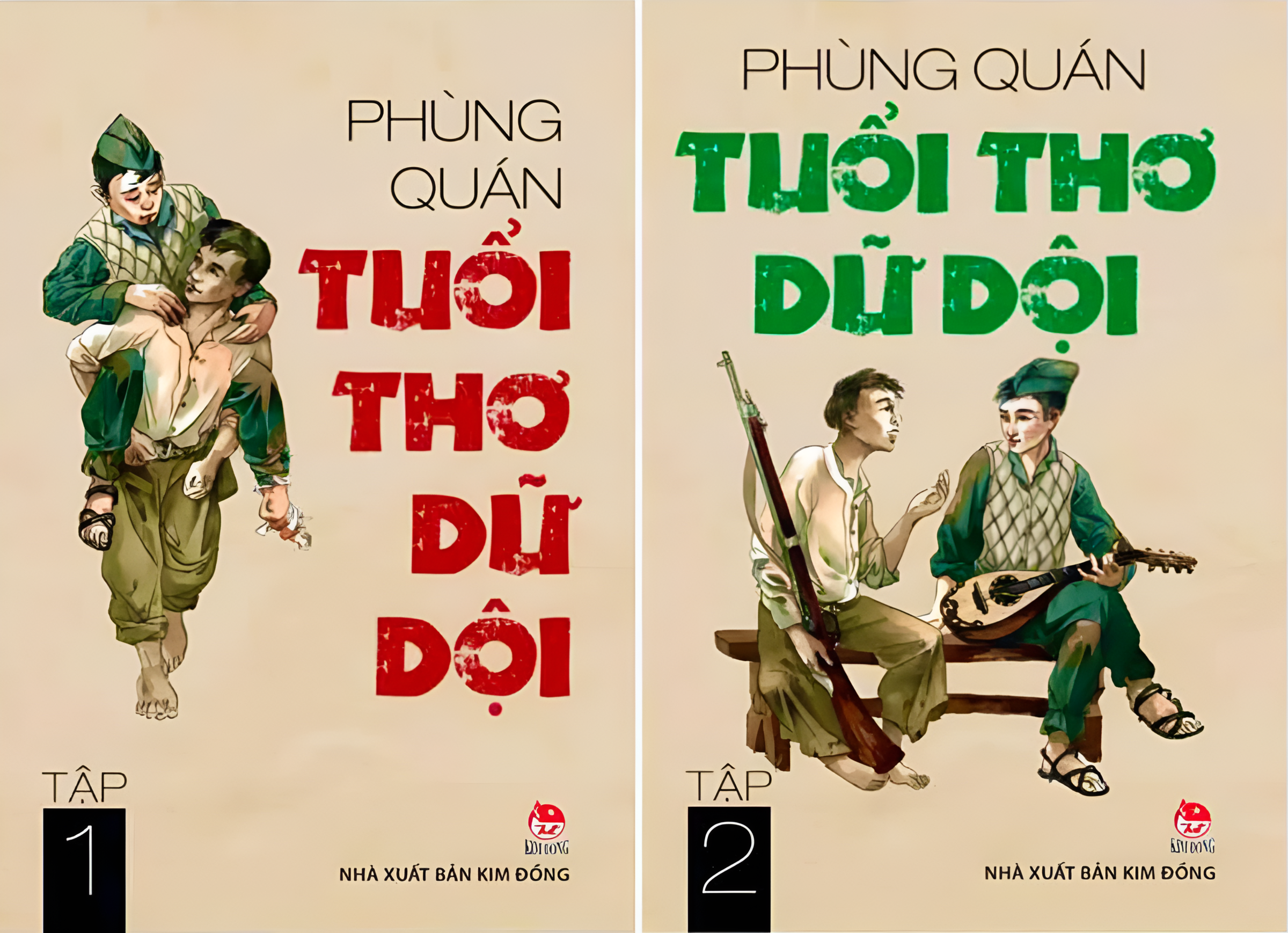 |
Two volumes of the work "Fierce Childhood," published by Kim Dong Publishing House. Photo: Fahasa
If someone were to ask me about my favorite book, it would be difficult to give an answer. But if asked which book is most worth reading, I would unhesitatingly choose 'Fierce Childhood'.
There are two main reasons for this. The first is Phung Quan's unique approach to depicting war: through the eyes of children. While "Tay Tien" or "Bai Tho Ve Tieu Doi Xe Khong Kinh" evoke a proud, heroic spirit, and "Nhat Ky Dang Thuy Tram" can be likened to a "gentle, low note in an epic symphony," 'Fierce Childhood' offers an intriguing blend.
War, in the eyes of these young squad members, was simultaneously grand, sacred, intimate, endearing, beautiful, and full of hope. They loved their homeland and the revolution with a pure love, just as naturally as they loved their grandparents and parents. In their imagination, victory over the enemy was a noble goal, yet that victory also seemed to merge with the childish satisfaction of winning a football match or a cricket fight. Through the children's perspective, war appeared simple: defeat the French invaders and they would return home, go to school. Amidst the smoke and fire, innocent dreams for the future still shone brightly, so innocent that they evoke deep sorrow in the reader.
Above all, beyond being a literary work, 'Fierce Childhood' reminds us to cherish "the childhoods yet to be born," as author Hoang Phu Ngoc Tuong put it. The 32 members of the Youth Scout squad were just children. At an age when they should have been attending school and nestled in their parents' arms, they were instead thrust into the battlefield to confront the enemy.
Without war, Vinh would not have died at 14. Without war, Quynh would have continued his education and played the piano. Without war, Luom would not have been brutally tortured in detention, nor would he have had to learn to wield a gun to kill at just 14 or 15. For others, life might extend to 60, 70, or even a hundred years, but for these young squad members, their lives lasted only a dozen years.
So many dreams remained untouched, so many plans unfulfilled, buried beneath a hail of bombs and bullets. Mung's mother never made it to a Government hospital for her asthma treatment. The commander of the C front never brought Ve home for schooling. Ve and Hien never fulfilled their promise to "live together once the French are defeated." And Quynh-son-ca, he dreamed of composing a beautiful piece of music for Hue's Huong River, one as good as "The Blue Danube." But in the end, before the music could take shape, he passed away at 13, dying in extreme pain and resentment.
Cao Ba Quat once wrote a couplet about Phu Dong Thien Vuong: "Pha tac, dan hiem tam tue van/Dang van, khuoc han cuu thien de" (At three, quelling invaders, I resented the delay / Reaching nine heavens, I still felt it too low). Everyone knows the story of Thanh Giong, who at three years old rode an iron horse to defeat the An invaders. But with 'Fierce Childhood', this is not a legend, nor is it a product of imagination. The 32 children are real - flesh and blood; 32 young lives pushed into an unwanted war due to adult greed are also real.
Children are a part of the world and the future of humanity. So why do adults exclude them from consideration when drafting ambitious plans for invasion, only to then force innocent children to suffer amidst smoke and stray bullets?
Therefore, reflecting on the war endured by the Tran Cao Van Regiment's Youth Scout squad, we must not only remember a glorious and proud era but also acknowledge the severe consequences that befell countless children. Whether in the past or present, 'Fierce Childhood' remains a wake-up call, urging us to feel compassion, empathy, and to cherish every young life. The past consists of what has happened, but the future is not immutable. The nation's wounds from the previous century still linger, and the choice of whether to allow those harms to recur for any generation or nation lies entirely in our hands.
Vu Cam Linh
11th-grade student, Literature 1 class, High School for the Gifted in Social Sciences and Humanities