


The art program on 10/1 in Hanoi brought together two major figures in Vietnamese music, creating a multifaceted emotional tapestry. Though seemingly distinct, the two composers' styles converged in their profound humanism.
For both, love was a persistent and enduring wellspring, expressed through simple notes and poetic verses. "Even though the two composers are gone, their works remain, allowing us to forever reminisce," said singer Hong Nhung.
Bang Kieu sings "Con tuoi nao cho em" (Trinh Cong Son).
Narrator Le Khanh, along with singers Hong Nhung, Bang Kieu, Ngoc Anh 3A, and Quang Ha, recreated moments from the lives and souls of the two composers. During his lifetime, Phu Quang once remarked, "I deeply empathize with Son's sorrows, which few truly understood." On one occasion, Trinh Cong Son sat pensively at Phu Quang's cafe, watching the rain and bustling traffic, then declared, "Life is beautiful!" He passed away over one month later. Out of respect and admiration, Phu Quang had previously organized several concerts featuring his and Trinh's music.
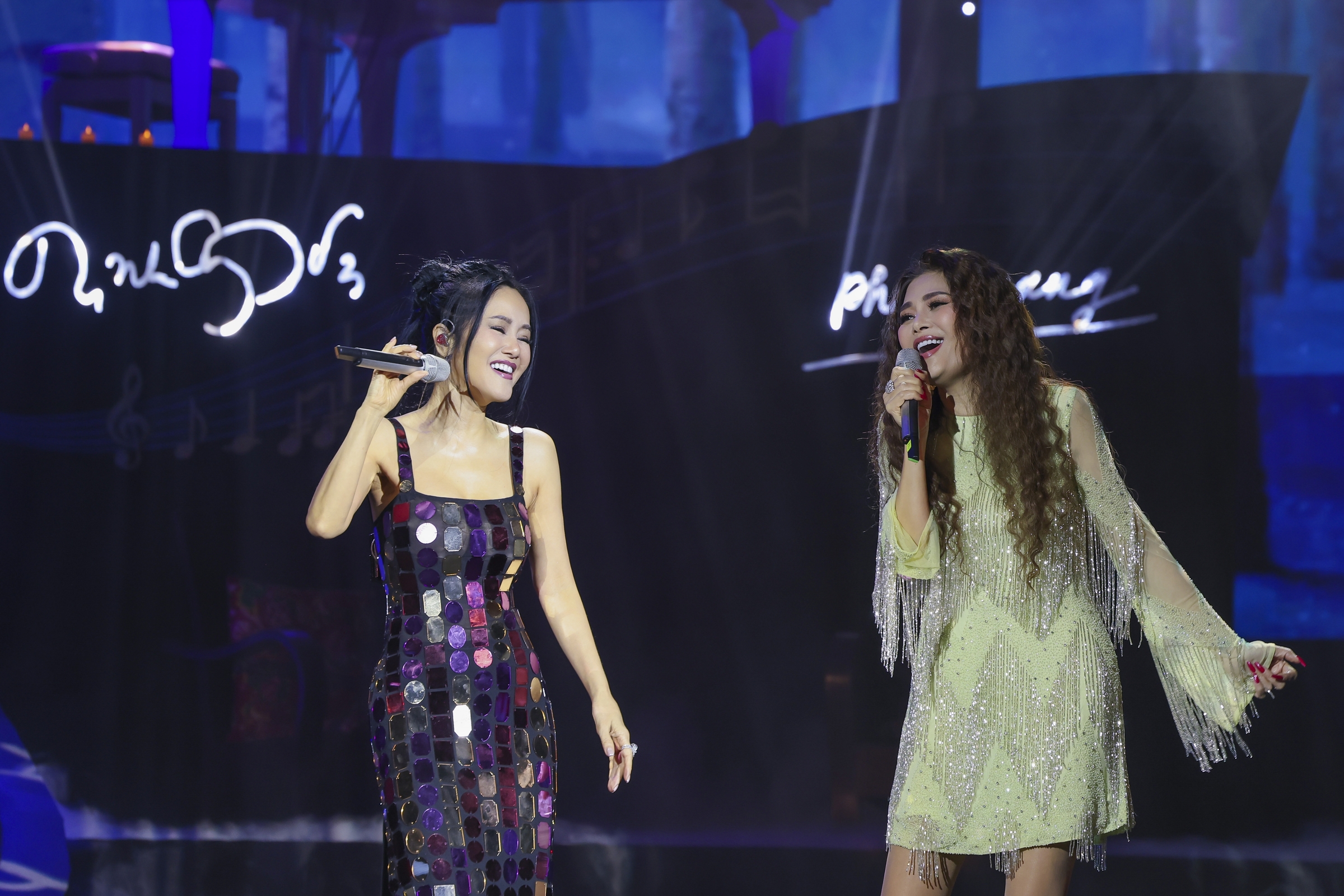 |
Singer Hong Nhung (left, Trinh Cong Son's "muse") and Ngoc Anh 3A (praised by Phu Quang for best performing his music). *Photo: Manh Nguyen*
This time, as editor, Giang Huong, Phu Quang's daughter, curated works with common themes, creating a dialogue between the two composers. They both wrote about the street, Hanoi, distant paradise, mothers, and life. Each melody served as a narrative, distinct yet harmoniously blended.
Both Phu Quang and Trinh Cong Son composed significant works about mothers. While singing "Huyen thoai me" (Legend of Mother), Hong Nhung recalled her first recording session with Trinh Cong Son in a small attic. He listened silently, then sat on the floor, weeping.
Actress Le Khanh reads a letter by Phu Quang about his mother.
For Phu Quang, the longing for his mother was embodied in her heartbroken gaze as her son left Hanoi to build a life elsewhere. During his years away, he tried to write about her multiple times without success. Only upon returning to his old home, remembering his deceased mother and her lullabies, did he complete the song "Me" (Mother).
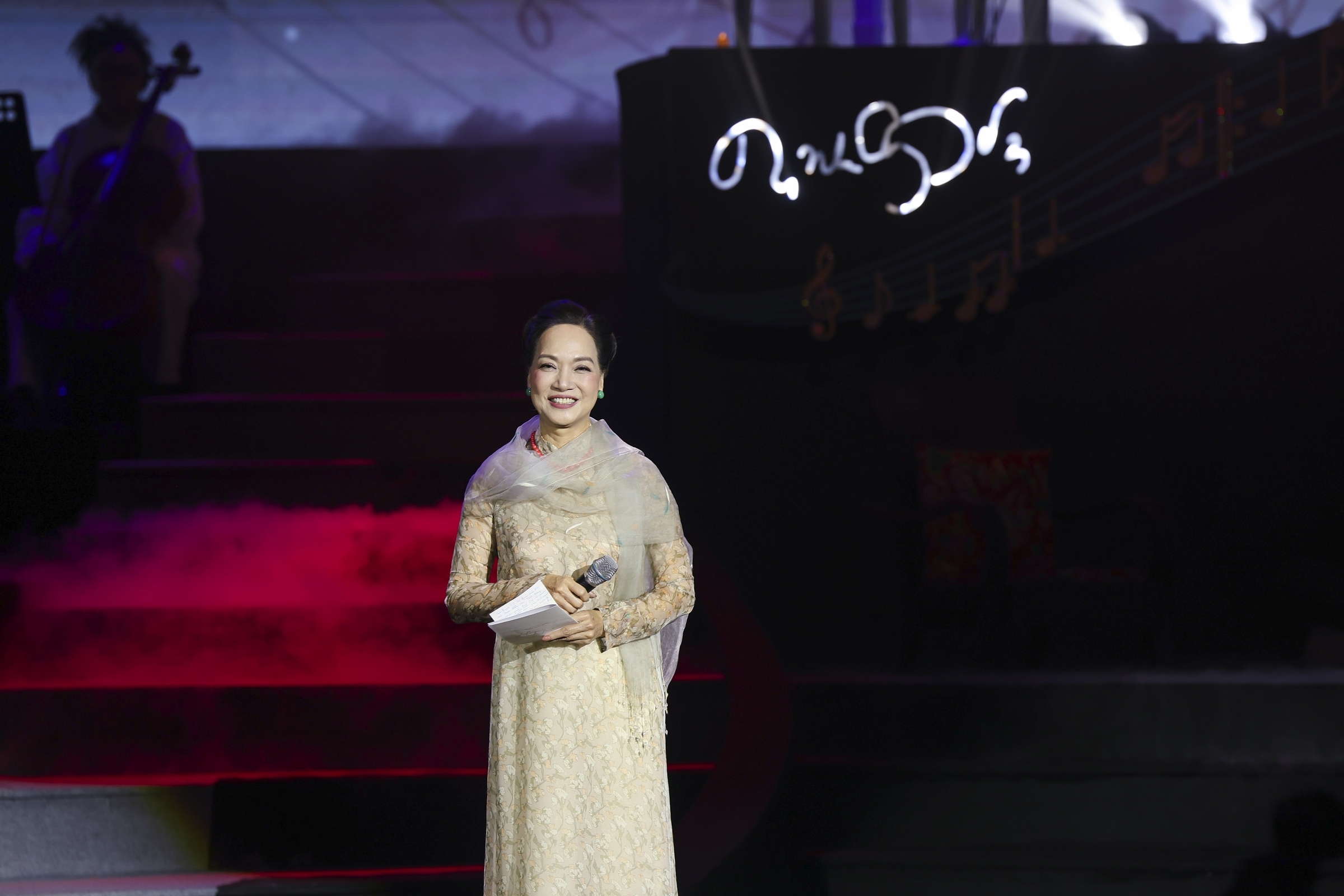 |
Actress Le Khanh, the narrator for the concert. *Photo: Manh Nguyen*
Through "Nho mua thu Ha Noi" (Remembering Hanoi's Autumn), Hong Nhung transported the audience to street memories of the 1980s, seen through the eyes of the traveler Trinh Cong Son. Hanoi emerged as an ethereal, picturesque vision.
Phu Quang's Hanoi was tangible, present in every street, flower scent, and corner, linked to everyday partings and losses. "Em oi Ha Noi pho" (Oh My Hanoi Street) expressed sadness over a changed Hanoi, while "Ve lai pho xua" (Returning to the Old Street) represented a return that haunted the composer.
Singer Hong Nhung performs "Nho mua thu Ha Noi".
Hong Nhung and Bang Kieu, both born and raised in Hanoi, shared a strong empathy with Phu Quang. Compared to her younger self, Hong Nhung now demonstrated greater emotional and technical mastery. Bang Kieu evoked 1980s street memories by recounting his narrative from the music video "Em oi, Ha Noi pho": "I was born and grew up on a small street behind Hang Co station – Ngo Si Lien street. As a child, every summer, my friends and I would climb the green, leafy bang trees lining the street to find ripe yellow bang fruits and share them."
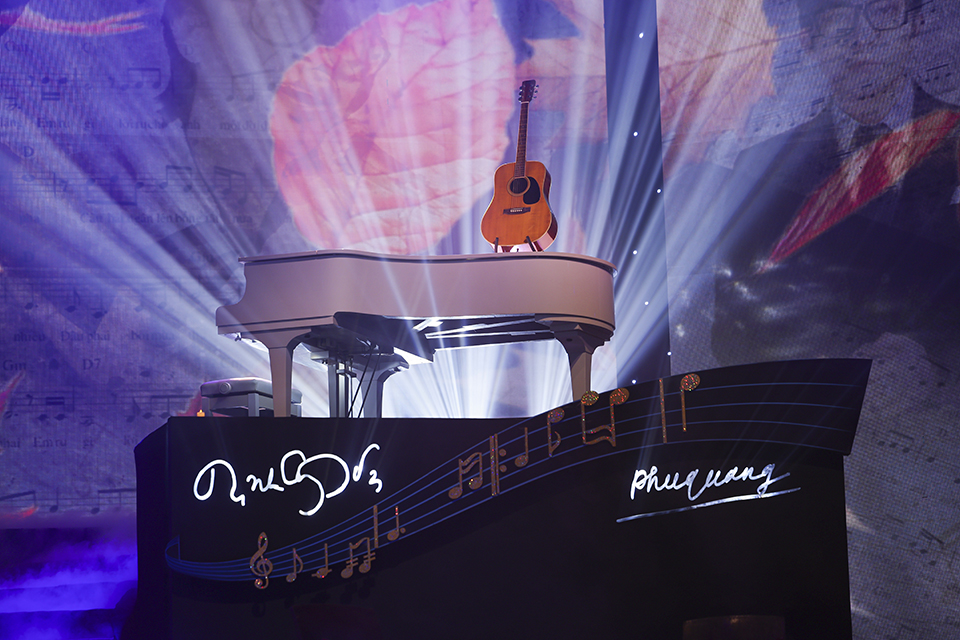 |
The stage design featured a piano, associated with Phu Quang, and a guitar, associated with Trinh Cong Son. *Photo: Manh Nguyen*
The program distinguished itself in staging and arrangement. Over three hours, the four vocalists performed about 30 musical pieces, creating an emotional flow that alternated between poignant and soaring. Highlights included collaborations like Bang Kieu and Quang Ha performing "Mua hong" (Pink Rain) by Trinh Cong Son, and Hong Nhung with Ngoc Anh 3A singing "Chieu dong Matxcova" (Winter Afternoon in Moscow) by Phu Quang. The show concluded with a message of love, conveyed through songs: "Dieu gian di" (Simple Thing) by Phu Quang and "Hay yeu nhau di" (Let's Love Each Other) by Trinh Cong Son.
Most of the audience at the Viet Xo Friendship Cultural Palace remained until the very end. Huyen Thanh, 46, from Hanoi, commented, "Trinh's music is contemplative, and Phu Quang's is poignant. It felt like I was transported back to my youth, listening to these songs on the radio. The new arrangements were balanced, preserving the original spirit of the songs, and truly moving."
Article, video: Ha Thu


