A team of researchers from South Korea and the United States has developed a robot technology that allows people to dress themselves without using their hands or needing assistance. This innovation is expected to have applications in clean rooms for semiconductor chip manufacturing and for emergency response forces.
Developed by scientists from the Korea Advanced Institute of Science and Technology (KAIST) and Stanford University, the technology uses flexible "soft vines" integrated within garments. These vines operate using air pressure; when inflated, they pull the fabric close to the wearer's body, similar to how ivy clings to surfaces. The system functions even when the wearer is moving, eliminating the need to stand still.
Kim Nam Gyun, a post-doctoral researcher at KAIST and the lead author of the study, shared his inspiration with Reuters: "I came up with this idea while riding my bicycle when it suddenly started to rain. At that moment, I thought it would be useful to have a raincoat that could put itself on me even while I was still cycling."
Robot helps people get dressed. Video: Reuters
According to Kim, the vine-like robot moves close to the body, donning clothes by turning the inside of the garment outwards. This method allows it to stably adhere to the body's contours. The entire process of putting on a complete outfit takes about 10 seconds.
A key feature of this technology, researchers noted, is that it does not require the wearer to stand still and avoids complex control algorithms.
Inspired by ivy, the robot moves by extending the tip of its "vine" rather than pulling its entire body forward. Professor Ryu Jee-Hwan, a lecturer in Civil and Environmental Engineering at KAIST, explained that this mechanism allows the robot to stably adhere to curved surfaces.
"The robot can pass through narrow gaps, flexibly adapt to the shape of its surroundings, and still move on various types of surfaces, whether slippery, adhesive, or inclined," he said.
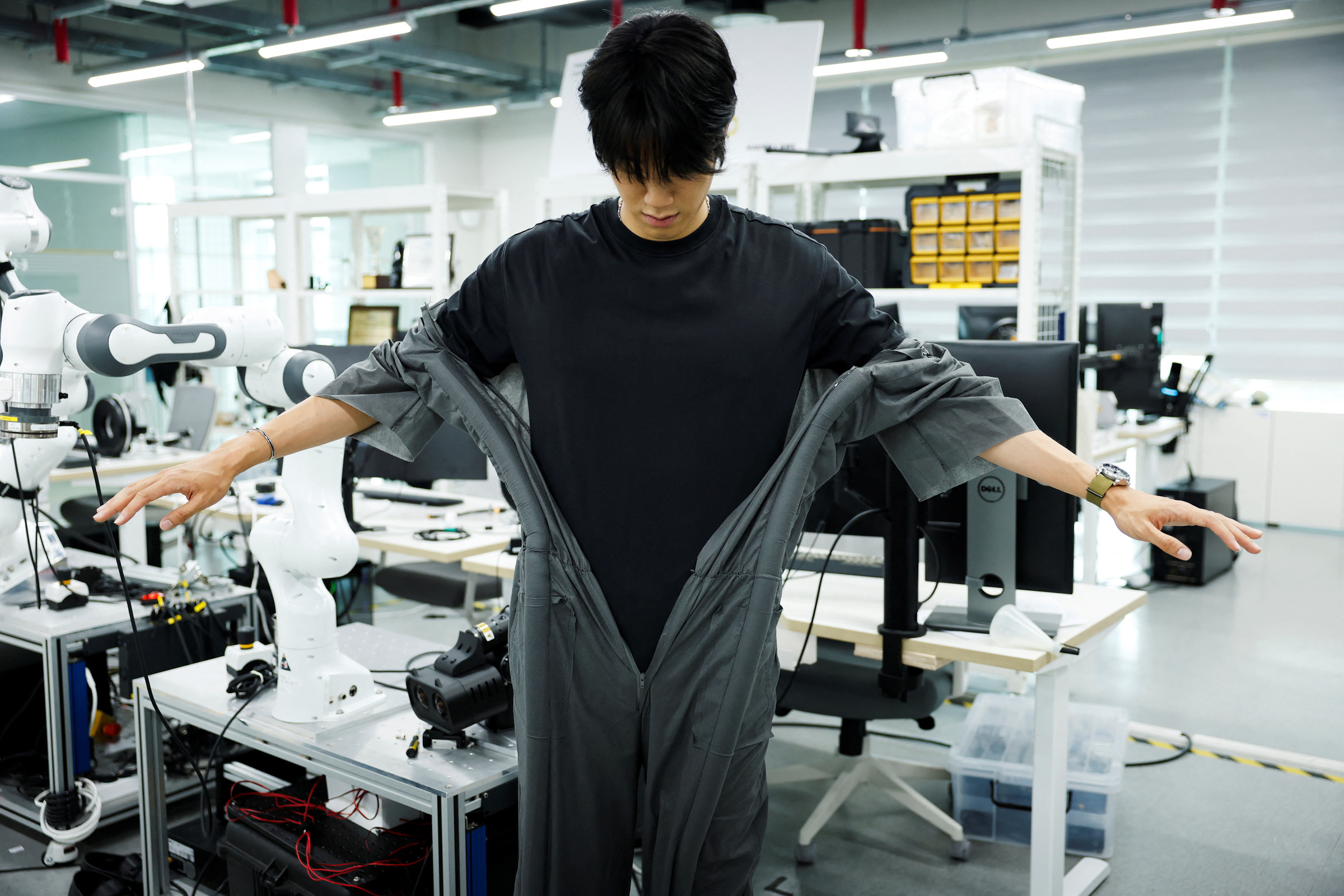 |
Hwang Jae Yun, a doctoral student in Civil and Environmental Engineering at KAIST, demonstrates the self-dressing robot at the institute's laboratory in Daejeon, South Korea, on 14/7. Photo: Reuters
Beyond assisting the elderly and people with disabilities in daily activities, the research team sees potential applications in environments requiring rapid donning and doffing of protective gear without using hands. Examples include clean rooms in semiconductor factories or for search and rescue forces who must use personal protective equipment.
Professor Ryu highlighted that while much attention currently focuses on software operating systems amidst the rapid development of artificial intelligence, the self-dressing robot demonstrates that breakthroughs in mechanical engineering also play a crucial role, alongside advancements in AI and software.
The research findings were published in IEEE Robotics and Automation Letters, a peer-reviewed scientific journal specializing in robotics and automation.
Hoa Mi (according to Reuters)