


In 11/2025, The Conversation published an essay by Italian scholar Francesco Agnellini, a lecturer in data and digital studies at Binghamton University in New York. The article discussed the future of writing in an era of advanced artificial intelligence (AI). This publication followed a research project announced in 10/2025 by US SEO company Graphite, which revealed that over 50% of internet content is AI-generated. Graphite collected this data by analyzing 65,000 English articles published from 1/2020 to 5/2025.
Agnellini titled his essay "More than half of new articles on the internet are being written by AI - is human writing headed for extinction?", referencing Graphite's findings. As an AI expert with a background in philosophy and art, Agnellini began his essay by highlighting the increasing difficulty in distinguishing between human- and AI-written content.
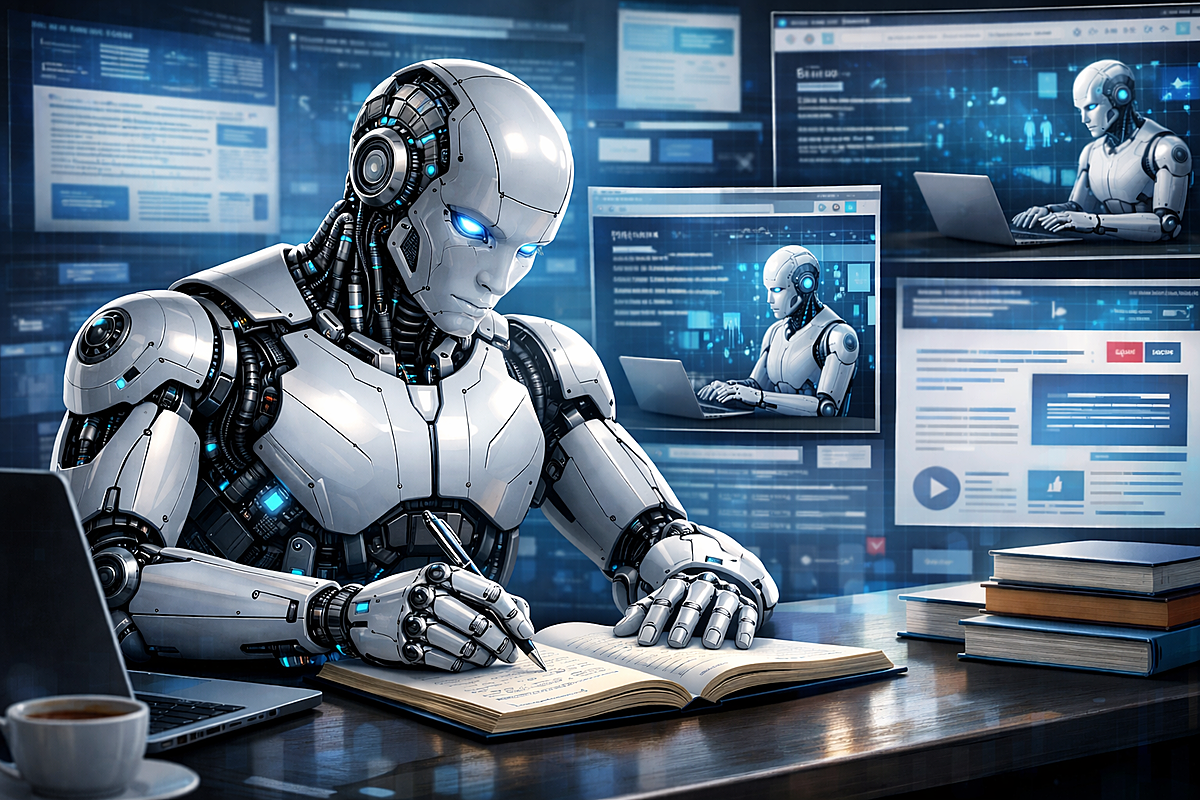 |
As AI increasingly takes over writing, many question the role and creativity of human authors in the creative field. *Photo: ChatGPT*
According to the scholar, the primary concern for artists and writers is the concept of authorship in the face of AI's advancement. He posed two questions: How can an individual compete with a system trained on millions of writing styles, capable of generating text at extreme speeds? If this model is accepted, how will it impact creative work, which serves as both a livelihood and a source of meaning?
To address this, Agnellini suggested clarifying the online materials Graphite randomly selected for analysis. Among the 65,000 articles, he observed that most AI-generated content is general, including news, product manuals, lifestyle articles, reviews, and explanations of product uses. For Agnellini, such content aims for monetary gain, seeking to persuade or inform customers, thus lacking uniqueness and creativity. He assessed that AI appears most useful for writing formulaic, low-risk texts such as listicles or business promotions.
Nevertheless, the writing industry, comprising many freelance writers and translators, earns a living by producing blogs, commercial content, and social media posts. Consequently, Francesco Agnellini noted that applying AI models to these types of articles is causing job losses for many.
 |
Portrait of scholar Francesco Agnellini. *Photo: Binghamton University*
The prospect of numerous writing jobs disappearing leads to another issue: content authenticity. In this scenario, the public must not only identify who or what created the text but also understand how humans perceive the value of creative activity. Agnellini continued by asking two questions: How can human-written work be distinguished from machine-generated content? And does that ability still matter?
Agnellini did not provide an answer to the first question. For the second question, he suggested that distinguishing between the two is becoming less important, especially as many articles result from human-AI collaboration. According to the author, an individual might outline a few ideas, then allow AI to develop them before refining the output into a complete text. He also cited his own experience, admitting that this article utilized AI. He had AI polish the English draft before submitting it to the editorial board, as English is not his native language.
"Occasionally, AI tries to reshape the message I want to convey. But once accustomed to its style, we can avoid edits and maintain our own voice," Francesco Agnellini added. Furthermore, he believes that today's AI models not only learn from human texts but are also trained on content co-created by AI and humans.
In the final section, the scholar discussed the importance of individual voice in the age of artificial intelligence, highlighting some downsides of AI misuse. Recent studies suggest that writers might feel more creative using AI, but their range of ideas could narrow. AI systems also impact users' writing styles, tending to guide individuals towards similar word choices, thereby reducing the distinctiveness that forms a unique voice. Simultaneously, some scientists warn that AI's suggestions could shift many people's writing styles towards a Western mode, even if they do not belong to that culture. This raises concerns about a new form of "AI colonialism", which could diminish cultural nuances in language.
Amidst the rise of machines, scholar Francesco Agnellini suggests that articles expressing unique identity, voice, and message will hold more significance. Such content could also play a crucial role in developing future generations of AI models. He believes that if humans discard the scenario of AI eradicating culture and trust in technology's continued development, profound and unique human-authored works will become increasingly valuable.
"In other words, the work of writers, journalists, and intellectuals will not become redundant simply because most internet content is no longer directly written by humans," the author concluded.
Trinh Lam (Source: The Conversation)


