Authored by the distinguished scholar Nhu Ba Si in the 19th century, "Viet Su Tam Bach Vinh" offers a comprehensive poetic journey through thousands of years of Vietnamese history. The collection, comprising 309 poems, commemorates historical figures from the Kinh Duong Vuong era to the end of the Later Tran dynasty. These poems are all written in the seven-word, eight-line regulated verse style of Tang poetry.
Beyond well-known emperors such as Ngo Vuong Quyen, Dinh Tien Hoang, Le Dai Hanh, Ly Thai To, Le Thai To, and Tran Thanh Tong, and renowned generals like Duong Dien Nghe, Ly Thuong Kiet, and Tran Hung Dao, the collection also includes verses about figures only briefly mentioned in official histories. These include Princess Huyen Tran, Zen Master Phap Loa, Yet Kieu, and Ha Dac. Furthermore, Nhu Ba Si included enemy generals like Thoat Hoan, Moc Thach, and Truong Phu, painting a comprehensive picture of the nation's history.
Scholar Le Van Uong undertook the extensive translation of this work over many years, with his second son, teacher Le Van Dinh, providing detailed annotations. Doctor Le Thuy Ha, daughter of teacher Le Van Dinh, and her husband, teacher Pham Gia Huan, carried out the manuscript editing. Each translated poem includes five parts: the original Chinese characters, romanization, a literal translation, a poetic translation, and annotations. The translator provided detailed explanations for contemporary readers, as the historical poetry style often borrows from classical allusions.
Han-Nom researcher Pham Tu Chau, in the second volume of the Dictionary of Literature, affirmed that through "Viet Su Tam Bach Vinh", Nhu Ba Si "praises and affirms the Hung Vuong era in many aspects, and extols all national heroes who contributed to the people and the country, regardless of their origin from lowlands or uplands, young or old, male or female, noble or humble birth."
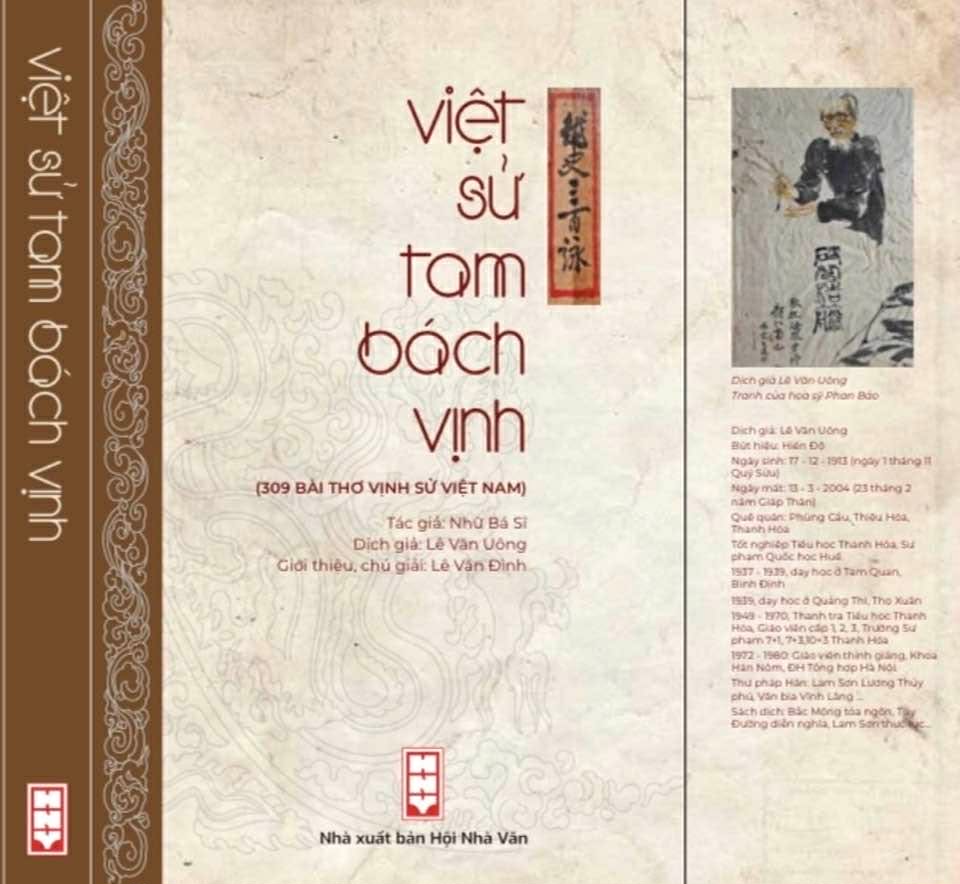 |
The cover of "Viet Su Tam Bach Vinh". Photo: Writers' Association Publishing House |
The cover of "Viet Su Tam Bach Vinh". Photo: Writers' Association Publishing House
Nhu Ba Si (1788-1867) was born in Cat Xuyen village, Hoang Cat commune, Hoang Hoa district, now Hoang Son commune, Thanh Hoa province. At 31, he passed the Huong Cong examination in the Tan Hoi year, during the 2nd year of Minh Mang's reign (1821), at the Thanh Hoa examination site. He held various official positions, including District Chief of Tien Lu (Hung Yen), before being promoted to Vien Ngoai Lang of the Ministry of Justice, Chu Su of the Ministry of Justice, and Lang Trung. Despite multiple demotions and reinstatements, including a period serving on a foreign trade delegation (performing duties abroad), he also held several educational roles within the Nguyen dynasty court, such as Huan Dao, Giao Thu, and Han Lam Vien Tu Soan. His final position was Doc Hoc of Thanh Hoa until his retirement (ceasing official duties) to teach and write at home.
Nhu Ba Si stands as one of the most prolific Confucian scholars of the 19th century, with many works yet to be fully cataloged. Among his literary and historical contributions, his two collections, Phi Dieu Nguyen Am and Viet Su Tam Bach Vinh, are highly regarded by later generations for their superior content and form.
Translator Le Van Uong graduated from Quoc Hoc Hue Pedagogy School in 1937. Before the August Revolution, he taught in Binh Dinh and Thanh Hoa. From 1947 to 1970, he served as a Primary Education Inspector for Thanh Hoa province, later becoming a teacher at pedagogy schools in Thanh Hoa. From 1972 to 1980, he was invited to lecture at the Department of Han-Nom Studies, Hanoi University.
Le Van Uong was a respected Han-Nom researcher and the author of translations of famous works, including the Lam Son Luong Thuy Phu, Vinh Lang Stele Inscription, and the novel Tuy Duong Dien Nghia. Notably, he translated the historical record Lam Son Thuc Luc, which accurately documented the entire progression of the Lam Son Uprising.
Le Tien Long