


According to The Value, a Hong Kong antiques collector consigned several Qing dynasty ceramic pieces to Beijing Poly for auction in late December 2025. Among these, a bowl crafted for the imperial court achieved the highest price, selling for 32,8 million yuan, including taxes and fees.
 |
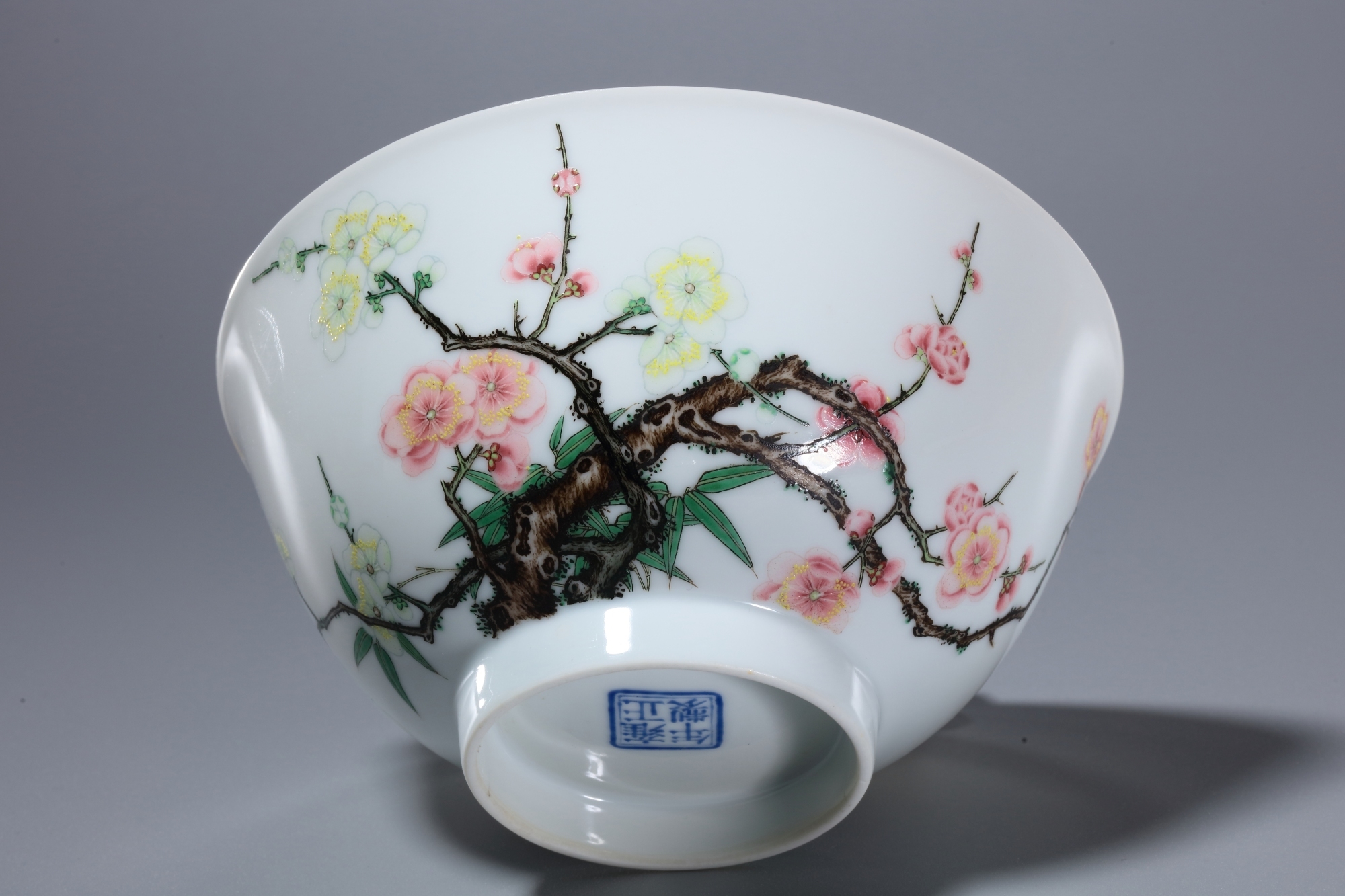
A bowl for Emperor Yongzheng's viewing. Photo: The Value
This artifact showcases the Falangcai technique, considered among the highest class of porcelain during the Qing dynasty. Falangcai porcelain originated during the Kangxi era and was exclusively for the emperor and imperial family. Its production costs were high, and output was low, making it a rare gift even for high-ranking officials. Most Falangcai porcelain resides in major museums, with only a handful of private collectors owning such treasures.
The bowl is notably thin, adorned with pink and white plum blossoms accented by bamboo leaves. Experts praise the exquisite and fluid brushwork, noting its simple yet elegant composition, typical of Yongzheng-era ceramics (1722-1735).
 |
Patterns on the bowl. Photo: The Value
In traditional East Asian culture, plum, orchid, chrysanthemum, and bamboo are known as the "four noble gentlemen," symbolizing integrity and purity. Scholars often use plum and bamboo imagery to convey steadfastness. According to researchers, court artists painted the plum blossom motifs.
The bowl also features a poem by Yang Wanli from the Song dynasty, which translates to "a few young green bamboo branches, after one night, have grown as tall as the red railing." This poem is commonly used in Chinese ceramic production.
 |
Portrait of Emperor Yongzheng at the Palace Museum. Photo: The Value
While most Qing dynasty imperial kilns were located in Jingdezhen, Jiangxi province, Falangcai porcelain bodies were uniquely crafted in Jingdezhen. They were then transported to the capital, Beijing, for the emperor to decide on the patterns and colors. Court artists would paint the porcelain bodies with falang colors, followed by low-temperature firing. After firing, the objects displayed a transparent, mirror-like sheen, with varying shades creating vibrant patterns.
Qing dynasty Falangcai ceramics consistently command high prices. In 2023, a Qianlong emperor bowl featuring apricot blossoms, willow trees, and swallows was auctioned for 198 million HKD (25,4 million USD).
As Anh (according to The Value)


