Amblyopia, commonly known as lazy eye, is a condition where one or both eyes experience reduced vision because the brain does not fully utilize them during development. This condition is a common cause of vision loss in children, often resulting from obstructions in the visual nerve pathway due to cataracts, corneal opacity, strabismus, or refractive errors. Untreated amblyopia can cause decreased visual acuity, diminished object sensitivity and sharpness, spatial distortion, and ultimately, blindness.
Dr. Doan Thi Phuong Nhi, a specialist in high-tech ophthalmology at Tam Anh General Clinic District 7, states that while amblyopia does not resolve on its own, it can be fully treated if detected early. Treatment methods are determined by the severity and underlying cause of the condition, and may include wearing glasses, eye patching therapy, using eye drops, or surgery.
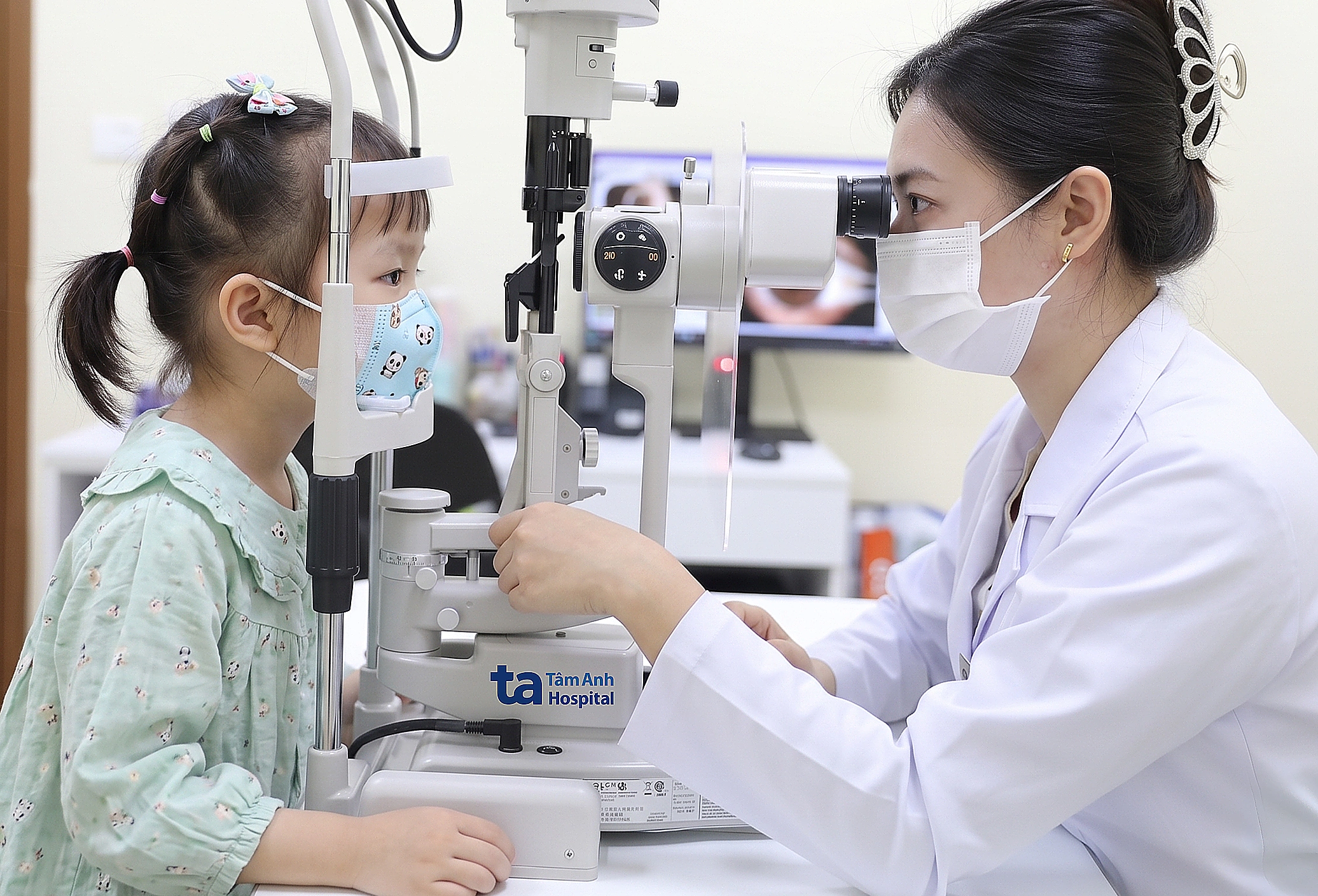 |
Dr. Nhi examines a young girl's eyes. *Illustration: Tam Anh General Hospital*. |
Parents can engage children in specific exercises to improve amblyopia. These activities help strengthen eye muscles, train coordination between both eyes and between the weaker eye and the brain. Such exercises also enhance a child's object recognition and concentration abilities.
**Eye Patching:** Parents should instruct the child to cover the stronger eye with their palm or an eye patch. The child then uses the weaker eye to observe and describe objects. This encourages the weaker eye to work harder, and the exercise can be repeated for several hours each day.
**Coloring Pictures:** Parents should provide their child with crayons and simple drawings that have clear outlines. After patching the stronger eye, guide the child to color within the correct patterns. This exercise can improve the eye's recognition and accuracy.
**Puzzles:** Select jigsaw puzzles or Lego sets with distinct colors to stimulate vision. The difficulty level should be appropriate for the child's age and gradually increase over time.
**Bead Stringing:** After patching the stronger eye, children can practice stringing beads onto a thread. This activity helps train hand-eye coordination and stimulates the weaker eye to work more effectively.
**Sorting Beans:** Parents can have their child sort different types of beans or seeds by size and color. This activity helps improve the child's observation skills and encourages both eyes to work cooperatively.
Amblyopia is often difficult to detect during a child's early years. Parents might notice symptoms such as frequent squinting, leaning close to the television, inaccurate grasping, head tilting, or complaints of dizziness, eye fatigue, or headaches. For an accurate diagnosis, children need to undergo vision tests and visual screening.
Dr. Nhi advises parents to take their child to a hospital with an ophthalmology department if they observe any unusual signs. Children should have regular check-ups every 6 to 12 months to screen for eye diseases or refractive errors.
Ngoc Kim Tham
| Readers can submit ophthalmology questions here for a doctor's answers |