


The monitor beeped rapidly, signaling severe cerebral vasospasm, blocking the surgical team's attempts. Assoc. Prof. Dr. Do Duc Thuan, head of the Stroke Department, stared at the screen. The first attempt to remove the blood clot failed. He knew that pushing the instrument further risked tearing a brain blood vessel, potentially killing the patient on the table.
"Stop. Administer vasodilators. Everyone remain still for two minutes," the terse command froze the operating room. No one moved. Only the sound of hurried breathing behind masks and tense eyes fixed on the screen remained.
Those were the two longest minutes in Dr. Thuan's career. With each passing second, 1.9 million nerve cells died in the patient's brain. Yet, he knew haste would only accelerate death. In the final seconds, the blood vessels began to dilate. The team swiftly performed the second intervention, successfully removing the blood clot. The man escaped permanent hemiplegia.
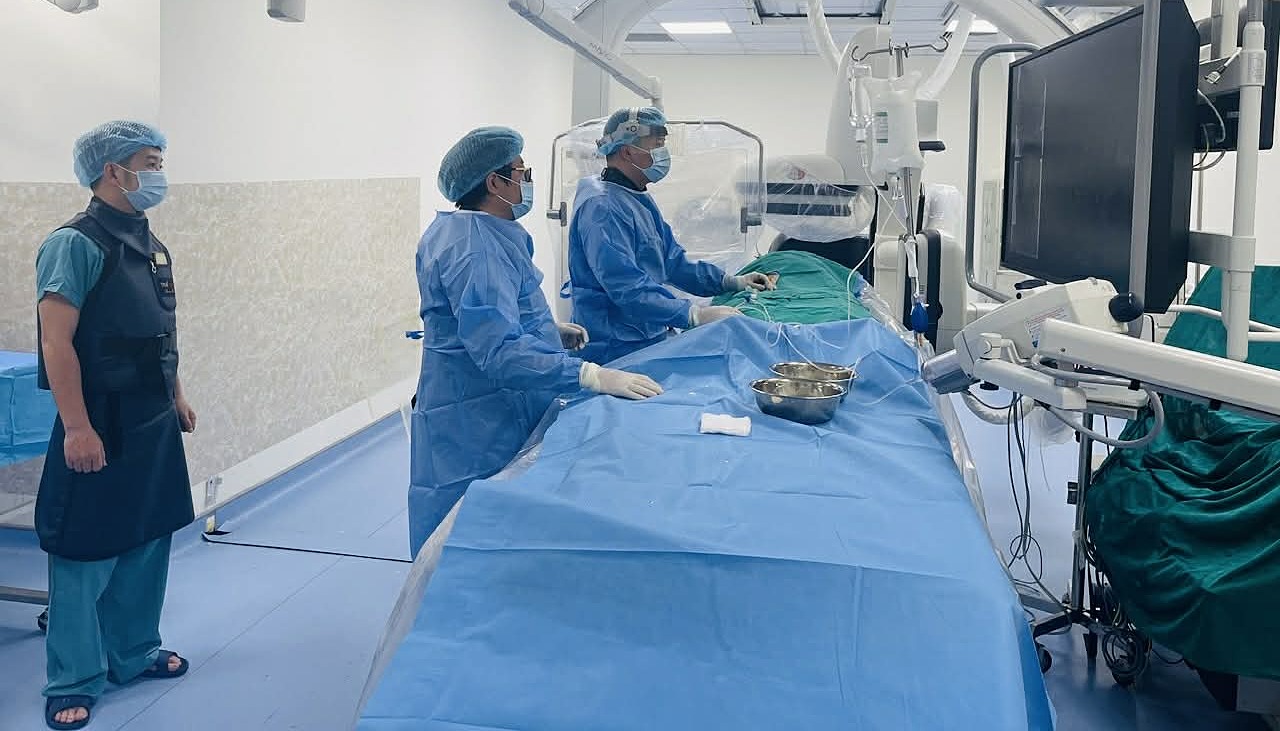 |
Doctors from the Stroke Department, Military Hospital 103, performing a cerebral vascular intervention to remove a brain venous blood clot. *Photo provided by doctors* |
Assoc. Prof. Thuan shared that this decision was not taught in any medical textbook. It was an instinct honed over thousands of surgeries, an ability to read the body's language as it wrestled between life and death.
"Medical literature can teach theory, but it cannot fully teach how to respond to unexpected anatomical changes on the operating table," Dr. Thuan said. "In the operating room, sometimes knowing when to stop requires more courage than pushing forward."
At K Hospital, Dr. Ha Hai Nam, deputy head of Department of Abdominal Surgery 1, also made a "counter-intuitive" decision when facing a 49-year-old female patient with gastric cancer. Pre-operative tests and diagnostic images showed a stage two tumor, with an optimistic prognosis if radically resected. However, upon inserting the endoscope into the abdominal cavity, Dr. Nam was surprised to find cancerous cells metastasized throughout the abdomen, far exceeding CT scan predictions.
Conventional logic dictates that once the abdomen is open, "something must be done." But Dr. Nam knew that attempting surgery at this point would not only fail to save the patient but could also become a "catalyst for faster malignant cell spread." He decided to close the incision.
"I was disappointed because my pre-operative diagnosis differed from reality," the doctor recounted. "But the decision to operate is to save the patient's life, not for ego or to demonstrate skill with a scalpel."
These situations highlight the immense pressure on surgeons, who must process thousands of data points in an instant. Neurological studies indicate that during a stroke, millions of nerve cells die each minute. This time pressure forces doctors to filter information from vital signs, CT images, and professional intuition to make decisions that no machine can replicate.
While the 2023 Law on Medical Examination and Treatment grants surgeons the authority to alter techniques or make emergency decisions to save a patient's life without administrative delays, the psychological burden and legal risks persist. Medical texts may cover theoretical anatomy, but no curriculum fully encompasses the complex variations of the human body. An 80-year-old patient will react completely differently from a 50-year-old; imaging sometimes fails to reveal abnormal blood vessels or hidden metastatic tumors. In such cases, the operating room becomes a place where all pre-operative plans can be overturned, and the gap between life-saving success and medical mishap becomes more fragile than ever, Assoc. Prof. Thuan shared.
Due to this complexity, experience and adherence to safety protocols are crucial. Data from the Journal of the American Medical Association (JAMA) indicates that surgeons performing over 20 complex cases annually have a 33% lower complication rate than those performing fewer than five cases. Simultaneously, implementing the WHO Surgical Safety Checklist in eight cities globally has demonstrably reduced mortality from 1.5% to 0.8%. These figures affirm that a doctor's "intuition" is not improvisation, but the culmination of thousands of hours of training and rigorous discipline.
 |
Dr. Ha Hai Nam and his team operating on a patient. *Photo provided by doctors* |
Under the operating lights, doctors often feel isolated. If they fail, they face public scrutiny and legal responsibility. "The medical profession is not for those seeking an easy life, because every decision in the operating room embodies conscience and knowledge," the doctor stated, adding that the greatest reward is not praise, but the patient's recovery.
Thuy An


