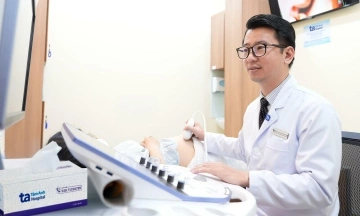
Dr. Ha Anh Duc, Director of the Department of Medical Examination and Treatment Management, Ministry of Health, emphasized at a Thanh Nien newspaper workshop on 9/10 that advanced medical techniques must be applied more broadly. He called for a shift from focusing solely on complex cases to ensuring widespread access for the public.
Dr. Duc noted Vietnam's advancements in complex medical procedures, including various organ transplants, with expertise matching global standards in some areas. The primary challenge remains the broader implementation of these achievements beyond a select few medical centers.
"Ensuring more people benefit from scientific and technical advancements is an issue that needs attention," Dr. Duc stated, stressing that technology choices must prioritize practical effectiveness and patient benefit.
 |
Dr. Ha Anh Duc, Director of the Department of Medical Examination and Treatment Management. Photo: Doc Lap
Robotic surgery exemplifies this challenge. While it offers enhanced precision for complex cases, especially cancer, its cost of 120-180 million VND restricts patient access.
Dr. Nguyen Phu Huu from Binh Dan Hospital reported that robotic surgery for adults began in 2016, mainly for prostate, bladder, kidney, and colorectal cancers. The hospital has completed over 4,300 robotic procedures to date.
Even after 10 years, robotic surgeries constitute only 1.62% of the hospital's total operations. This is due to a limited number of robotic systems, causing long patient wait times. The hospital currently operates one system and expects to add two more this year.
Dr. Huu noted that robotic surgery costs about three times more than standard laparoscopic procedures, with no health insurance coverage. He suggested that authorities explore partial cost subsidies to improve patient access.
 |
Robotic surgery at Binh Dan Hospital. Photo: Hospital provided
For medical technology to be effective, Dr. Duc stated that human resource development is crucial. He advocated for hospitals to share expertise, irrespective of public or private status or geographical location. Technology choices, he emphasized, must prioritize patient needs over simply acquiring modern equipment.
Despite advances in artificial intelligence and machinery, the doctor's role remains irreplaceable. Dr. Duc highlighted that empathy and patient understanding are qualities technology cannot replicate. He asserted that humans must master technology, converting scientific progress into tangible healthcare benefits.
The Director of the Department of Medical Examination and Treatment Management noted that Vietnam's healthcare system handles about 200 million patient visits yearly. Integrating scientific and technological advancements more broadly requires collaboration among management agencies, hospitals, training centers, and media. This aims to enhance treatment quality and increase patient access.
Le Phuong